Operating Instructions
11
WARNING
To prevent injury from cylinders tipping over, do not use cannula tubing
lengths over 10 feet with small compressed oxygen cylinders.
Unattended cylinders should be secured in a cylinder stand.
NOTE– A mask should not be used in the PulseDose delivery mode as it may not fit to
the face well enough to allow the conserving device to sense inhalation efforts.
Also, the therapeutic effect of PulseDose would not be realized, as the dose of
oxygen would be diluted in the mask prior to inhalation.
NOTE– A pediatric or low-flow cannula should not be used in PulseDose delivery mode.
The reduced diameter of the cannula causes too much back pressure and will
affect the oxygen volume delivered.
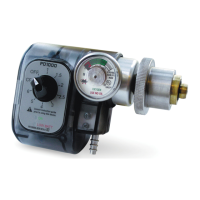
NOTE– PulseDose delivers oxygen in a very short “puff.” It does not deliver oxygen
during the entire inhalation. The length of time that PulseDose delivers oxygen
will not vary from breath to breath. The time is set in correlation to the oxygen
dosage set on the conserving device (patient’s prescription setting).
NOTE– PulseDose is designed to prevent the delivery of pulses more than every 1 1/2
seconds. If the breath rate is greater than 40 BPM, this feature prevents
delivery of excessive oxygen by not dosing on every breath.
NOTE– If using NiMH batteries, carefully monitor when the low battery indicator
flashes red. It is recommended that a spare fully-charged set of batteries be
kept in reserve and installed when the change battery indicator is constant red.


 To Next Page