ENGLISH
21
WARNING: Drill may stall if overloaded causing a
sudden twist. Always expect the stall. Grip the drill
firmly to control the twisting action and avoidinjury.
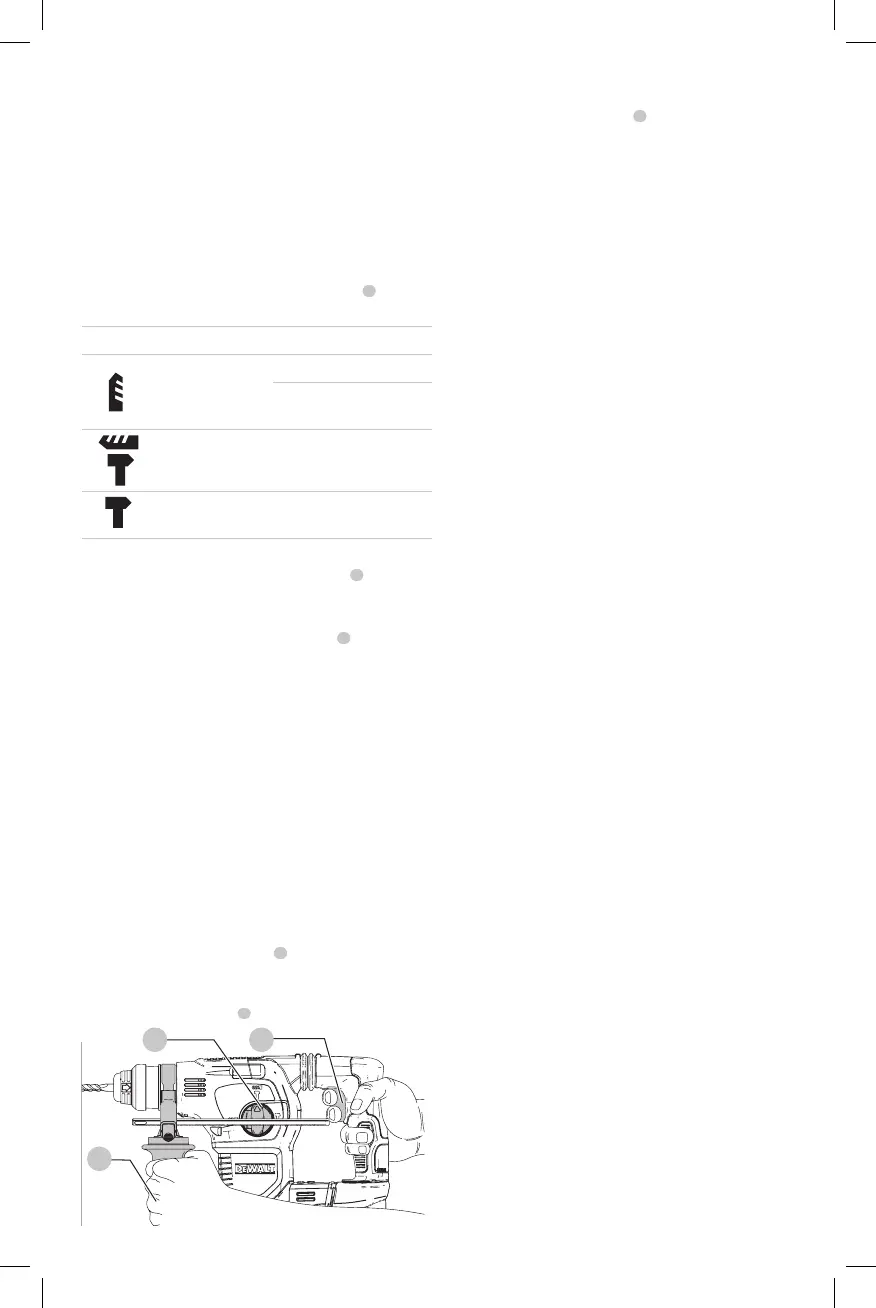
Operation Modes (Fig. A)
WARNING: Do not select the operating mode when
the tool isrunning.
CAUTION: Never use in Rotary Drilling or Rotary
Hammering mode with a chisel bit in the bit holder.
Personal injury and damage to the the tool mayresult.
Your tool is equipped with a mode selector dial
3
to
selectthe mode appropriate to desiredoperation.
Symbol Mode Application
Rotary Drilling
Screwdriving
Drilling into steel, wood
andplastics
Rotary
Hammering
Drilling into concrete
and masonry
Hammering
only
Lightchipping
To select an operating mode:
1. Depress the mode selector release button
4
.
2. Rotate the mode selector dial so that the arrow points to
the symbol corresponding for the desiredmode.
NOTE: The arrow on the mode selector dial
3
must be
pointing at a mode symbol at all times. There are no
operable positions inbetween. It may be necessary to briefly
run the motor after having changed from 'hammering only'
to 'rotary' modes in order to align thegears.
Performing an Application (Fig. F)
WARNING: TO REDUCE THE RISK OF PERSONAL
INJURY, ALWAYS ensure workpiece is anchored or
clamped firmly. If drilling thin material, use a wood
“back-up” block to prevent damage to thematerial.
WARNING: Always wait until the motor has come to
a complete standstill before changing the direction
ofrotation.
1. Choose and install the appropriate chuck, adapter, and/
or bit onto to the tool. Refer to Bit and BitHolder.
2. Using the mode selector dial
3
, selectthe mode
appropriate to desired application. Refer to
OperationModes.
3. Adjust the side handle
5
asnecessary.
Fig. F
5
3 1
4. Place the bit/chisel on the desiredlocation.
5. Depress the trigger switch
1
.
6. To stop the rotary hammer, release theswitch.
Recommendations for Tool Operation
• Large (5/16" to 1/2" [7.9 mm to 12.7 mm]) holes in steel
can be made easier if a pilot hole (5/32" to 3/16" [4 mm
to 4.8 mm]) is drilledfirst.
• When drilling, always apply pressure in a straight line
with the bit, but do not push hard enough to stall the
motor or deflect thebit. A smooth even flow of material
indicates the proper drillingrate.
• If drilling thin material or material that is prone to
splinter, use a wood “back-up” block to prevent damage
to theworkpiece.
WARNING:
• Do not use this tool to mix or pump easily
combustible or explosive fluids (benzine,
alcohol,etc.).
• Do not mix or stir inflammable liquids
labelledaccordingly.
MAINTENANCE
WARNING: To reduce the risk of serious personal
injury, turn unit off and disconnect it from
power source before making any adjustments or
removing/installing attachments or accessories.
An accidental start-up can causeinjury.
Your D
WALT power tool has been designed to operate
over a long period of time with a minimum of maintenance.
Continuous satisfactory operation depends upon proper
tool care and regularcleaning.
Lubrication
Your power tool requires no additionallubrication.
Cleaning
WARNING: Blow dirt and dust out of all air vents with
clean, dry air at least once a week. To minimize the
risk of eye injury, always wear approved eye protection
when performingthis.
WARNING: Never use solvents or other harsh
chemicals for cleaning the non-metallic parts of
the tool. These chemicals may weaken the plastic
materials used in these parts. Use a cloth dampened
only with water and mild soap. Never let any liquid
get inside the tool; never immerse any part of the tool
into aliquid.
Accessories
WARNING: Since accessories, other than those
offered by
, have not been tested with this
product, use of such accessories with this tool could be
hazardous. To reduce the risk of injury, only
recommended accessories should be used with
thisproduct.


 To Next Page