ENGLISH
10
Common Cutting Techniques
Felling
The process of cutting down a tree. Do not fell trees in high
windconditions.
WARNING: Felling can result in injury. It should only be
performed by a trainedperson.
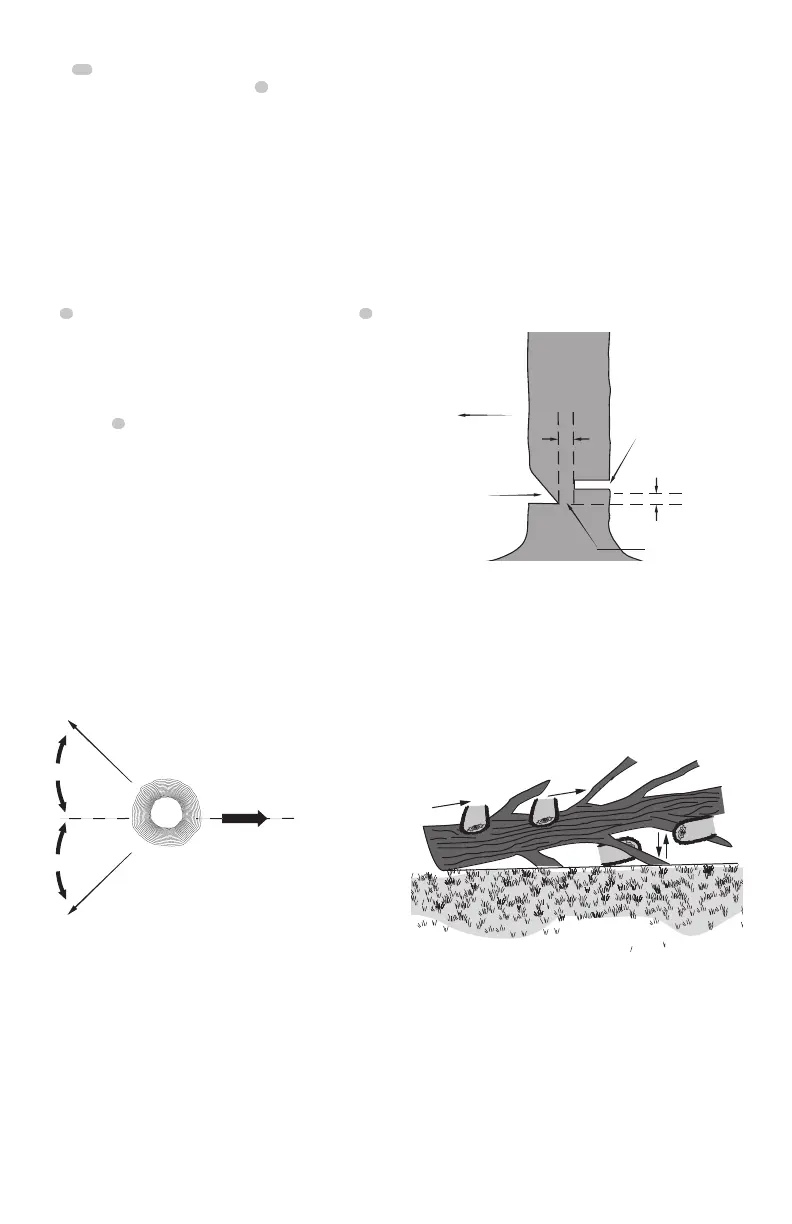
• A retreat path should be planned and cleared as necessary
before cuts are started. The retreat path should extend back
and diagonally to the rear of the expected line of fall as
shownbelow.
DIRECTION
OF
FALL
RETREAT
45°
TREE
45°
RETREAT
• Before felling is started, consider the natural lean of the
tree, the location of larger branches and the wind direction
to judge which way the tree will fall. Have wedges (wood,
plastic or aluminum) and a heavy mallet handy. Remove
dirt, stones, loose bark, nails, staples, and wire from the tree
where the felling cuts are to bemade.
• Notching Undercut - Make the notch 1/3 of the
diameter of the tree, perpendicular to the direction of
the fall. Make the lower horizontal notching cut first. This
will help to avoid pinching of either the saw chain or the
guide bar when the second notch cut is being made as
shownbelow.
3. Rotate your left hand forward around the front
handle
13
so the back of your hand comes in contact
with the chain brake/front hand guard
3
and push it
forward, toward the workpiece. The saw chain should
stopimmediately.
NOTE: If saw does not stop immediately, stop use of tool
and bring it to an authorized service center nearestyou.
WARNING: Make sure to set chain brake
beforecutting.
ON/OFF Switch (Fig. M)
Always be sure of your footing and grip the chain saw firmly
with both hands with the thumb and fingers encircling
bothhandles.
1. To turn the unit on, push down on the the lock off
lever
2
, shown in Fig.M, and squeeze the trigger switch
1
.
Once the unit is running, you may release the lock offlever.
2. In order to keep the unit running you must continue to
squeeze the trigger. To turn the unit off, release thetrigger.
NOTE: If too much force is applied while making a cut
the saw will turn off. To restart saw, you must release the
trigger switch
1
before the saw will restart. Begin your cut
again this time with less force. Allow the saw to cut at its
ownpace.
WARNING: Never attempt to lock a switch in the
ONposition.
• Felling Back Cut - Make the felling back cut at least 2"
(51mm) higher than the horizontal notching cut. Keep the
felling back cut parallel to the horizontal notching cut. Make
the felling back cut so enough wood is left to act as a hinge.
The hinge wood keeps the tree from twisting and falling
in the wrong direction. Do not cut through the hinge as
shownbelow.
• As the felling cut gets close to the hinge the tree should
begin to fall. If there is any chance that the tree may not fall
in the desired direction or it may rock back and bind the saw
chain, stop cutting before the felling cut is complete and
use wedges to open the cut and drop the tree along the
desired line of fall. When the tree begins to fall remove the
chainsaw from the cut, stop the motor, put the chainsaw
down, then use the retreat path planned. Be alert for
overhead limbs falling and watch yourfooting.
2" (51 mm)
DIRECTION OF FALL
2" (51 mm)
HINGE
NOTCH
FELLING BACK CUT
Limbing
Removing the branches from a fallen tree. When limbing,
leave larger lower limbs to support the log off the ground.
Remove the small limbs in one cut. Branches under tension
should be cut from the bottom of the branch towards the
top to avoid binding the chainsaw as shown below. Trim
limbs from opposite side keeping tree stem between you
and saw. Never make cuts with saw between your legs or
straddle the limb to becut.
Bucking
WARNING: Recommend that first‑time users should
practice cutting on a sawhorse.
Cutting a felled tree or log into lengths. How you should
cut depends on how the log is supported. Use a saw horse
wheneverpossible as shownbelow.


 To Next Page