7
ENGLISH
Safety Of Others
• Always store the chainsaw with the battery removed, brake
set, scabbard installed and out of the reach of children.
mask if operation is dusty. ALWAYS WEAR CERTIFIED
SAFETYEQUIPMENT:
• ANSI Z87.1 eye protection (CAN/CSA Z94.3),
• ANSI S12.6 (S3.19) hearing protection,
• NIOSH/OSHA/MSHA respiratoryprotection.
WARNING: Some dust contains chemicals known to
State of California to cause cancer, birth defects or other
reproductive harm. Some examples of these chemicals are:
• compounds in fertilizers,
• compounds in insecticides, herbicides andpesticides,
• arsenic and chromium from chemically treatedlumber.
To reduce your exposure to these chemicals, wear approved
safety equipment such as dust masks that are specially
designed to filter out microscopicparticles.
• Avoid prolonged contact with dust from power sanding,
sawing, grinding, drilling, and other construction activities.
Wear protective clothing and wash exposed areas with
soap and water. Allowing dust to get into your mouth, eyes, or
lie on the skin may promote absorption of harmfulchemicals.
WARNING:
Use of this tool can generate and/or
disperse dust, which may cause serious and permanent
respiratory or otherinjury. Always use NIOSH/OSHA
approved respiratoryprotection.
WARNING: Always wear proper personal hearing
protection that conforms to ANSI S12.6 (S3.19) during
use. Under some conditions and duration of use, noise from
this product may contribute to hearingloss.
CAUTION: When not in use, place tool on its side
on a stable surface where it will not cause a tripping
or falling hazard. Some tools with a large battery pack will
stand upright but may be easily knockedover.
• Air vents often cover moving parts and should be avoided.
Loose clothes, jewelry or long hair can be caught in movingparts.
• The maximum speed of the saw chain is less
than20m/s
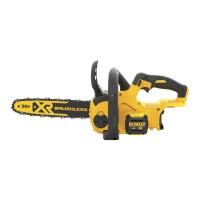
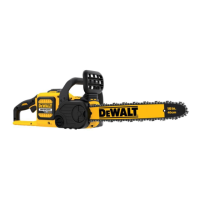
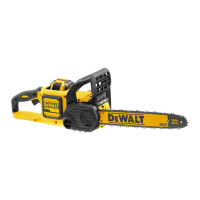
• Chain Saw Powerhead ‑ A chain saw without the saw
chain and guidebar.
• Drive Sprocket or Sprocket ‑ The toothed part that drives
the sawchain.
• Felling ‑
The process of cutting down atree.
• Felling Back Cut ‑
The final cut in a tree felling operation
made on the opposite side of the tree from the notchingcut.
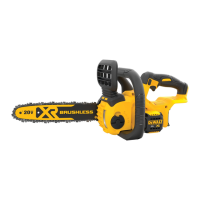
• Front Handle ‑ The support handle located at or toward
the front of the chainsaw.
• Front Hand Guard ‑ A structural barrier between the front
handle of a chain saw and the guide bar, typically located
close to the hand position on the fronthandle.
• Guide Bar ‑ A solid railed structure that supports and
guides the sawchain.
• Scabbard/Guide Bar Cover ‑ Enclosure fitted over guide
bar to help prevent tooth contact when saw is not inuse.
• Kickback ‑ The backward or upward motion, or both of the
guide bar occurring when the saw chain near the nose of the
top area of the guide bar contacts any object such as a log
or branch, or when the wood closes in and pinches the saw
chain in thecut.
• Kickback, Pinch ‑
The rapid pushback of the saw which can
occur when the wood closes in and pinches the moving saw
chain in the cut along the top of the guidebar.
• Kickback, Rotational ‑ The rapid upward and backward
motion of the saw which can occur when the moving saw
chain near the upper portion of the tip of the guide bar
contacts an object, such as a log orbranch.
• Limbing ‑ Removing the branches from a fallentree.
• Low‑Kickback Chain ‑ A chain that complies with the
kickback performance requirements of ANSI B175.1–2012
(when tested on a representative sample of chain saws).
• Normal Cutting Position ‑ Those positions assumed in
performing the bucking and fellingcuts.
• Notching Undercut ‑ A notch cut in a tree that directs the
tree’sfall.
• Rear Handle ‑ The support handle located at or toward the
rear of thesaw.
• Reduced Kickback Guide Bar ‑ A guide bar which has
been demonstrated to reduce kickbacksignificantly.
• Replacement Saw Chain ‑ A chain that complies with
kickback performance requirements of ANSI B175.1–2012
when tested with specific chain saws. It may not meet the
ANSI performance requirements when used with othersaws.
• Saw Chain ‑ A loop of chain having cutting teeth, that cut
the wood, and that is driven by the motor and is supported by
the guidebar.
• Ribbed Bumper ‑ The ribs used when felling or bucking to
pivot the saw and maintain position whilesawing.
• Switch ‑ A device that when operated will complete or interrupt
an electrical power circuit to the motor of the chainsaw.
• Switch Linkage ‑ The mechanism that transmits motion
from a trigger to theswitch.
• Switch Lockout ‑ A movable stop that prevents the
unintentional operation of the switch until manuallyactuated.
Additional Safety Information
WARNING:
Never modify the power tool or any part of it.
Damage or personal injury couldresult.
WARNING: ALWAYS use safety glasses. Everyday
eyeglasses are NOT safety glasses. Also use face or dust
The label on your tool may include the following symbols. The
symbols and their definitions are asfollows:
V ......................... volts
Hz .......................hertz
min ..................... minutes
or DC ......direct current
...................... Class I
Construction
(grounded)
…/min ..............per minute
BPM .................... beats per minute
IPM ..................... impacts per
minute
RPM .................... revolutions per
minute
sfpm ................... surface feet per
minute
SPM .................... strokes per minute
A ......................... amperes
W ........................watts
or AC ...........alternating current
or AC/DC .... alternating or
direct current
...................... Class II
Construction
(double insulated)
n
o
.......................no load speed
n ................. rated speed
m/s ............ meters per second
............. earthing terminal
.............safety alert symbol
.............Visible radiation


 To Next Page