Need help?
Do you have a question about the DeWalt DWE493 and is the answer not in the manual?
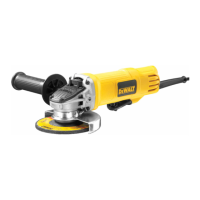
This document provides instructions and safety guidelines for the DEWALT Large Angle Grinder models DWE492, DWE493, and D28413.
The DEWALT heavy-duty angle grinder is designed for professional grinding, sanding, wire brushing, and cutting. It is intended for use in various applications, including metal and stone work. The tool is not recommended for polishing operations.
The technical data for the models are as follows:
| Specification | DWE492 | DWE493 | D28413 |
|---|---|---|---|
| Voltage | 220-240 VAC | 220-240 VAC | 220-240 VAC |
| Type | 20 | 20 | 20 |
| Power input | 2200 W | 2200 W | 2200 W |
| No-load/rated speed | 6600 min⁻¹ | 8500 min⁻¹ | 8500 min⁻¹ |
| Wheel diameter | 230 mm | 180 mm | 180 mm |
| Spindle diameter | M14 | M14 | M14 |
| Spindle length | 19 mm | 19 mm | |
| Weight | 5.2 kg | 5.2 kg | 4.7 kg |
The tool is double insulated in accordance with EN60745, meaning no earth wire is required.
General Safety Warnings: Users must read all safety warnings and instructions to prevent electric shock, fire, and serious injury. The work area should be clean and well-lit, and power tools should not be operated in explosive atmospheres. Children and bystanders must be kept away.
Electrical Safety: Power tool plugs must match the outlet, and the plug should never be modified. Avoid body contact with earthed or grounded surfaces. Do not expose power tools to rain or wet conditions. The cord should not be abused; keep it away from heat, oil, sharp edges, or moving parts. When operating outdoors, use an extension cord suitable for outdoor use. If operating in a damp location, use a residual current device (RCD) protected supply.
Personal Safety: Stay alert and use common sense. Do not operate the tool when tired or under the influence of drugs, alcohol, or medication. Always wear eye protection and other personal protective equipment such as dust masks, non-skid safety shoes, hard hats, or hearing protection. Prevent unintentional starting by ensuring the switch is in the off position before connecting to the power source or battery pack. Remove any adjusting key or wrench before turning the power tool on. Maintain proper footing and balance. Dress properly, avoiding loose clothing or jewelry. If dust extraction and collection facilities are provided, ensure they are connected and properly used.
Power Tool Use and Care: Do not force the power tool; use the correct tool for the application. Do not use the power tool if the switch does not turn it on and off. Disconnect the plug from the power source before making adjustments, changing accessories, or storing the tool. Store idle power tools out of reach of children and untrained users. Maintain power tools by checking for misalignment, binding, breakage, or other conditions that may affect operation. Keep cutting tools sharp and clean. Use the power tool, accessories, and tool bits according to instructions and working conditions.
Specific Safety Rules for Large Angle Grinders: This power tool is intended for use as a grinder, sander, wire brush, or cut-off tool. Operations like polishing are not recommended. Use only accessories specifically designed and recommended by the tool manufacturer. The rated speed of the accessory must be at least equal to the maximum speed marked on the power tool. The outside diameter and thickness of the accessory must be within the capacity rating of the power tool. Threaded mounting of accessories must match the grinder spindle thread, and for flange-mounted accessories, the arbour hole must fit the locating diameter of the flange.
Before each use, inspect accessories for damage (chips, cracks, tears, excess wear, loose or cracked wires). If the tool or accessory is dropped, inspect for damage or install an undamaged accessory. After inspection and installation, position yourself and bystanders away from the plane of the rotating accessory and run the power tool at maximum no-load speed for one minute. Wear personal protective equipment, including face shield, safety goggles, safety glasses, dust mask, hearing protectors, gloves, and workshop apron. Keep bystanders a safe distance away. Hold the power tool by insulated gripping surfaces when cutting where the accessory may contact hidden wiring or its own cord. Position the cord clear of the spinning accessory. Never lay the power tool down until the accessory has come to a complete stop. Do not run the power tool while carrying it at your side. Regularly clean the power tool's air vents. Do not operate the tool near flammable materials. Do not use accessories that require liquid coolants.
Causes and Operator Prevention of Kickback: Kickback is a sudden reaction to a pinched or snagged rotating accessory. To prevent kickback, maintain a firm grip, use the auxiliary handle, and position your body and arm to resist forces. Never place your hand near the rotating accessory. Do not position your body in the area where the tool will move if kickback occurs. Use special care when working corners, sharp edges, etc. Do not attach a saw chain woodcarving blade or toothed saw blade.
Specific Safety Warnings for Grinding and Abrasive Cutting-Off Operations: Use only recommended wheel types and the specific guard designed for the selected wheel. The grinding surface of centre depressed wheels must be mounted below the plane of the guard lip. The guard must be securely attached and positioned for maximum safety. Wheels must be used only for recommended applications; do not grind with the side of a cut-off wheel. Always use undamaged wheel flanges of correct size and shape. Do not use worn-down wheels from larger power tools.
Additional Safety Warnings Specific for Abrasive Cutting-Off Operations: Do not "jam" the cut-off wheel or apply excessive pressure. Do not position your body in line with and behind the rotating wheel. When the wheel is binding or when interrupting a cut, switch off the tool and hold it motionless until the wheel comes to a complete stop. Never attempt to remove the cut-off wheel from the cut while it is in motion. Do not restart the cutting operation in the workpiece; let the wheel reach full speed and carefully reenter the cut. Support panels or oversized workpieces to minimize wheel pinching and kickback. Use extra caution when making a "pocket cut" into existing walls or other blind areas.
Safety Warnings Specific for Sanding Operations: Do not use excessively oversized sanding disc paper. Follow manufacturer's recommendations for sanding paper selection.
Safety Warnings Specific for Wire Brushing Operations: Be aware that wire bristles are thrown by the brush during ordinary operation. Do not overstress the wires. If a guard is recommended for wire brushing, ensure no interference with the wire wheel or brush.
Additional Safety Rules for Grinders: Do not use Type 11 (flaring cup) wheels on this tool. Always use the side handle and tighten it securely. An RCD with a residual current rating of 30mA or less is recommended.
Residual Risks: Despite safety regulations, certain residual risks cannot be avoided, including hearing impairment, personal injury due to flying particles, burns from hot accessories, and personal injury due to prolonged use.
Markings on Tool: The tool displays pictograms indicating: "Read instruction manual before use," "Wear ear protection," and "Wear eye protection." The date code (X), including the year of manufacture, is printed into the housing.
Package Contents: The package contains: 1 Angle grinder, 1 Guard, 1 Side handle, 1 Flange set, 1 Two-pin spanner, and 1 Instruction manual. Check for damage upon receipt and read the manual thoroughly before operation.
Assembly and Adjustments: Before making any adjustments or removing/installing attachments, turn the tool off and disconnect it from the power source. Depress and release the trigger switch to ensure the tool is off before reconnecting.
Attaching Side Handle (Fig. 2): Screw the side handle (G) tightly into one of the holes (M) on either side of the gear case. The side handle must always be used to maintain control.
Mounting and Removing a Keyed Guard (Fig. 1, 3): Guards must be used with this grinder. For cutting metal or masonry, a Type 1 guard MUST be used. Place the angle grinder on a table, spindle (F) up. Align lugs (N) with notches (O). Press the guard (E) down and rotate to the required position. Securely tighten the screw. To remove, slacken the screw. If the guard cannot be tightened, do not use the tool; take it to a service center for repair.
Fitting and Removing a Grinding or Cutting Disc (Fig. 1, 4, 5): Do not use a damaged disc. Place the tool on a table, guard up. Fit the backing flange (J) onto the spindle (F). Place the disc (O) on the backing flange (J). If fitting a disc with a raised centre, ensure the raised centre (P) faces the backing flange (J). Screw the threaded clamp nut (K) onto the spindle (F). For a grinding disc, the ring on the clamp nut (K) must face towards the disc. For a cutting disc, the ring on the clamp nut (K) must face away from the disc. Press the spindle lock button (C) and rotate the spindle (F) until it locks. Tighten the threaded clamp nut (K) with the two-pin spanner. Release the spindle lock. To remove, loosen the threaded clamp nut (K) with the two-pin spanner.
Fitting and Removing a Backing Pad/Sanding Sheet (Fig. 1, 4, 6): Place the tool on a table or flat surface, guard facing up. Remove the backing flange (J). Place the rubber backing pad onto the spindle (F). Place the sanding sheet on the rubber backing pad. Screw the threaded sanding clamp nut (L) onto the spindle, with the ring facing the rubber backing pad. Press the spindle lock button (C) and rotate the spindle (F) until it locks. Tighten the threaded sanding clamp nut (L) with the two-pin spanner. Release the spindle lock. To remove, loosen the threaded clamp nut (L) with the two-pin spanner.
Fitting a Wire Cup Brush: Screw the wire cup brush directly onto the spindle without the spacer and threaded flange.
Prior to Operation: Install the guard and appropriate disc or wheel. Do not use excessively worn discs or wheels. Ensure inner and outer flanges are mounted correctly. Make sure the disc or wheel rotates in the direction of the arrows on the accessory and the tool. Do not use a damaged accessory. Inspect accessories before each use. If dropped, inspect for damage or install an undamaged accessory. After inspecting and installing, run the tool at maximum no-load speed for one minute. Never use blotters with bonded abrasive products. Do not work with a grinding cup without a suitable guard. Do not strain the machine to a standstill. After heavy straining, run the tool at no-load for several minutes to cool down the accessory. Do not touch grinding and cutting discs before they have cooled.
Instructions for Use: Always observe safety instructions and regulations. Secure all materials to be ground or cut. Use clamps or a vice to hold the workpiece. Support panels or oversized workpieces to minimize wheel pinching and kickback. Always wear regular working gloves. Apply only gentle pressure; do not exert side pressure on the disc. Avoid overloading; if the tool becomes hot, run it at no-load to cool the accessory. Never work with a grinding cup without a suitable protection guard. Do not use the power tool with a cut-off stand. Never use blotters with bonded abrasive products. Be aware that the wheel continues to rotate after the tool is switched off. The tool is not designed to be used with a grinding cup. Do not use separate reducing bushings or adapters to adapt large hole abrasive wheels.
Proper Hand Position: Always use proper hand position as shown in Figure 1, with one hand on the side handle (G) and the other on the body of the tool. Hold securely in anticipation of a sudden reaction.
Lock-on Button (Fig. 1): For continuous operation, depress the lock-on button (H) and release the on/off trigger switch. To stop, press the on/off switch again. The lock-on button can be permanently removed by a DEWALT Service Centre.
Spindle Lock (Fig. 1): The spindle lock (C) prevents the spindle from rotating when installing or removing wheels. Operate the spindle lock only when the tool is turned off, unplugged, and has come to a complete stop. Do not engage the spindle lock while the tool is operating to prevent damage and possible injury. To engage, depress the spindle lock button and rotate the spindle until it locks.
Metal Applications: When using the tool in metal applications, ensure an RCD is inserted to avoid residual risks from metal swarf. If the RCD shuts off the power supply, take the tool to an authorised DEWALT repair agent. In extreme working conditions, conductive dust can accumulate inside the machine housing, degrading protective insulation and posing an electrical shock risk. To avoid metal swarf build-up, clear ventilation slots daily.
Cutting Metal: For cutting with bonded abrasives, always use a Type 1 protection guard. Work with moderate feed, adapted to the material. Do not exert pressure, tilt, or oscillate the machine. Do not reduce the speed of running down cutting discs by applying sideward pressure. The machine must always work in an upgrinding motion. When cutting profiles and square bar, start at the smallest cross section.
Rough Grinding: Never use a cutting disc for roughing. Always use a Type 27 guard. Best results are achieved at an angle of 30° to 40°. Move the machine back and forth with moderate pressure to prevent overheating, discolouration, and grooves.
Cutting Stone: The machine shall be used only for dry cutting. For cutting stone, use a diamond cutting disc. Operate the machine only with an additional dust protection mask.
Working Advice: Exercise caution when cutting slots in structural walls. Observe country-specific regulations and consult a structural engineer, architect, or construction supervisor.
Using Flap Discs: Extensive use of flap discs in metal applications can lead to increased potential for electric shock due to metal dust build-up. To reduce this risk, insert an RCD before use and clean the ventilation slots daily by blowing dry compressed air into them.
Lubrication: Your power tool requires no additional lubrication.
Cleaning: Blow dirt and dust out of the main housing with dry air as often as dirt is seen collecting in and around the air vents. Wear approved eye protection and dust mask. Never use solvents or other harsh chemicals for cleaning non-metallic parts of the tool. Use a cloth dampened with water and mild soap. Never let any liquid get inside the tool; never immerse any part of the tool into a liquid.
Optional Accessories: Only DEWALT recommended accessories should be used with this product to reduce the risk of injury. Consult your dealer for further information. The accessory chart provides details on various accessories, including depressed centre grinding discs, flap wheels, wire wheels, wire cups, backing pads, sanding sheets, masonry cutting discs, metal cutting discs, and diamond cutting wheels, along with their guard types and fitting instructions.
Protecting the Environment: This product must not be disposed of with normal household waste. Make it available for separate collection. Separate collection of used products and packaging allows materials to be recycled and reused, preventing environmental pollution and reducing demand for raw materials. Local regulations may provide for separate collection of electrical products. DEWALT provides a facility for the collection and recycling of DEWALT products once they have reached the end of their working life. Contact your local DEWALT office or visit www.2helpU.com for authorised repair agent locations.
 General
| Power Source | Corded |
|---|---|
| Voltage | 230 V |
| No Load Speed | 11000 rpm |
| No Load RPM | 11000 rpm |
| Spindle Thread | M14 |
| Weight | 5.7 kg |
| Length | 490 mm |
| Disc Diameter | 125 mm |
| Wheel Diameter | 125 mm |
| Arbor Size | 22.23 mm |


 To Next Page