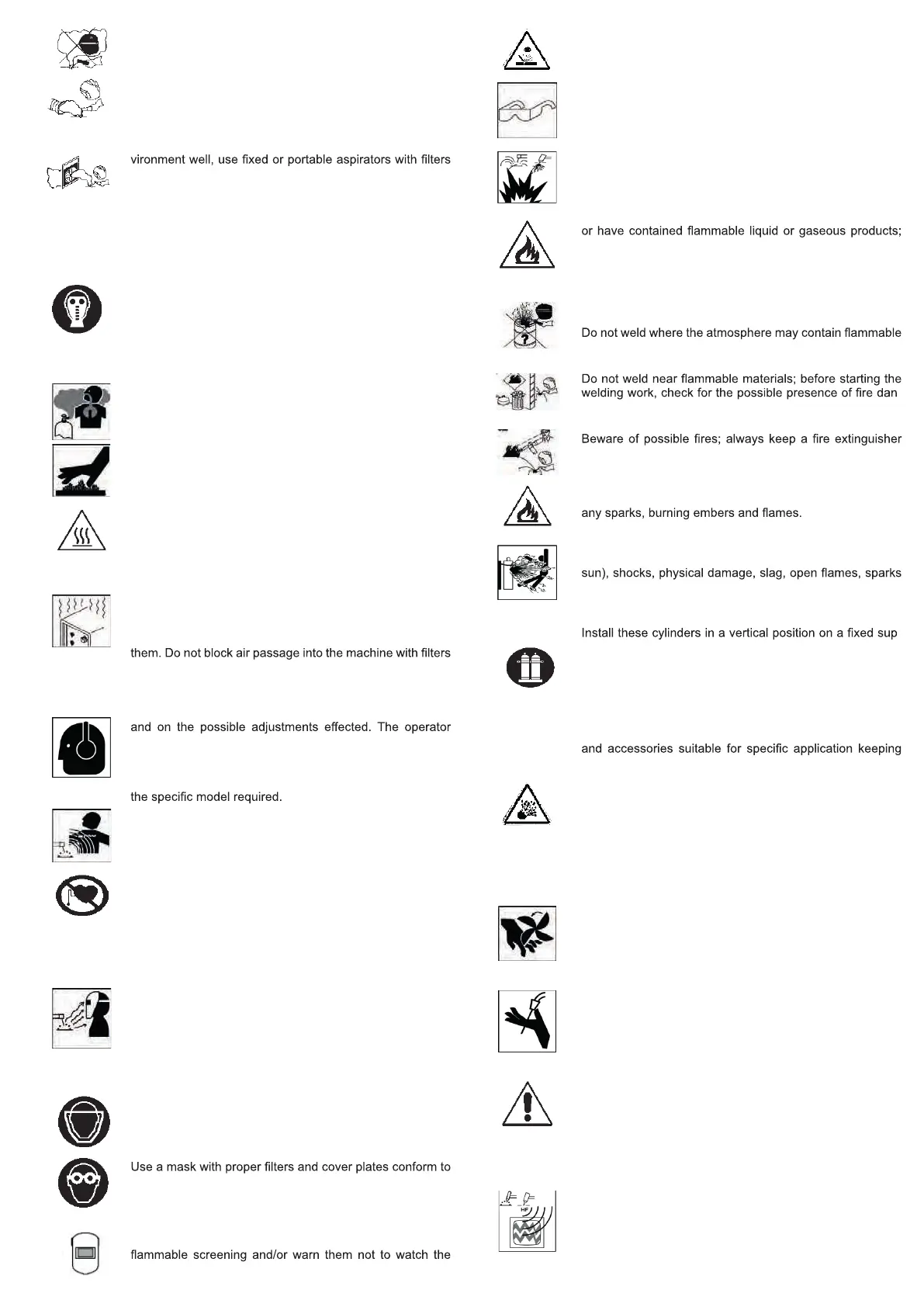
When welding, keep your head out of the fumes.
Avoid the use of this machine in places without ventilation.
To dispose of the fumes and gases produced by welding
when working in a closed environment, ventilate the en-
and/or open windows and doors. Do not weld or cut near
scouring, cleaning, or spraying operations. The heat and
rays produced by the arc can react with the vapors and
form highly toxic and irritating gases.
People who use pacemakers or other medical devices
must keep a safe distance.
Pacemaker users must consult their physician before stan-
ding close to the areas where this machine is used.
DIN to protect your eyes from UVA and
UVB rays.
Under the mask wear proper safety glasses with lateral
shields. Protect other nearby personnel with suitable, non
arc nor expose themselves to the arc rays or to hot spatter
or metal.
Do not weld when using contact lenses.
FLYING PIECES OF METAL OR DIRT CAN DAMAGE
EYES
Welding, cutting, brushing, grinding and deburring opera-
tions can produce sparks and metal projections. When the
welded part has cooled down slag can be projected.
WELDING AND CUTTING OPERATIONS CAN CAUSE
FIRE OR EXPLOSION
Do not weld or cut, on containers or piping that contain
make sure that the working area has been correctly reclai-
med.
Do not carry out welding or cutting operations on closed
containers such as tanks, drums or pipes unless they are
properly prepared in compliance with the Safety Standards.
dust, gas or vapors (example: petrol vapours).
GAS STORE CAN CAUSE DEADLY LESIONS
Always close the bottle valve when it is not being used.
HOT PARTS CAN CAUSE SERIOUS BURNS
Do not touch hot parts. Wait until the torch cools down be-
fore touching it or making any operation on it.
Protect yourself and the others from sparks and hot metal.
AN EXCESSIVE USE OF THE MACHINE CAN CAUSE
IT’S OVERHEATING
Allow the machine to cool down. Reduce the current or the
work cycle before starting to weld again. The air opening
are very important for its correct functioning. Do not cover
or anything else.
NOISE CAN DAMAGE HEARING
The noise emitted depends on the work place conditions
must check if the level of personal daily exposure “LEP,d”
is excessive, in other words 80dB (A) or higher. In such
case it is obligatory to use adequate devices for personal
protection: use the suitable ear plugs or ear coverings of
MAGNETIC FIELDS CAN INTERFERE WITH VITAL
ELECTRICAL OR ELECTRONIC DEVICES.
Do not perform welding or cutting operations on coated
metals, such as galvanized, leaded or cadmium-plated
iron, unless the coating is previously removed from the wel-
ding area, the area is not well ventilated and, if necessary,
you are not wearing an air-supplied respirator. Coatings
and any metal containing these elements can emit toxic
fumes when welded.
A systematic approach is needed to evaluate the exposure
limits of welding fumes according to their composition, con-
centration and duration of exposure.
ARC RAYS CAN CAUSE BURNS TO EYES AND SKIN
The electric welding arc is very dangerous for the intense
development of infrared and ultraviolet radiations.
Operator must be aware of the safe use of the welding
machine, of the capacitors discharge welding process, and
should also be informed about the risks related to arc wel-
ding procedures, the associated protection measures and
emergency procedures. (Also refer to the “TECHNICAL
DIRECTIVE IEC o CLC/TS 62081”: INSTALLATION AND
USE OF ARC WELDING MACHINES).
Do not look at the light of the arc if your eyes are not pro-
tected by a proper mask.
-
ger centers in the surrounding environment.
nearby. Remove lighters or matches from yourself before
starting any welding operation.
Once the job is complete, inspect the area and check for
Closed containers may explode if exposed to welding.
Protect gas cylinders from excessive heat (also from the
and electric arcs. Do not use the gas cylinder disposed on
the support surface in a horizontal position.
-
port or on in the apposite containers to prevent it from fal-
ling over or falling. Keep these cylinders away from welding
operations or electrical circuits. Never wrap a welding torch
around a gas cylinder.
Do not touch the electrode with the cylinder.
MOVING PARTS CAN BE DANGEROUS
Keep away from moving parts. Keep away from potentially
dangerous parts, such as rollers.
Keep all doors, panels, covers and guards closed and in
place.
WELDING WIRE MAY CAUSE INJURY
Do not press the torch trigger until you are well prepared to
do so or have been instructed to do so.
Do not point the torch towards your body or towards third
parties while feeding the welding wire
Use only the inert gas cylinders, regulators and tubes
everything in good condition.
When opening the valve of the cylinders, keep the face
away from the outlet nozzle.
Keep the protective cap on the valve except when these
cylinders are in use.
Use the proper procedure, the appropriate equipment and
the right number of people to lift cylinders.
Carefully read and follow the instructions on compressed
inert gas cylinders and related accessories.
Do not get distracted during welding or cutting operations.
Pay close attention. Avoid and/or remove people or equip-
ment that could cause distraction.
THE RADIATIONS EMITTED BY HIGH FREQUENCY
THEY MAY CAUSE INTERFERENCE.
Electromagnetic waves can cause interference with the
operation of sensitive electronic devices, such as televi-
sions, mobile phones, magnetic cards, instruments, data
transmission networks, telephone networks, remote con-
trols, pacemakers, computers and computer-controlled
machines, such as robots.
Do not wear watches that can be damaged by high fre-
quency.


 To Next Page
 Loading...