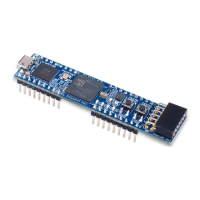
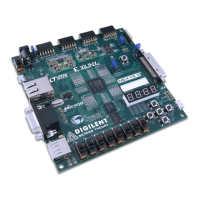
Nexys 3™ FPGA Board Reference Manual
Copyright Digilent, Inc. All rights reserved.
Other product and company names mentioned may be trademarks of their respective owners.
1 Configuration
After power-on, the Spartan-6 FPGA board must be configured (or programmed) before it can perform any
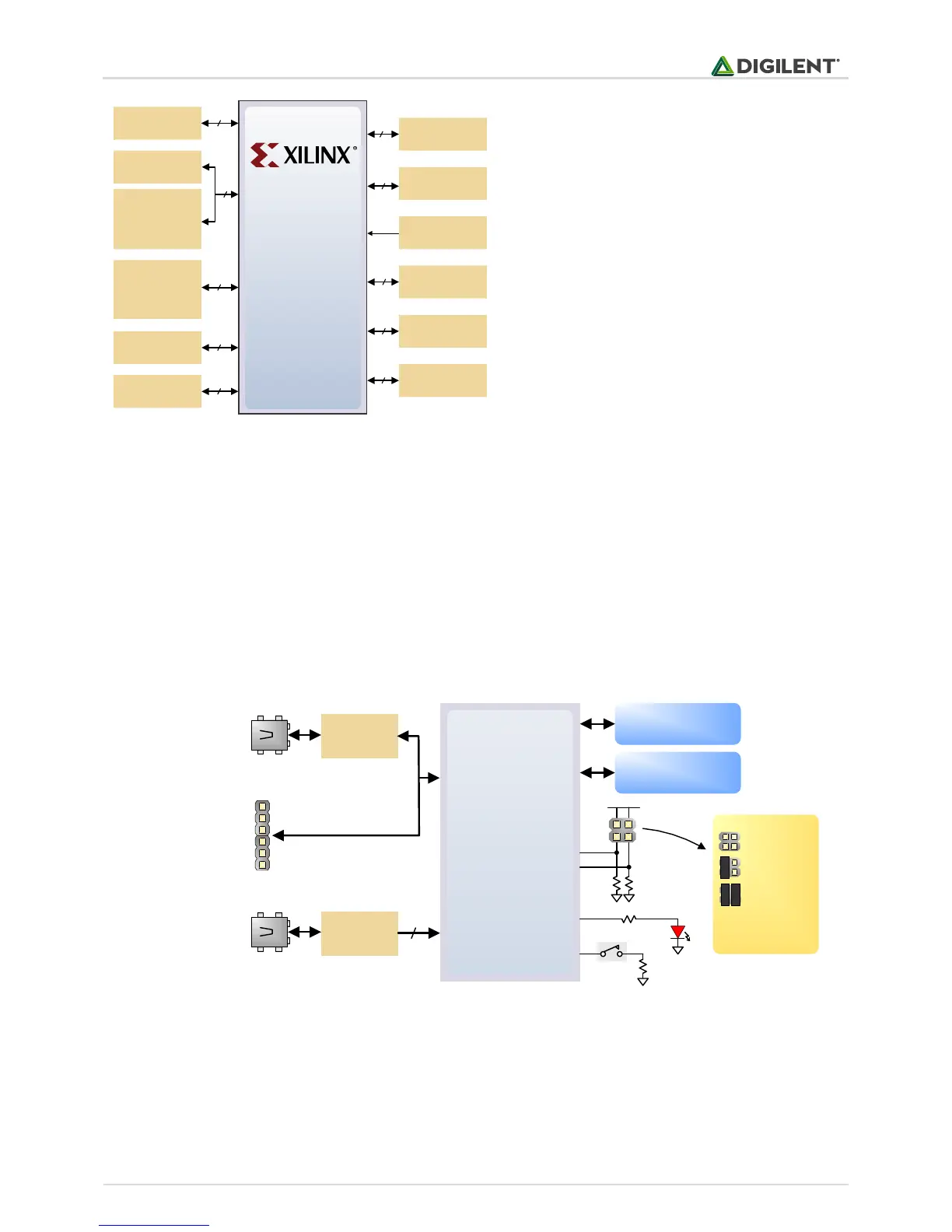
functions. The FPGA can be configured in one of four ways: a PC can use the Adept "USB Prog" port to program
the FPGA any time power is on; a configuration file stored in the non-volatile parallel PCM device can be
transferred to the FPGA at power-on using the BPI-UP port; a file stored in the non-volatile serial (SPI) PCM device
can be transferred to the FPGA using the SPI port; or a programming file can be transferred from a USB memory
stick attached to the USB HID port. An on-board "mode" jumper (J8) selects between the programming modes as
shown in the J8 Mode legend in the figure below. JTAG Mode can be accessed at any time without changing
jumpers.
M0
M1
JTAG
Port
USB
Controller
Micron SPI Quad
mode PCM (P5Q)
1x6 JTAG
Header
SPI
Port
Micro-AB USB
Connector
Adept “USB Prog” Port
Spartan6
Done
PIC24
Type A USB
Connector
Host Port
Serial
Prog. Port
2
Micron Parallel
PCM (P8P)
BPI
Port
J8
Programming
Mode
SLV Serial
SPI
BPI UP
M0 M1
6-pin JTAG
Header (J7)
Prog
Programming files are stored in SRAM-based memory cells within the FPGA. This data defines the FPGA's logic
functions and circuit connections, and it remains valid until it is erased by removing board power, by pressing the
reset button attached to the PROG input, or by writing a new configuration file using the JTAG port.
FPGA configuration files transferred via the JTAG port use the .bin or .svf file types, files transferred from a USB
stick use the .bit file type, and BPI or SPI programming files can use .bit, .bin, or .mcs types. The ISE/WebPack or
EDK software from Xilinx can create bit, svf, bin, or mcs files from VHDL, Verilog, or schematic-based source files
23
Cellular RAM
16MByte
High-Speed
Expansion
USB HID Host
Mouse/Keyboard
Spartan-6
XC6SLX16
CSG324C
Basic I/O
LEDs, Btns, Swts
Pmod Port
Expansion
8
22
40
32
4
USB-UART
2
Clock 100MHz
Adept USB2
Config & data
SPI PCM (x4)
Nonvolatile
Memory
16MByte
28
10/100
Ethernet PHY
Parallel PCM
Nonvolatile
Memory
16MByte
10
8-bit VGA
47
2,278 slices each containing four 6-input LUTs
and eight flip-flops
576Kbits of fast block RAM
two clock tiles (four DCMs & two PLLs)
32 DSP slices
500MHz+ clock speeds
Spartan-6 LX16 features include:


 To Next Page