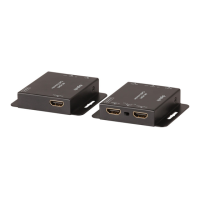
This document describes a 4K HDMI CAT6 Extender with IR Extender, a device designed to extend HDMI signals over long distances using a single CAT6 cable. The system comprises two main units: a transmitting unit and a receiving unit, which work in tandem to facilitate seamless audio and video transmission, along with bi-directional infrared (IR) pass-through for remote control functionality.
The primary function of this extender is to overcome the distance limitations of standard HDMI cables. It allows users to connect high-definition sources, such as DVD players, set-top boxes, or media players, to 4K displays or HDTVs located up to 70 meters away for 1080p signals or 40 meters for 4K signals. This is achieved by converting the HDMI signal into a format suitable for transmission over a CAT6 Ethernet cable, and then converting it back to HDMI at the receiving end. The use of a single CAT6 cable simplifies installation and reduces cable clutter, making it a convenient solution for various applications, including home theater setups, commercial displays, and conference rooms.
A key feature of this extender is its support for a wide range of video resolutions, including up to 4K (3820x1920) at 30Hz and 1080p (1920x1080) at 60Hz. This ensures compatibility with modern high-resolution displays and content. The device also supports deep color video, enhancing the visual quality of the transmitted content. In terms of audio, the extender is highly versatile, supporting various formats such as LPCM 2/5.1/7.1CH, Dolby Digital, DTS 5.1, Dolby Digital+, Dolby TrueHD, DTS-HD Master Audio, Dolby Atmos, and DTS:X. This comprehensive audio support ensures that the extended signal maintains high-fidelity sound, providing an immersive viewing experience.
The extender incorporates EDID (Extended Display Identification Data) management, which is crucial for seamless integration between the source and the display. EDID allows the source device to identify the display's capabilities, ensuring that the optimal video and audio settings are used. The transmitting unit features an EDID DIP switch, offering flexibility in how EDID information is handled. Users can choose to copy the EDID information from the HDMI loop out display (connected to the transmitter) or from the receiver's display, allowing for proper "handshake" and compatibility. This feature helps prevent common display issues such as incorrect resolutions or audio formats.
Another significant feature is the bi-directional IR pass-through. This allows users to control the source device from the display location or vice versa. The system includes an IR emitter cable and an IR receiver cable. The IR emitter connects to the transmitter and is placed in front of the source device's IR port, while the IR receiver connects to the receiver unit and is positioned near the display. This setup enables the remote control signals to travel alongside the HDMI signal over the CAT6 cable, providing convenient control over the entire setup without needing to be in direct line-of-sight of the source device. The IR frequency supported is 20-60KHz, which covers most standard remote controls.
The device is compliant with HDMI 1.4b, HDCP 1.4, and DVI 1.0 standards. HDCP (High-bandwidth Digital Content Protection) support is essential for playing protected content, ensuring compatibility with most modern media sources and displays. The extender also supports 3D content, adding to its versatility for entertainment systems.
Installation of the extender is straightforward. For the transmitting unit, the DC plug of the mains power adaptor is connected to the power socket, and the adaptor is plugged into a 240VAC wall socket. An HDMI cable connects the source device (e.g., PayTV, DVD player) to the HDMI input of the transmitter. Optionally, another HDMI cable can connect the HDMI output of the transmitter to a local TV or monitor, allowing for local viewing while extending the signal. A CAT6 Ethernet network cable connects the Ethernet output of the transmitter to the Ethernet input of the receiver. The IR emitter cable is connected to the IR output socket on the transmitter, and its 3M sticker is used to attach the emitter in front of the source device's IR port.
For the receiving unit, the opposite end of the CAT6 Ethernet network cable is connected to the Ethernet input of the receiver. An HDMI cable connects the HDMI output of the receiver to the HDMI input of the TV or monitor. The IR receiver cable is connected to the IR input socket on the receiver, and its end is placed in front of the TV or monitor to receive IR signals. Each unit is powered by a supplied DC 12V/1A power adaptor.
The device includes indicator lights for easy monitoring of its status. The transmitting unit has a POWER LED that illuminates when powered on. Both units have a DIGITAL SIGNAL INDICATOR LIGHT: a steady light indicates an HDMI signal with HDCP, a flashing light indicates an HDMI signal without HDCP, and no light means no HDMI signal. These indicators help in troubleshooting and confirming proper operation.
Maintenance features are minimal, as the device is designed for reliable operation. Users are advised not to open or repair the device without professional assistance to avoid electrical shock. It should not be exposed to water, moisture, or any liquid. Positioning the unit in a well-ventilated area is recommended to prevent overheating, ensuring longevity and stable performance. Only the supplied DC 12V/1A power adaptor should be used; using third-party power supplies with incorrect voltage could damage the unit.
Troubleshooting guidance is provided for common issues. If there is no video output, users are advised to adjust the EDID switch, check if the source device and monitor/TV resolution and frequency match the extender's supported resolution, ensure all devices are switched on, verify that a standard CAT6 Ethernet cable (not a crossover cable) is used, check power adaptor connections, and reconnect HDMI cables. For flickering or unstable images, checking the Link LED and Power LED indicators, and reconnecting HDMI cables to ensure they are functioning correctly, are recommended steps. If the infrared remote control is not working, users should reattach the IR emitter over the source device's IR port, ensuring proper alignment. It's also important to confirm that the device's IR frequency is within the supported 20-60KHz range. If LED indicators do not show, checking power adaptor connections and reconnecting HDMI cables are the first steps.
In summary, this 4K HDMI CAT6 Extender with IR Extender is a robust and user-friendly solution for extending HDMI and IR signals over significant distances using a single CAT6 cable. Its comprehensive support for various video and audio formats, EDID management, and bi-directional IR pass-through make it a versatile tool for integrating high-definition systems in diverse environments, while its simple installation and clear status indicators ensure ease of use and maintenance.


 To Next Page
 General