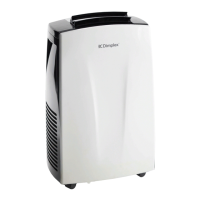
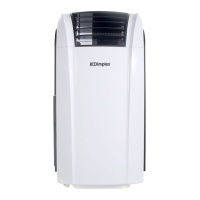
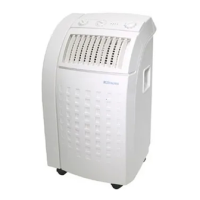
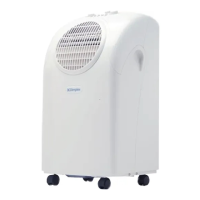
This document serves as an instruction manual for the Dimplex DC10RC, DC12RCBW, and DC15RCBW Reverse Cycle Portable Air Conditioners with Dehumidifier. It provides essential information for the safe and efficient operation, installation, and maintenance of these units.
Function Description
The Dimplex portable air conditioner is a versatile appliance designed to provide cooling, heating, and dehumidification functions for indoor environments. As a reverse cycle unit, it can both cool a room during warmer periods and provide warmth during colder seasons, offering year-round comfort. The integrated dehumidifier function helps to reduce excess moisture in the air, contributing to a more comfortable and healthier indoor atmosphere. The unit is designed for portability, featuring wheels for easy movement within a space.
Usage Features
The operation of the Dimplex portable air conditioner is managed through a control panel located on the unit and a remote control, offering convenience and flexibility.
- Power Control: The unit is turned on or off using the POWER button on both the control panel and the remote. A compressor delay protection circuit is incorporated to prevent damage from rapid starts and stops. After switching on or changing from dehumidify to air conditioning mode, the compressor will start after a 3-minute delay.
- Function Selection: The FUNCTION button allows users to select between cooling, heating, or dehumidification modes. When operating in heating or dehumidification modes, it is necessary to remove the upper drain plug and attach a drain hose (not supplied) to manage condensed water.
- Temperature Adjustment: The TEMP+ and TEMP- buttons are used to set the desired temperature. In cooling mode, the temperature can be adjusted from 17°C to 30°C. In heating mode, the range is from 15°C to 25°C. The time it takes to reach the set temperature depends on the ambient conditions and room size.
- Fan Speed Control: The SPEED button offers selections for LOW, MEDIUM, HIGH, or AUTO fan speed. In AUTO mode, the fan speed adjusts based on the difference between the room temperature and the set temperature, aiming for efficient operation. When the room temperature is more than 2°C from the set temperature, the unit operates at maximum capacity and high fan speed. Within 2°C, it switches to medium capacity and fan speed. Once the set temperature is reached, it operates at minimum capacity and low fan speed. In heating mode, only HIGH and LOW fan speeds are available.
- Programmable Timer: The unit features a TIMER ON/OFF button for a programmable timer function. This allows users to set a delay for the unit to turn on automatically when the unit is off, or to set a duration for the unit to remain on before automatically turning off when the unit is already running. Pressing the POWER button before the delay is complete will cancel the timer.
- Sleep Comfort Mode: The SLEEP button activates a sleep comfort mode. In this mode, when cooling, the set temperature will gradually increase by 1°C per hour, up to a maximum of 2°C over two hours. When heating, the set temperature will gradually decrease by 1°C per hour, up to a maximum of 2°C over two hours. These adjusted temperatures are maintained for the duration set by the TIMER function, enhancing sleep comfort. The set hours for sleep mode can be viewed by pressing TEMP+ or TEMP- buttons.
- Installation: The unit requires a flat, stable surface for operation to prevent water leakage. Adequate clearance (minimum 50cm from walls and other objects) is necessary to ensure proper airflow. The exhaust tube, stored under the rear air outlet, must be installed by rotating it clockwise onto the rear air outlet and extended to the closest window. An adjustable window slider kit is provided to secure the exhaust pipe in the window and prevent hot air from re-entering the room. For heating, the rear air outlet with the exhaust tube should be moved to the front of the unit. The appliance should not be used in damp areas or placed in direct sunlight.
- Water Drainage (Error Code E4): During cooling, excess water condensation is collected in an internal container. If this container becomes full, the unit will stop operating and display an E4 error code. Manual drainage is required by switching off and unplugging the unit, moving it to a suitable drainage location, removing the lower drain plug, and slightly tilting the unit to the rear. The drain plug must be securely re-fitted before restarting.
Maintenance Features
Regular maintenance is crucial for the efficient and safe operation of the Dimplex portable air conditioner.
- Filter Cleaning: The air filters, located at the rear of the unit, should be cleaned frequently to ensure efficient operation. They can be removed by pulling the filter frame slightly out and then across to the side. Always unplug the unit before moving or cleaning.
- Cabinet Cleaning: The exterior cabinet can be cleaned by wiping it with a damp cloth and then polishing it with a soft cloth.
- Power Connection: The unit must be plugged into a 220-240V ~ 50Hz AC, 10 Amp power outlet. Extension cords should not be used. When unplugging, always hold the plug, not the cord.
- Storage and Transport: The air conditioner must always be stored and transported upright. If there is any doubt about its upright position, it is recommended to wait at least 24 hours before operation. Before moving the unit, ensure any collected water is cleared.
- Error Codes and Troubleshooting: The unit's display will show error codes if a fault occurs.
- E1: Indicates an open or short circuit in the room temperature sensor.
- E2: Indicates an open or short circuit in the pipe temperature sensor.
- E4: Indicates the internal water container is full, requiring manual drainage. If E4 persists after drainage, contact an authorized service center.
- Overheat Protection: The unit has an overheat prevention device that will automatically turn it off if it overheats. It can be restarted after 30 minutes.
- Troubleshooting steps are provided for common issues such as the unit not operating (check power, E4 code, active timer), inefficient operation (direct sunlight, open windows/doors, dirty filters, blocked inlets/outlets, room temperature below set temperature), noisy operation (unit not level), and compressor not working (overheat protection activated).
- Remote Control Maintenance: When the remote control batteries no longer work, they must be removed and disposed of safely. If the remote control is not functioning, check the distance to the unit, aim it directly at the control panel, and replace the batteries if flat.
- Professional Service: In case of persistent operational issues, the unit should be unplugged, and advice sought from a local after-sales service agent or the Customer Care Centre. Unauthorized repairs are not recommended as they may void the warranty and pose safety risks.
- Disposal: Electrical appliances should not be disposed of as unsorted municipal waste. Separate collection facilities should be used, and local government contacted for information on available collection systems. Improper disposal can lead to hazardous substances leaking into groundwater, polluting the food chain, and damaging health.



 To Next Page
 General