EasyManua.ls Logo

Dokorder 7700 - Technical Description; Solenoid Drive Circuit

Default Icon
34 pages
Print Icon
To Next Page IconTo Next Page
To Previous Page IconTo Previous Page
Loading...
A. TECHNICAL
DESCRIPTION
8-1 SOLENOID DRIVE CIRCUIT
ln
Model 7700, a special
voltage
reduction
circuit is
used in the operating
power
supply
for the
pinch
roller and
brake solenoid
which lowers
the
operating
voltage required
for normal operation
of
the
solenoid
to approxi-
mately one-half
of
the
initial
drive
voltage. This
circuit
not only suppresses
the
heating of
the solenoid coil
effectively,
but it also
lowers the
power
consumption,
ensuring
the stability
of the
solenoid
operation and
a
prolonged
service
life for
the
solenoid.
1
(A)
Operation
Principle
Before
nraking reference to
the
actual
circuit diagram,
the
principle
of the
voltage-reduction
circuit
will be
explained
below.
AC Supplv
FFlRew
Power
T
ransf
ormer
F
ig.8 1
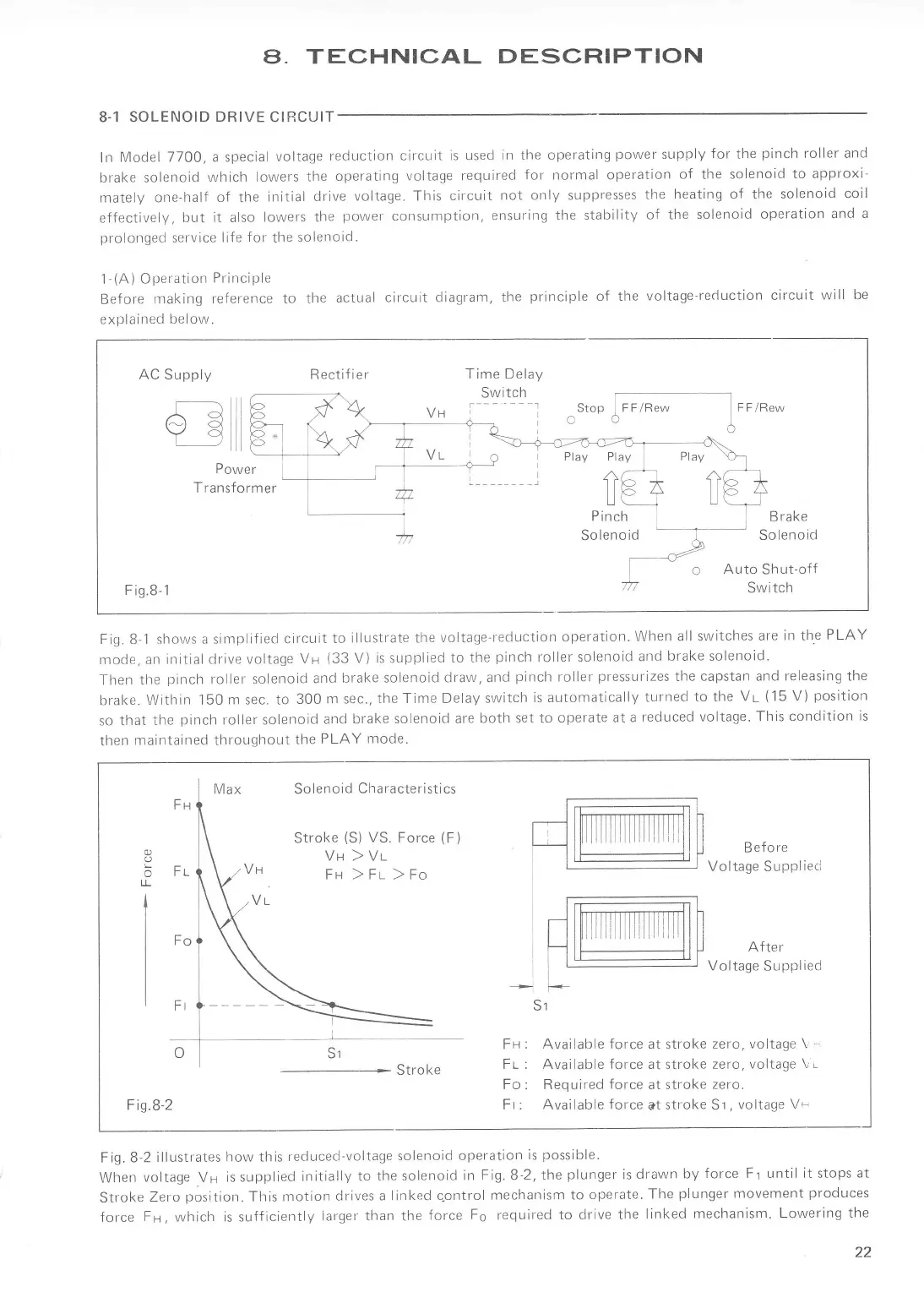
Fig. B-1 shows
a
sirnplified
circuit
to
illustrate the
voltage-reduction
operation.
When all switches
are
in th.e
PLAY
moCe, an
initial drive
voltage
Vr-1
(33
V) is supplied
to the
pinch
roller
solenoid
and
brake solenoid,
Then
the
pinch
roller
solenoid
and
brake
solenoid draw, and
pinch
roller
pressurizes
the
capstan
and
releasing the
brake.
Within 150
m
sec.
to
300
m sec., the
Time Delay switch
is automatlcally
turned
to the
Vr
(15
V)
position
so that
the
pinch
roller sotenoid
and brake
solenoid are
both set to
operate
at a
reduced
voltage. This
condition
is
then
maintained throuqhout
the
PLAY
mode.
Max
{cli
Solenoid
Characteristics
Stroke
(S)
VS.
Force
(F)
Vs )Vr
FH )Fl )Fo
B
efo
re
Voltage
Supplieil
After
Voltage
Supplied
St
Stro ke
Fs: Available
force at
stroke
zero,
voltage \'-
Fr- : Available force at stroke
zero, voltage
\ .
Fo: Required
force
at stroke
zero.
Fr : Available
force
at
stroke
Sr
,
voltage
VH
Fig.8 2
Fig.8-2
illustrates
how this
reduced-voltage
solenoid
operation
is
possible.
When
voltage
VH
is supplied
initially to
the solenoid
in
Fig.8-2, the
piunger
is
drawn
by
force Fr until
it
stops
at
Stroke
Zero
position.
This motion
drives a linked
c.ontrol
mechanism to
operate.
The
plunger
movement
produces
force
Fr-r,
which is suff iciently
iarger than the
force
Fo
required
to drive the
linked
mechanism. Lowering
the