
 Need help?
Do you have a question about the Dometic 310 Series and is the answer not in the manual?
Key warnings before servicing the toilet, emphasizing not to disassemble.
Step-by-step procedure to resolve issues with water retention in the bowl.
Details manufacturer liability limits and critical warnings for safe operation.
Step-by-step instructions for mounting the toilet to the floor flange and connecting water supply.
Instructions for cleaning mineral deposits from the flush ball and seal to prevent leaks.
Recommended method for winterizing the toilet using nontoxic antifreeze.
Explains that freeze damage to the water valve voids the warranty.
Diagnoses and provides solutions for various leak points in the toilet system.
This document is an instruction manual for Dometic 310 and 320 Series Gravity-Flush Toilets. It provides comprehensive information on the function, usage, and maintenance of these toilets, designed for installation directly above a holding tank in RVs or other vehicles.
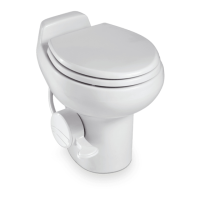
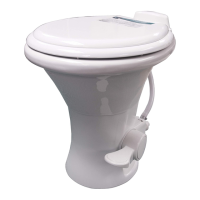
The Dometic 310 and 320 Series Gravity-Flush Toilets are designed to provide a lightweight, residential-sized toilet solution for recreational vehicles and similar applications. They utilize a gravity-flush mechanism to discharge waste directly into a holding tank. The core function involves a foot pedal operation that controls water flow into the bowl and the opening/closing of a flush ball to allow waste to pass into the tank. A key feature is the "PowerFlush technology," which employs an improved pressurized rim flow to create a high-speed, full bowl rinsing action, ensuring efficient and thorough flushing. The toilets are designed to create an airtight seal in the bowl after flushing, preventing holding tank odors from entering the living space.
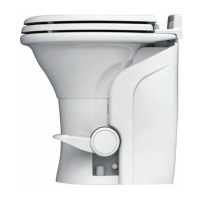
The Dometic gravity-flush toilets offer several user-friendly features aimed at enhancing comfort and ease of use. They boast a "Premium user comfort" design with a full-size seat, deep bowl, and an 18-inch (457 mm) seat height, providing a more homelike performance compared to smaller RV toilets. The "Easy installation" is highlighted by a two-bolt design that fits most existing toilet floor flanges, making them suitable for both new installations and replacements. The compact design allows for a small footprint with 10-inch or 11-inch (254 or 279 mm) rough-in, accommodating various vehicle layouts. The "Ergonomically enhanced pedal operation" features a lower pedal height for easier use and a "one-direction" action to both add water to the bowl and flush. To add water, the user presses the flush pedal part way down, allowing water to flow into the bowl while the flush ball remains closed. This is recommended before flushing solids and toilet paper to help prevent odors. To flush, the pedal is pressed down completely until it contacts the floor, then released after the flush is complete. For liquids, a 1-2 second pedal press is sufficient, while solids require the pedal to be held until the bowl contents are rinsed.
The manual emphasizes several maintenance aspects to ensure the longevity and proper functioning of the toilet. A significant innovation is the "Flush ball seal" design, which allows for the replacement of worn or damaged ball seals without requiring tools or toilet disassembly. This can be done in minutes, with detailed instructions provided in replacement kits. The "Snap-in water valve cartridge" facilitates easy replacement of worn or damaged water valves. Users are advised to follow winterizing procedures to prevent water valve failure, especially in cold climates. The "Factory-sealed bowl-to-base assembly" means the ceramic bowl and plastic base of 310 and 320 series toilets should not be separated for any reason, as disassembly of components may void the warranty.
For routine cleaning, the manual recommends using SeaLand® Toilet Bowl Cleaner or any non-abrasive bathroom and toilet bowl cleaner, following label instructions. Periodic cleaning of the flush ball and seal is crucial to prevent mineral deposits from hard water, which can lead to slow water leaks. This involves slowly pressing and releasing the flush pedal multiple times to loosen debris, and if necessary, cleaning with a soft bristle brush and cleaner, applying downward pressure around the seal's perimeter. If a leak persists, the flush ball seal should be replaced.
Winterization is a critical maintenance procedure for periods of storage or exposure to freezing temperatures. The recommended method is "Non-toxic Antifreeze Winterization," where non-toxic antifreeze (propylene glycol) designated for potable water systems is poured into the potable water tank, and the toilet is flushed several times until antifreeze flows through completely. If the toilet has a hand sprayer, it must also be activated to cycle antifreeze through it. Alternatively, users can "Drain Water from Toilet" by turning off the water supply, removing the water supply line from the water valve, and pressing the flush pedal to drain all water from the water valve and vacuum breaker. It is explicitly stated that the toilet is not intended for use when exposed to freezing temperatures, and automotive-type antifreeze (ethylene glycol) should never be used in freshwater systems. The warranty specifically excludes coverage for freeze-damaged water valves, which are indicated by white stress marks on the freeze damage indicator window. If such damage occurs due to improper winterization, the water valve must be replaced. The manual also provides troubleshooting steps for common issues like water not staying in the bowl, odors, incomplete flush ball closure, continuous water flow, and leaks, offering solutions such as cleaning, replacing seals or valves, and tightening connections.
 General
| Type | Toilet |
|---|---|
| Flush Type | Gravity Flush |
| Bowl Material | Ceramic |
| Color | White |
| Bowl Shape | Elongated |
| Weight | 23.5 lbs (10.7 kg) |
| Water Consumption | 0.5 gallons per flush |



 To Next Page