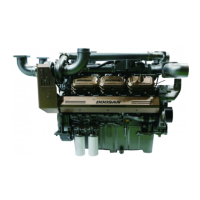
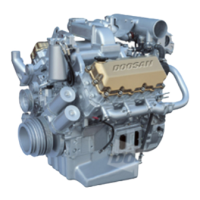
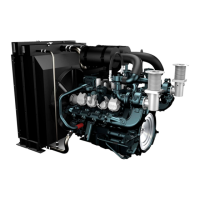
DL06K Interim Tire-4 Diesel Engine Maintenance of Major Components
190
5.3.7. Diagnostics and troubleshooting
1) When abruptly increasing the engine rpm after starting the engine, the crank shaft
rotates at an excessive speed before the journal bearing of the crank shaft is not
lubricated due to an insufficient supply of lubrication oil. When the turbocharger
rotates under these conditions, cooling and lubrication are not smoothly executed
causing burnt adhesion of the bearing and damage to parts.
2) Perform idling operation of the engine for two minutes or longer before operating
the engine to ensure that sufficient lubrication oil is circulated in the turbocharger
after replacing the engine oil or the oil filter.
3) When the engine is run at a high speed for an extended period of time, sufficiently
perform idling operation and then stop the engine. Otherwise, the turbine wheel
continuously operates without oil pressure on the turbocharger. In this case, an oil
film is not formed on the center bearing and the journal bearing of the turbocharger
causes abrasion and reduces the life span of the turbocharger.
4) When operating the engine in extremely cold temperatures or if the engine has
been shut down for an extended period of time, perform the idling operation after
starting the engine until the oil pressure of the engine reaches normal conditions.
5) The turbocharger turbine rotates at the super high speed of 50,000 - 200,000 rpm.
Oil supply to the bearings may have significant effects on the life span of the
turbocharger. Use only the standard engine oil that is recommended by the
company, and regularly check and replace the engine oil.
6) Using contaminated air cleaner for an extended period may cause critical damage
to the Turbo charger. Regularly check and replace the air cleaner.
7) The turbocharger is a very complicated and precise part. Only authorized
mechanics should service the turbocharger.
8) Operating the turbocharger with no intake and exhaust pipes mounted may cause
serious damage to the engine or physical injury of workers. The turbocharger
should be operated with all the parts correctly mounted on the correct positions.
9) Do not lift the turbocharger by the actuator of the turbocharger. The turbocharger
may be damaged by its own weight.
10) The weight of the turbocharger is approx. 9.0 kg. When lifting the turbocharger for
removing or mounting, the worker should lower their center of gravity, or lift the
turbocharger with the body of worker closely in contact with the turbocharger.
Otherwise, the turbocharger may be dropped, causing damage to the parts or
physical injury of the worker.



 To Next Page