
 Need help?
Do you have a question about the Dormakaba ED50LE and is the answer not in the manual?
This Quick Start Guide provides instructions for programming the dormakaba ED50LE/ED100LE/ED900 operator, ensuring compliance with the ANSI A156.19 Standard for Low Energy Power Operated Doors. It is designed to assist users in setting up the device for optimal performance and safety.
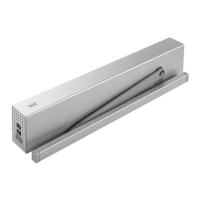
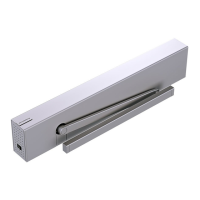
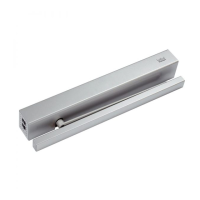
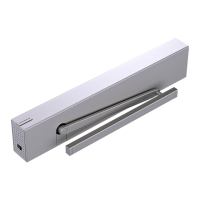
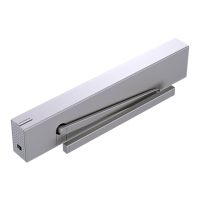
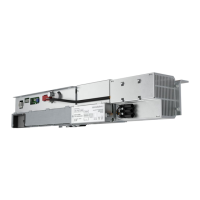
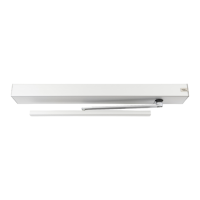
The dormakaba ED50LE/ED100LE/ED900 is a low-energy power-operated door operator. Its primary function is to automate the opening and closing of doors, providing accessibility and convenience while adhering to safety standards. The device utilizes a display and a series of buttons for programming and configuration. It supports various installation types, including pull arm with track (wall mounting on pull or approach side) and push arm with track (wall mounting on approach side). The operator can be configured for different door widths and types, including single doors. A crucial aspect of its operation is the "learn cycle," during which the operator calibrates itself to the specific door's dimensions and movement characteristics. This self-calibration ensures smooth and safe operation tailored to the installation. The device also incorporates safety features such as power fail closing speed verification and braking circuit plug position checks to prevent high-speed door closure in the event of a power failure or incorrect setup.
The operator's programming interface is designed for straightforward interaction. Upon powering on, the display shows a series of numbers and letters, eventually settling on two horizontal dashes moving up and down. During this state, pressing the bottom button allows the unit to identify its mounting orientation, ensuring the display text is correctly oriented. The display then shows a "P" on the right with a rotating segment on the left, indicating readiness for parameter programming.
To access the programming menu, the user presses and holds the right button until "Parameter ID" is displayed. Navigation through parameters is done using the right button to advance and the up/down buttons to change settings. The left button is used to accept changes, return to the programming menu, or exit the menu entirely. The display provides visual feedback, flashing the current setting when it's being adjusted and showing the new setting once accepted.
Key parameters that can be configured include:
After setting the required parameters, the device enters a "learn cycle." This is initiated by pressing and holding the bottom button. During this cycle, the door performs several movements, and the display cycles through letters and numbers. The user is prompted to manually push the door open to the desired angle (between 90 and 110 degrees) when the display shows "4." The operator then completes the learn cycle, calibrating its movement. Once finished, two horizontal bars appear on the display, indicating successful completion.
The device also provides feedback for potential issues. If the door closes and an "F" is displayed, it indicates that the spring force is too low. This requires manual adjustment of the spring tension.
While the guide focuses primarily on initial setup and programming, it touches upon aspects relevant to ongoing maintenance and troubleshooting.
The guide emphasizes that the operator must be completely installed according to the dormakaba USA Inc. ED operator Installation Instruction Manual before programming. This underscores the importance of proper physical installation as a prerequisite for effective and safe operation and subsequent maintenance. Regular checks of the door's closing speed and braking function are implied as part of ensuring continued safe operation.
 General
| Opening Speed | Adjustable |
|---|---|
| Closing Speed | Adjustable |
| Opening Width | Adjustable |
| Product Type | Electromechanical Door Operator |
| Operating Modes | Automatic, Manual |
| Safety Features | Obstacle detection |
| Finish | Anodized aluminum |
| Holding Force Adjustment | Yes |


 To Next Page