Need help?
Do you have a question about the Doro 1350 and is the answer not in the manual?
Instructions for powering the phone on and off, including SIM PIN entry.
Steps to answer or reject an incoming call and end a call.
How to adjust the sound volume during a call using the device's buttons.
Activate and deactivate silent mode to disable tones and vibrations.
Setting up and using speed dial entries for quick dialing.
Instructions for inserting SIM and optional memory cards and the battery.
Guide to entering text using the keypad, including character selection.
Making calls by dialing directly or from the phonebook.
Steps to add new contacts with name and phone numbers to the phonebook.
How to use the assistance button for emergency calls and messages.
Instructions for composing and sending SMS messages.
Guide for sending MMS messages, including adding pictures.
Instructions for taking a photograph using the phone's camera.
Pairing the phone with other Bluetooth devices.
Adjusting various sound settings like ringtone and message tones.
Changing the display text size for better readability.
Adjusting the screen brightness for optimal viewing.
Turning the torch on and off using the dedicated button.
Setting and managing alarms, including snooze function.
Troubleshooting steps for when the battery is not installed correctly.
Actions to take if the PIN code is rejected or blocked.
Steps to resolve issues with the SIM card not being recognized.
Guidance on cleaning and drying the SIM card for proper function.
Warning about potential hearing damage from prolonged exposure to loud sounds.
Information regarding the need for a service provider subscription.
Details about PIN and PUK codes for SIM card security.
Specifications for supported GSM frequency bands.
Details about the phone's battery type and capacity.
Estimated time required to fully charge the battery.
Recommended operating temperature range for the device.
Information on the Specific Absorption Rate (SAR) values.
Information about radio signal usage and potential interference.
Caution regarding electronic systems in vehicles and radio equipment.
Tips for protecting the phone from damage and wear.
Instructions on how to clean the phone safely.
Warning about potential hearing damage from prolonged exposure to loud sounds.
Advice regarding the use of mobile phones near implanted medical devices.
Precautions for using the phone in areas with explosion risks.
Safety warning and handling instructions for Li-ion batteries.
Information on warranty terms and conditions for the device.
Requirements for proof of purchase for warranty claims.
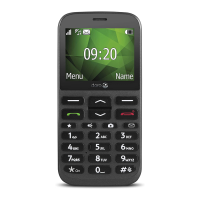
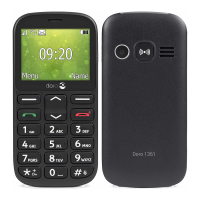
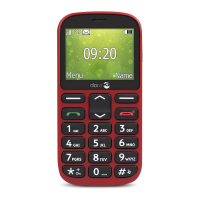
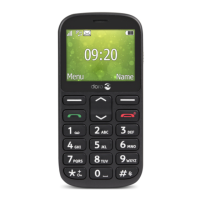
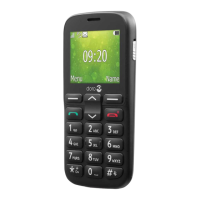
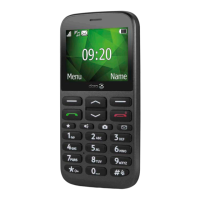
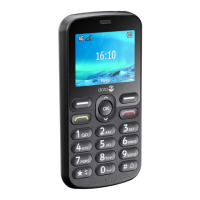
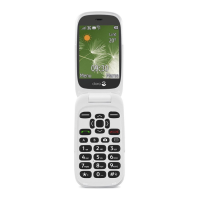
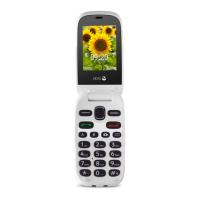
This document describes the Doro 1350, a mobile phone designed for ease of use, particularly for individuals who may benefit from simplified features and enhanced safety functions.
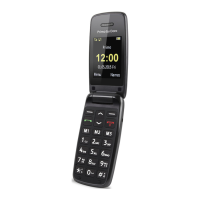
The Doro 1350 is a mobile phone equipped with essential communication features, including making and receiving calls, sending and receiving text messages (SMS), and picture messages (MMS). It also incorporates several safety and convenience features, such as an assistance button, ICE (In Case of Emergency) information storage, and a torch. The phone supports dual SIM cards (SIM1 and SIM2) and an optional SD card for additional storage.
Call Functions: Users can make calls by entering a phone number directly or by selecting a contact from the phonebook. Speed dial functionality allows for quick calling of pre-assigned numbers by pressing and holding a single digit (0, 2-9). The phone also supports international calls, requiring the use of '+' before the country code. During a call, users can adjust the volume using the scroll buttons. The call log stores received, missed, and dialed calls, with up to 20 entries of each type.
Messaging Functions: The Doro 1350 enables users to create and send text messages (SMS) and picture messages (MMS). Text input is done by repeatedly pressing numerical keys to cycle through characters. Special characters and writing language can also be selected. For picture messages, users can either select an existing picture from "My pictures" or take a new one using the camera. The phone allows for adding sound and video to MMS messages.
Safety Features: A prominent feature is the Assistance Button, which, when pressed and held for 3 seconds or pressed twice within 1 second, initiates an assistance call. This call begins after a 5-second delay, during which it can be cancelled. An assistance text message (SMS) is sent to all predefined recipients, and the first recipient in the list is dialed. If unanswered, the phone proceeds to dial the next number, repeating this process up to three times or until a call is answered. During an assistance call, the phone automatically switches to handsfree mode.
The ICE (In Case of Emergency) feature allows users to store critical personal information such as medication details and next of kin. This information can be accessed by first responders in an emergency, potentially increasing chances of survival. All fields are optional, but providing more information is recommended.
Other Features:
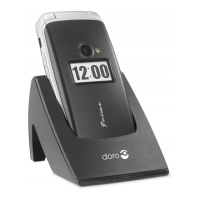
Getting Started: To begin, users need to remove the battery cover, insert a SIM card (preferably in SIM1 slot if only one is used), and optionally an SD card. The battery is then inserted, and the battery cover replaced. The phone is charged by connecting the mains adapter to the charging socket or cradle.
Turning On/Off: The phone is turned on/off by pressing and holding the red button. If a SIM card is protected by a PIN code, the user will be prompted to enter it. The phone also supports PUK code entry if the PIN is blocked.
Text Input: Text is entered by repeatedly pressing numerical keys. The cursor can be moved using the scroll buttons. Special characters and writing language can be selected.
Navigation: The scroll buttons (up/down) are used to navigate through menus and lists. The left and right selection buttons perform actions displayed on the screen, while the OK button confirms selections.
Call Options: During a call, the soft keys provide access to additional functions.
Speed Dial: Numbers can be assigned to digits 0 and 2-9 for quick dialing from standby.
Phonebook Management: Contacts can be added, edited, and deleted through the Phonebook menu. Quick search by pressing the key corresponding to the first letter of a name is available.
Assistance Button Configuration: The assistance function needs to be activated, and help numbers configured, before use. Thorough testing of the application is recommended.
Language, Time, and Date: These settings can be changed via the menu. The default language is determined by the SIM card.
Battery and Charger: Only use batteries, chargers, and accessories approved for this specific model to avoid danger and invalidate the phone's type approval and guarantee. The phone indicates when the battery is low.
SIM Card and SD Card Handling: When inserting SIM and SD cards, ensure the gold-colored circuit board faces down for SIM cards and contacts face downwards for SD cards. Avoid scratching or bending the circuit boards.
Cleaning: The device should be cleaned with a soft, clean cloth. Do not use strong chemicals or cleaning agents.
General Care:
Troubleshooting: The manual provides guidance for common issues such as battery not installed, charger incorrectly connected, SIM card not inserted, and phonebook memory full, directing users to check connections, contact the service provider, or delete entries.
Disposal: The device, battery, and accessories should be disposed of according to local regulations for electronic waste. Do not dispose of them with household waste.
 General
| Display Size | 2.4 inches |
|---|---|
| Rear Camera Resolution | 0.3 MP |
| Standby Time (max) | 500 hours |
| Battery | 800 mAh |
| Network | 2G |
| Display Type | TFT |
| Colors | Black |


 To Next Page