Need help?
Do you have a question about the Doro 1360 and is the answer not in the manual?
Instructions for removing the battery cover, inserting the SIM card, and inserting the SD card.
Steps for inserting the battery into the compartment and replacing the cover.
Procedure to power the phone on and off, including PIN code entry.
Guide to inputting text using the keypad, special characters, and case changes.
How to adjust the phone's language, time, and date settings.
Instructions for dialing numbers, initiating calls, and using international format.
Steps to find and call contacts stored in the phonebook.
Accessing and viewing received, missed, and dialled call history.
Procedure for adding new contacts with name and phone numbers.
How to use the assistance button for emergency calls and SMS alerts.
Adding emergency contact information for first responders.
Guidance on composing and sending SMS messages to contacts.
Instructions for sending MMS messages, including adding pictures.
Steps to enable Bluetooth connectivity and visibility on the device.
How to find and bond with other Bluetooth compatible devices.
Customizing incoming call melodies and notification tones.
Adjusting the font size for menus and messages (Normal or Large).
Customizing the display brightness settings from Level 1 to 3.
Setting and managing alarms, including single or repeated occurrences.
Instructions for turning the device's flashlight on and off.
Solutions for issues like low battery or incorrect battery installation.
Troubleshooting steps for battery charging problems.
Guidance on incorrect PIN entry and using the PUK code.
Resolving issues related to damaged or incorrectly installed SIM cards.
Troubleshooting network connection problems with SIM or GSM service.
Resolving issues when the phonebook memory is full.
Addressing issues where a function is not supported or subscribed.
Important safety precautions, including handling small parts and operating environment.
Precautions regarding interference with medical equipment and implants.
Safety guidelines for using the phone in potentially explosive environments.
Warnings and precautions for handling and disposing of Li-ion batteries.
Advice on preventing hearing damage from loud sounds and safe listening.
Important note on the limitations of mobile phones for emergency calls.
Information on potential interference with vehicle electronic systems.
Tips for protecting the unit from moisture, dust, and extreme temperatures.
Instructions on how to clean the device without using strong chemicals.
Details on network bands, power, dimensions, weight, battery, and temperature limits.
Information on the device's compliance with radio wave exposure guidelines.
Guidelines for the responsible disposal of the product and electronic accessories.
Instructions for recycling and disposing of batteries according to regulations.
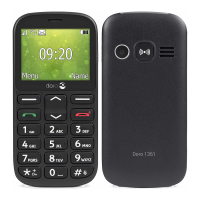
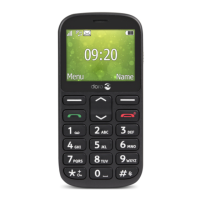
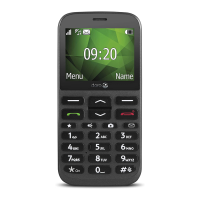
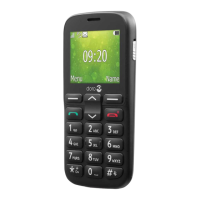
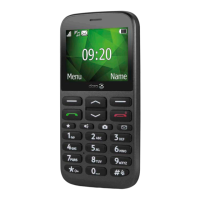
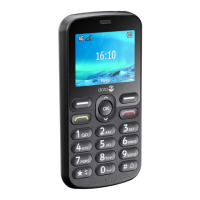
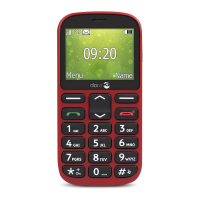
The device is a mobile phone, specifically the Doro 1360. It is designed for ease of use, particularly for individuals who may find more complex smartphones challenging.
The Doro 1360 is a mobile phone primarily designed for making and receiving calls and text messages. It features a color display and a physical keypad for navigation and input. The device includes a camera for taking photos and a flashlight for convenience. It also supports Bluetooth connectivity for use with wireless accessories. An alarm clock function is integrated, and the phone can play an FM radio.
Basic Operation: The phone is turned on by pressing and holding the red button. To turn it off, the same button is pressed and held. The device uses a standard SIM card and a battery that needs to be inserted correctly for the phone to function. The battery cover slides on and off.
Calls: To make a call, the user enters the phone number and presses the green call button. To end a call, the red button is pressed. Calls can also be made from the phonebook, which stores contacts. For international calls, a plus symbol can be entered before the country code. The phone supports handsfree mode during calls.
Text Messages: The Doro 1360 allows users to send and receive text messages (SMS). Messages can be created, read, and managed within the messaging menu. The device supports predictive text input, which can be toggled on or off, to assist with typing.
Phonebook: The phonebook stores contact information, including names and phone numbers. Contacts can be added, edited, and deleted. When a call or message is received from a stored contact, their name will be displayed.
Camera: The device includes a camera for taking photos. Photos can be viewed in the gallery and can be set as wallpaper. The camera function is accessed through the menu.
Bluetooth: The Doro 1360 supports Bluetooth, allowing it to connect wirelessly to other Bluetooth-compatible devices, such as headsets. To use Bluetooth, it must be activated in the settings, and devices must be paired.
Alarm Clock: An alarm clock function is available, allowing users to set multiple alarms with specific times and tones. Alarms can be set to repeat daily or on specific days.
FM Radio: The phone includes an FM radio. To use the radio, a headset must be connected, as it acts as the antenna. Users can scan for and save radio stations.
Flashlight: A built-in flashlight provides illumination and can be turned on and off from the menu or by a dedicated shortcut.
ICE (In Case of Emergency): The ICE feature allows users to store critical information that can be accessed by first responders in an emergency. This includes medical conditions, allergies, medications, and emergency contact numbers. This information is accessible even when the phone is locked.
Security Features: The phone can be secured with a PIN code to prevent unauthorized access. The PIN code is required when the phone starts up or when certain functions are accessed. The SIM card can also be protected with its own PIN.
Sound and Display Settings: Users can adjust the volume for calls, ringtones, and media. The display brightness and text size can also be customized for better visibility. The phone offers different ringtones and message tones.
Emergency Calls: The device supports emergency calls, allowing users to dial emergency numbers even without a SIM card or sufficient credit.
Battery Management: The phone uses a rechargeable battery. It is recommended to fully charge the battery before first use. The battery indicator on the screen shows the remaining charge. The phone should be charged using the supplied charger.
Troubleshooting: The manual provides a troubleshooting section to address common issues such as the phone not turning on, charging problems, network connection issues, and SIM card errors. It offers solutions like checking battery connection, verifying charger functionality, and ensuring the SIM card is correctly inserted.
Cleaning: The device should be cleaned with a soft, clean cloth. Avoid using harsh chemicals or abrasive materials that could damage the phone.
Software Updates: While not explicitly detailed as a user-initiated feature, the device's software may receive updates. It is generally recommended to keep the device's software up to date for optimal performance and security.
SIM Card Handling: The SIM card should be handled with care to avoid damage. It should be inserted and removed according to the instructions to ensure proper contact with the phone.
General Care: To ensure the longevity of the device, it should be protected from extreme temperatures, moisture, and physical impact. Avoid dropping the phone or exposing it to liquids. The device should be used within the specified operating temperatures.
 General
| Display diagonal | 2.4 \ |
|---|---|
| Display resolution | 240 x 320 pixels |
| RAM capacity | 8 MB |
| Flash card support | Yes |
| Compatible memory cards | MicroSD (TransFlash) |
| Data network | GPRS, GSM |
| SIM card capability | Dual SIM |
| 2G bands (primary SIM) | 850, 900, 1800, 1900 MHz |
| Mobile network generation | 2G |
| Bluetooth version | 3.0+HS |
| Headphone connectivity | 3.5 mm |
| Multimedia Messaging Service (MMS) | Multimedia Messaging Service (MMS) is a standard way to send messages that include multimedia content to and from a mobile phone over a cellular network |
| Talk time (2G) | 8 h |
| Battery capacity | 800 mAh |
| Standby time (2G) | 300 h |
| Standby time (3G) | - h |
| Subscription type | No subscription |
| Type | Feature phone |
| Product color | Black |
| Form factor | Bar |
| Personal info management (PIM) | Alarm clock, Calendar |
| Cables included | USB |
| Body SAR (EU) | 1.67 W/kg |
| Head SAR (EU) | 0.486 W/kg |
 Weight and Dimensions
| Depth | 13 mm |
|---|---|
| Width | 61.5 mm |
| Height | 126 mm |
| Weight | 96 g |

 To Next Page