Introduction 1
Introduction 1
1.1. Loudness Monitoring
Double Standards
For nearly 60 years the world has used two different standards for audio
monitoring. In the United States, the VU meter, introduced in 1937, was the
standard for level monitoring. In Europe, the PPM (Program Peak Meter)
was the standard.
The VU meter is a quasi-average reading device. Basically a voltmeter
calibrated in power with ballistics chosen to represent early radio and film
program material, it was never intended to indicate the peak excursions
found in today’s program material.
The PPM addressed the limitations of the VU meter, but because it displays
and holds only the peak level of the waveform, the integration time of the
quasi-average program level is almost completely ignored.
Most contemporary studios have tried to solve their metering problems by
using both VU and PPM meters on the same source in an attempt to get the
maximum usable level out of a piece of program material. This has led to
cramped and overly complex metering bridges and panels, and does not
overcome the limitations of these systems. Even the switchable bar graph
meters offered as a solution by some console manufacturers suffer from the
same ballistic limitations.
Unification
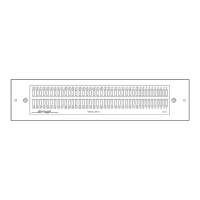
In 1980, after years of hands-on experience and frustration with both
conventional VU and PPM metering, Dorrough research led to the
introduction of the Dorrough Model 40 Loudness Meter. By providing an
easy to understand display showing the relationship between integration of
RMS and peak level display, the model 40 was an overnight success. Today
the model 40 is regarded as the standard in audio monitoring and is used
throughout recording and broadcast facilities around the world.
0
2
0
4
0
6
0
8
0
1
0
0
-
2
0
-
1
0
-
7
-
5
-
3
-
2
-
1
V
U
+
1
+
2
+
3
1
2
3
4
5
6
7


 To Next Page