2 Introduction
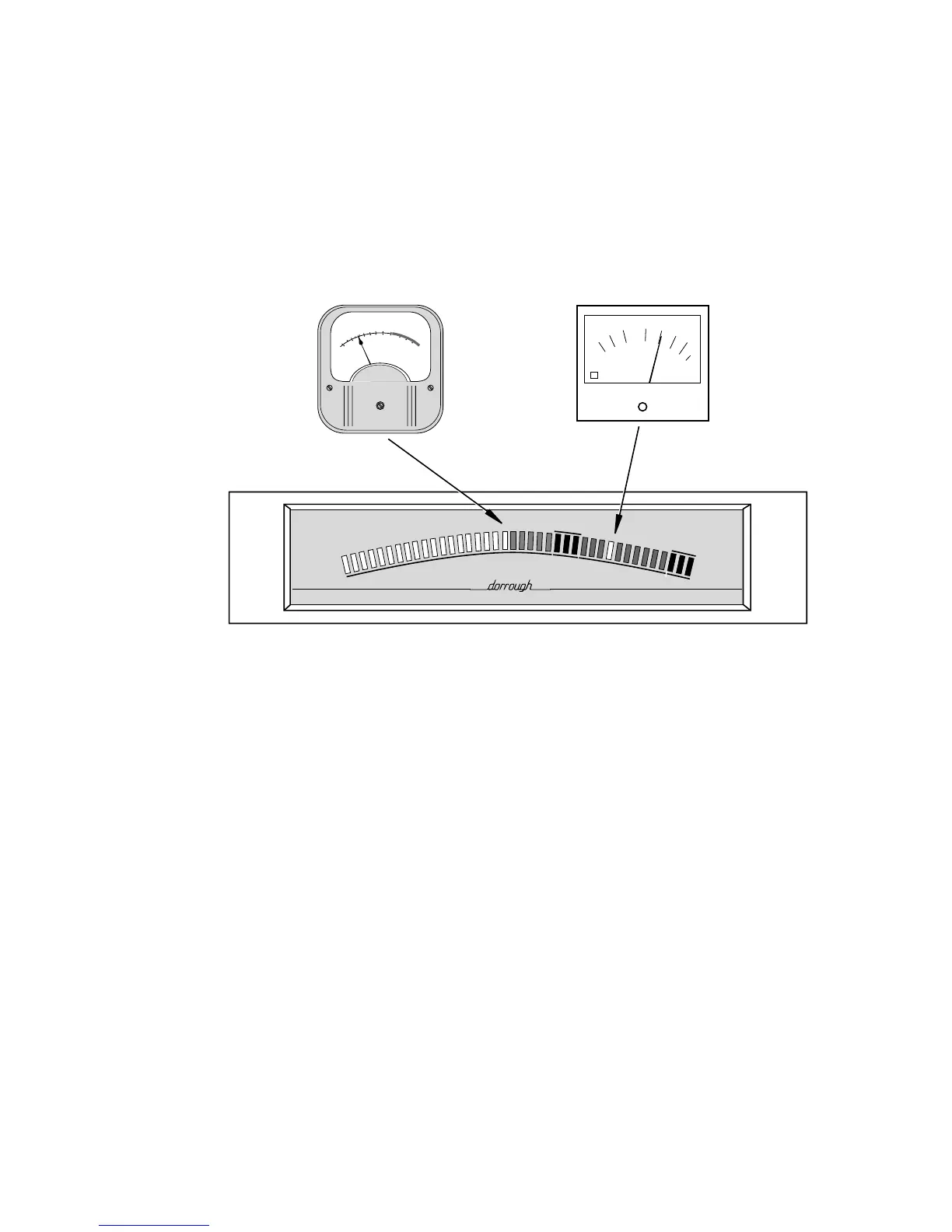
The Dorrough Loudness Meter gives you a much more accurate picture of
the actual energy content of audio program material than conventional
metering. By simultaneously displaying two ballistics, the Dorrough
Loudness Meter shows you the relationship between average and peak.
You need only adjust the program level until either the peak or persistence
reference is reached. This will result in the maximum level, regardless of
program content. Material with or without compression can easily be
matched for the same listening level.
1.2. Digital Audio and the Dorrough Loudness Meter
Into the Digital Domain
The Audio Engineering Society (AES), together with the European
Broadcasting Union (EBU), have established a digital audio interface
standard known as the AES/EBU interface. This standard provides robust
formats for the exchange of digital audio information between professional
audio devices, yet also provides flexibility for specialized applications. The
International Electrotechnical Commission (IEC) has also endorsed a
format based on the AES/EBU standard for consumer digital audio devices.
Briefly, the AES/EBU format standard defines how two channels of audio
information are periodically sampled, uniformly quantized and transmitted
over a twisted wire pair. Left and Right audio channels are multiplexed, and
the channel is self-clocking and self-synchronizing. The format is
independent of sampling frequency and can be used with any sampling
frequency including 32 kHz, 44.1 kHz, and 48 kHz, which are those
recommended by AES for PCM applications.
N
O
R
M
A
L
P
E
A
K
R
A
N
G
E
-
2
5
-
2
2
-
2
0
-
1
8
-
1
6
-
1
4
-
1
2
-
1
0
-
8
-
6
-
4
-
2
0
+
2
+
4
+
6
+
8
+
1
0
+
1
2
+
1
4
N
O
R
M
A
L
P
E
R
S
I
S
T
E
N
C
E
R
A
N
G
E
LOUDNESS MONITOR MODEL 40-A
0
2
0
4
0
6
0
8
0
1
0
0
-
2
0
-
1
0
-
7
-
5
-
3
-
2
-
1
V
U
+
1
+
2
+
3
1
2
3
4
5
6
7


 To Next Page