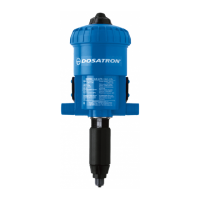
The Dosatron D25RE2 is a water-powered dosing injector designed for precise and consistent injection of concentrates into a water line. This device operates without electricity, using the flow of water as its power source, making it suitable for various applications where accurate dosing is critical.
Function Description
The primary function of the Dosatron D25RE2 is to inject a specified percentage of a concentrate into a main water line. As water flows through the Dosatron, it activates a piston assembly that draws the concentrate from a container and mixes it uniformly with the water. The dosing percentage is adjustable, allowing users to control the concentration of the injected solution. The device is designed to maintain a consistent dosing ratio regardless of variations in water pressure or flow rate, ensuring reliable and accurate application of chemicals, fertilizers, medications, or other liquid concentrates.
The troubleshooting guide provided in the manual addresses three main scenarios:
- Injector is not drawing concentrate, but is clicking: This indicates a mechanical issue preventing suction, even though the internal mechanism is attempting to operate. Common causes include a clogged strainer, issues with the suction hose, or a worn plunger seal.
- Injector is pushing water down into the concentrate container, but is clicking: This points to a problem with the check valve, which is designed to prevent backflow of water into the concentrate.
- Injector is not clicking: This suggests a more significant mechanical failure within the piston or actuator assembly, preventing the device from cycling.
Important Technical Specifications
While specific numerical technical specifications like flow rates or pressure ranges are not explicitly detailed in the provided pages, the manual highlights key components and tools necessary for maintenance and repair, which indirectly point to the device's design and operational characteristics:
- Strap Wrench (Part #: TOOL01): Essential for loosening and tightening the lid, indicating a robust, sealed design that requires mechanical assistance for disassembly.
- Small Tip Phillips Head Screwdriver: Used for various assembly and disassembly tasks, suggesting the use of standard fasteners in its construction.
- Plunger Seal (Part #: J009): A critical component for creating suction and preventing leaks within the dosing mechanism. Its replacement is a common maintenance task for suction issues.
- Check Valve Seal (Part #: J051): Prevents backflow of water into the concentrate container. Its integrity is vital for proper dosing and preventing contamination of the concentrate.
- Check Valve Assy. (Part #: MPDI122): The complete check valve assembly, which includes the seal and other components, is crucial for unidirectional flow of concentrate.
- Actuator Spring (Part #: M238): Part of the internal mechanism that drives the piston, responsible for the "clicking" sound and the reciprocating motion.
- Piston Shell (Part #: P421): The main body of the piston assembly, which moves within the Dosatron to draw and inject concentrate. Wear on this part can lead to inefficient operation.
- Push Rod O-ring (Part #: J020): Another sealing component, important for the smooth operation and sealing of the push rod within the piston assembly.
The use of these specific parts indicates a precision-engineered device with replaceable components, allowing for extended service life through maintenance.
Usage Features
The Dosatron D25RE2 is designed for straightforward operation and maintenance:
- Water-Powered Operation: Eliminates the need for electricity, making it versatile for use in remote locations or environments where electrical power is a concern.
- Adjustable Dosing: While not explicitly detailed on how to adjust, the nature of a dosing injector implies an adjustable ratio for different concentrate requirements.
- Consistent Dosing: Designed to maintain a stable injection rate irrespective of water flow or pressure fluctuations, ensuring reliable application.
- Easy Concentrate Connection: The suction hose and barb system allows for simple connection to a concentrate container.
- Visual Troubleshooting: The manual emphasizes visual inspection of components like the strainer, plunger seal, and check valve, enabling users to identify common problems.
Maintenance Features
The provided troubleshooting guide serves as a comprehensive maintenance manual, detailing step-by-step procedures for common issues:
- Strainer Cleaning (Step 1, Part 1): A simple initial check and cleaning procedure for the most common cause of no suction, highlighting ease of access for routine maintenance.
- Suction Hose Inspection and Trimming (Steps 2-5, Part 1): Guides users on how to check and rectify issues with the suction hose, including trimming a small section to improve suction, suggesting a practical, field-repairable design.
- Plunger Seal Replacement (Steps 10-12, Part 1): Detailed instructions for inspecting and replacing the plunger seal (J009), a key wear part. This involves disassembling the lid and piston, demonstrating that critical internal components are accessible for service.
- Check Valve Inspection and Replacement (Steps 3-6, Part 2): Provides a clear process for checking and replacing the check valve barb (J051) and the entire check valve assembly (MPDI122). This involves prying out the assembly with a pick (TOOL02), indicating a design that allows for component removal and reinstallation.
- Actuator Spring and Piston Shell Inspection/Replacement (Steps 6-9, Part 3): Guides users through inspecting the actuator springs (M238) and the piston shell (P421) for wear or damage. This involves more extensive disassembly of the piston assembly, including removing screws and retainers, showcasing the modular design of the internal mechanism.
- Push Rod O-ring Replacement (Step 14, Part 3): Instructions for replacing the push rod o-ring (J020), another critical seal for proper piston function.
- Reassembly Instructions: Each troubleshooting section concludes with detailed reassembly steps, ensuring that users can put the device back together correctly after maintenance.
- Safety Recommendations: Emphasizes the importance of proper protection (gloves, eye wear, aprons) during disassembly, indicating a commitment to user safety during maintenance.
- QR Code Support: Provides QR codes for accessing video tutorials, offering an additional layer of support for visual learners and complex procedures, enhancing the user's ability to perform maintenance effectively.
Overall, the Dosatron D25RE2 is presented as a robust, maintainable dosing injector with a design that facilitates troubleshooting and part replacement, ensuring a long operational lifespan.


 To Next Page

 General