
 Need help?
Do you have a question about the Dräger Pac 5000 and is the answer not in the manual?
Check remaining instrument life by pressing keys when turned off.
Start the instrument's usable life by pressing and holding the + key for 3 seconds.
Press and hold the OK key to turn on the instrument; it performs a self-test.
Check for notice icon, clip instrument, ensure gas opening is clear.
Connect test gas, press '+' for 3s to enter bump test mode, and open valve.
Display shows high concentration or negative drift; indicates alarms and life signal.
Simultaneously hold both keys for approximately 2 seconds to turn off.
Stores 60 events; data downloadable via PC connection.
Connect Pac 5000 to PC for calibration and configuration using software.
Set individual operation periods like 'calibration due date' via PC.
Alarms activate when thresholds A1 or A2 are exceeded; vibrating, LED, and audible alerts.
Low battery warnings with audible alarms and LED flashes.
Replace the lithium-ion battery with specific types, not in explosion-hazard areas.
Caution: Do not throw into fire, charge, or open; dispose of as special waste.
Warning period before instrument's usable life expires.
List of error codes, causes, and remedies for instrument malfunctions.
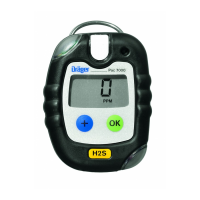
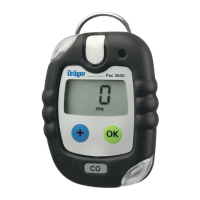
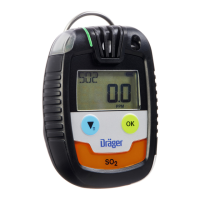
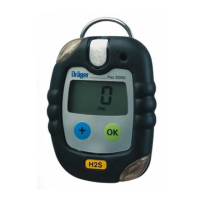
The Dräger Pac 5000 is a personal gas alarm designed for use in the workplace, providing continuous monitoring for Carbon Monoxide (CO), Hydrogen Sulfide (H2S), and Oxygen (O2) in potentially hazardous environments. Its primary function is to alert the user to dangerous gas concentrations through a combination of visual, audible, and vibrating alarms.
The device is equipped with a single sensor that measures the concentration of a specific gas (CO, H2S, or O2, depending on the model). It continuously displays the current gas concentration on its screen. The Pac 5000 features two alarm thresholds, A1 and A2, for each gas. When the gas concentration exceeds the A1 threshold, the device activates a blinking LED, an audible alarm, and a vibrating alarm. If the concentration further increases and surpasses the A2 threshold, the LED and audible alarm will repeat in a double pattern, while the vibrating alarm continues.
The alarms can be configured as either "acknowledgeable" or "latching." If acknowledgeable, pressing the [OK] button for one second will silence the alarm and LED. If latching, the alarm will only deactivate once the gas concentration falls below the alarm threshold and the [OK] button is pressed for one second. If the alarm is not latching, it will deactivate as soon as the concentration drops below the threshold.
Beyond gas alarms, the Pac 5000 also provides battery pre-alarms and main alarms. A battery pre-alarm is indicated by an audible alarm, a blinking LED, and a "low battery" icon. This pre-alarm can be acknowledged by pressing [OK] for one second, and the battery is expected to last for approximately one more week. A battery main alarm, indicated by a repeating pattern of two tones and a blinking LED, is not acknowledgeable and will cause the instrument to automatically turn off after about one minute.
The device also incorporates an event logger that stores up to 60 events, such as bump test results, alarm activations, and other operational data. This data can be downloaded to a PC using a connecting cradle and specialized software (Pac Vision or Gas Vision).
The Pac 5000 is designed for straightforward operation. To activate a new instrument, the user presses and holds the [+] button for approximately three seconds until a countdown appears, initiating the device's usable life. To turn the instrument on for daily use, the [OK] button is pressed and held until a countdown completes. During startup, the device performs a self-test, illuminating all display segments, activating the LED, audible alarm, and vibrating alarm in sequence, allowing the user to verify their functionality. It also displays the software version, gas name, remaining operational days, and alarm limits. A sensor warm-up time of up to five minutes is required after initial activation, during which the gas name flashes.
Before entering a potentially hazardous area, users are advised to check for a notice icon [!] on the display. If lit, a bump test is recommended. The instrument should be clipped to clothing, ensuring the gas opening is not covered and is near the user's breathing area.
A bump test can be performed by connecting the Pac 5000 to a test gas cylinder or a Dräger Bump Test Station. Pressing and holding [+] for three seconds initiates the bump test mode. The user then introduces a test gas with a concentration higher than the alarm threshold. If an alarm occurs, pressing [OK] for one second completes the test, and the [!] icon is removed. If no alarm occurs within one minute, the instrument indicates failure with beeps and an [X] icon.
During operation, if the measurement range is exceeded or a negative drift occurs, the display will show specific symbols. A continuous function is indicated by a "life signal," which is a beep every 60 seconds if configured. To turn the instrument off, both keys are simultaneously held until a countdown completes, after which the alarm and LED activate momentarily before the device shuts down.
The device also features an adjustable operation timer, which can be configured via PC software to set calibration due dates, inspection dates, or "out of order" dates. A "usable life alarm" warns the user when the instrument's operational life is nearing its end, displaying the remaining days. This message can be acknowledged by pressing [OK] for one second to continue using the device.
The Pac 5000 requires regular calibration and bump testing, which should be conducted according to local regulations. Calibration and configuration can be performed by connecting the device to a PC using a connecting cradle or the E-Cal System, utilizing Dräger's Pac Vision or CC Vision software. This allows for individual configuration of settings and adjustment of the operation timer.
The instrument contains a replaceable lithium-ion battery. Battery replacement should only be performed outside of explosion-hazard areas, using specific Duracell DL 123 Lithium Type CR123A, 3 V batteries. The process involves unscrewing four screws from the back case, opening the front case, removing the depleted battery, inserting the new battery with correct polarity, and then reassembling the device. Exhausted batteries must be disposed of as special waste in accordance with local regulations and should never be thrown into fire, charged, or opened.
 General
| Sensor Type | Electrochemical |
|---|---|
| Resolution | 1 ppm |
| Operating Temperature | -20°C to +50°C |
| Protection Class | IP 54 |
| Response Time | < 15 seconds |
| Alarm Type | Visual and audible alarms |
| Data Logging | Yes |
| Battery Life | Approx. 2 years (continuous operation) |


 To Next Page