EasyManua.ls Logo

DRAKE TR-4CW - Chapter IV: Theory of Operation; General Theory and Receiver Circuitry

DRAKE TR-4CW
42 pages
Print Icon
To Next Page IconTo Next Page
To Previous Page IconTo Previous Page
Loading...
DRAKE
CHAPTER
IV
THEORY
OF
OPERATION
4-1.
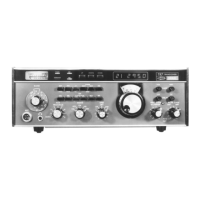
GENERAL.
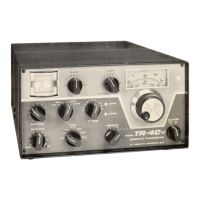
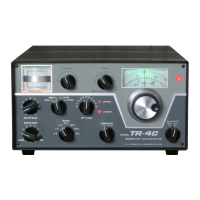
The
TR—4C
is
a
300
Watt
HF
single
sideband
trans-
ceiver
which
covers
the
80
through
10
meter
ama-
teur
bands.
AM
and
CW
modes
are
also
included.
The
TR—4C
requires
either
an
R.
L.
Drake
AC—4,
120
V
AC
power
supply,
or
an
R.
L.
Drake
DC—4,
12
V
DC
power
supply.
The
TR—4C
features
a
high-stability
linear
permeability
tuned
VFO
and
two
8
pole
crystal
lattice
filters
for
sideband
selec-
tion.
Some
of
the
circuits
are
common
to
both
the
transmit
and
receive
functions.
Refer
to
the
block
diagram
figure
4-1
and
the
schematic
diagram
figure
5-5
as
required
to
supplement
the
following
discussion.
4-2.
RECEIVER
CIRCUITRY.
A
signal
entering
the
antenna
terminal
passes
through
the
antenna
switching
contacts
of
the
relay
and
is
applied
to
the
grid
of
the
RF
amplifier
V7
through
the
selectivity
of
the
L/C
network
formed
by
T9,
T10
anda
section
of
the
RF
TUNE
capacitor
C37.
After
being
amplified,
it
is
passed
through
an
additional
L/C
network
consisting
of
T7,
T8
and
the
remaining
section
of
C37,
to
the
grid
of
the
mixer
V3B.
At
this
point
it
is
combined
with
a
sig-
nal
from
the
premixer
system
of
the
required
fre-
quency
to
yield
a
9.0
MHz
IF.
The
premixer
system
consists
of
a
4.9-5.5
MHz
solid
state
permeability
tuned
VFO,
a
buffer
Q2,
a
switchable
overtone
crystal
oscillator
VIA,
the
premixer
pentode
V1B
and
a
cathode
follower
V3A.
The
VFO
signal
output
is
applied
to
the
grid
of
the
premixer
pentode
through
the
buffer
Q2
and
its
associated
circuitry.
For
80
and
20
meter
operation,
the
VFO
signal
bypasses
the
premixer
and
is
con-
nected
through
the
cathode
follower
to
the
mixer.
On
40,
15
and
10
meters
a
signal
from
the
crystal
oscillator
heterodynes
with
the
VFO
in
the
pre-
mixer,
V1B,
to
produce
the
desired
injection
frequency.
On
40
meters,
for
example,
a
21.5
MHz
overtone
crystal
and
the
appropriate
coil
L1
are
switched
into
the
crystal
oscillator
circuit.
The
output
from
the
oscillator
is
coupled
into
the
pre-
mixer
pentode
where
it
heterodynes
with
the
4.9-
5.5
MHz
VFO
to
produce
an
output
frequency
of
16.0-16.6
MHz.
This
output
is
coupled
through
the
16.0-16.6
MHz
bandpass
coupler,
T3,
and
to
the
cathode
follower,
V3A.
On
15
meters,
a
35.5
MHz
crystal
is
used with
a
30.0-30.6
MHz
coupler,
T2,
and
on
the
three
10
meter
ranges,
42.5,
43.0
and
43.6
MHz
crystals
are
used
with
a
37.0-38.7
MHz
coupler,
T1.
The
9.0
MHz
output
of
the
mixer,
V3B,
passes
through
the
impedance
matching
transformer
T6
into
the
upper
or
lower
sideband
crystal
filter.
The
setting
of
the
SIDEBAND
knob
determines
which
crystal
filter
is
used.
From
the
crystal
filter
the
signal
passes
through
the
impedance
matching
transformer,
T13,
and
is
amplified
by
the
9
MHz
receiver
IF
amplifier
system,
V11
and
V12
and
the
IF
transformers
Tl]
and
T12.
The
output
of
T12
is
applied
to
the
AGC
amplifier,
V13A,
to
the
product
detector,
V16,
and
to
the
diode
detector,
V2.
The
AGC
amplifier
V13A
is
biased
beyond
cutoff
to
provide
an
AGC
delay.
When
sufficient
RF
volt-
age
from
T12
is
applied
to
its
grid,
plate
current
flows
during
part
of
the
cycle.
This
causes
ampli-
fied
negative
voltage
to
appear
across
its
plate
load
resistor
R63,
thus
charging
C115.
This
negative
control
voltage
is
applied
to
the
grids
of
V7,
V11
and
V12.
C115
discharges
through
R63
with
a
time
constant
of
approximately
one
second.
Rotating
the
RF
Gain
control
counterclockwise
applies
in-
creasingly
more
negative
bias
to
the
AGC
control-
led
grids,
thus
limiting
their
maximum
gain.
The
product
detector
tube,
V16,
consists
of
a9
MHz
crystal
oscillator
formed
by
the
cathode,
grid
1
and
grid
2.
A
product
detector
is
formed
by
the
cathode,
grid
3,
and
the
plate.
The
IF
signal
is
applied
to
grid
3
where
it
heterodynes
with
the
BFO
voltage
in
the
tube.
The
resulting
audio
signal
is
of
sufficient
amplitude
to
drive
the
audio
pre-
amplifier
transistor,
Q5,
which
drives
the
audio
output
tube,
V17.

Related product manuals