- 10 -
BASIC WOODTURNING
USING WOODWORKING CHISELS:
Professional woodturning chisels have handles approximately 250mm long. This
provides the operator with good grip and leverage. A sharp chisel will be much easier
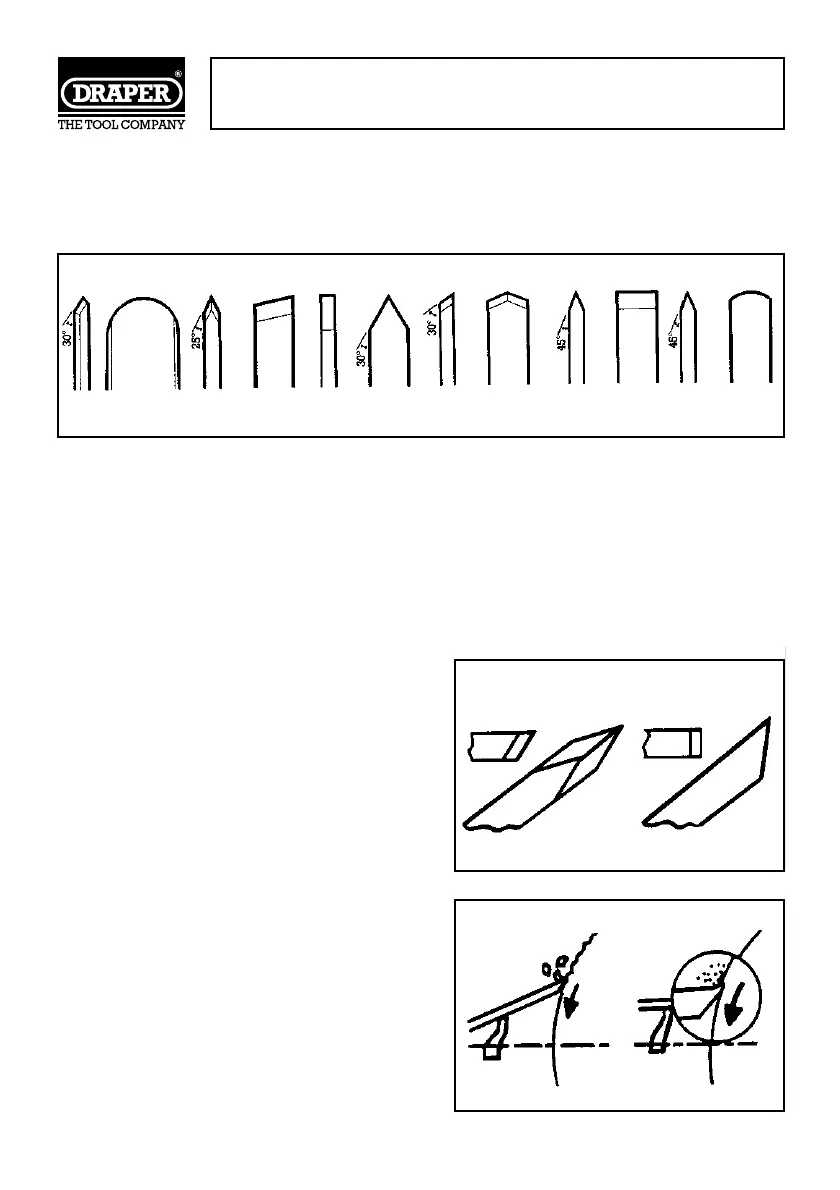
to work with and will give the job a cleaner finish. Fig. 20 shows the six most commonly
used types of turning chisel.
THE THEORY OF TURNING:
There are two types of turning chisel. These are:
1. Those intended primarily for cutting,
2. Those used only for scraping.
The cutting chisels are the gouge, skew and parting type. These are sharpened to a
razor edge by honing on both sides.
The scraping chisels are the flat nose, round nose and spear point. These are not honed
on the flat sides - the wire edges produced by scraping are left on to aid in the
scraping process. Fig.21. Shows the two types of chisel.
CUTTING AND SCRAPING:
To make a cut, the chisel should be held so
that the sharp edge actually digs into the
revolving workpiece, shavings should now
peel off. To scrape, the chisel should be held
at a right angle to the surface of the
workpiece, fine pieces of wood will be
produced when scraping instead of shavings.
See Fig.22.
Many operations require the cutting chisel to
be used for scraping but scraping chisels are
very rarely used for cutting. Scraping will
blunt/dull a chisel much faster especially
when using razor sharp cutting chisels.
Cutting is much faster than scraping and
produces a much smoother finish. Cutting is
more difficult than scraping, but scraping is
more precise and easier to control.
Fig.20.
Fig.21.
Fig.22.
GOUGE SKEW PARTING
TOOL
SPEAR
POINT
FLAT NOSE ROUND
NOSE



 To Next Page