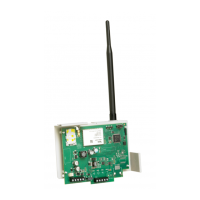
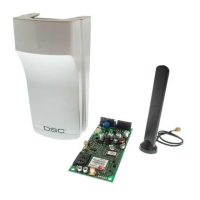
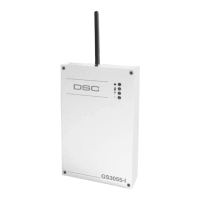
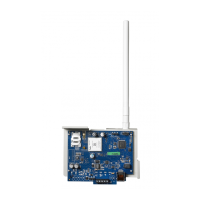
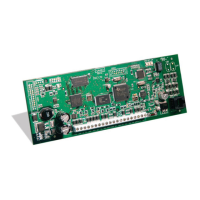
General Information 3G Alarm Communicator Installation Manual
6
GENERAL INFORMATION
All versions of the HSPA/3G and Ethernet Alarm Communicator, operate on a HSPA/3G network and are housed inside the Self Con-
tained Wireless Alarm System Model SCW9055/9057. The Communicators use an Internal Antenna only.
Each version of Alarm Communicators covered by this Installation Manual are described below:
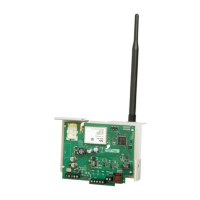
3G2075: A High Speed Packet Access/Global System for Mobile (HSPA/3G) wireless Alarm Communicator that sends alarm communication
to Sur-Gard System I, II, III (SG-DRL3IP), and IV (SG-DRL4IP) central station receivers via a HSPA/3G digital cellular network.
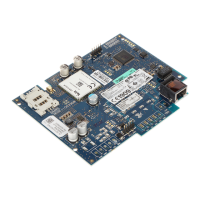
TL2753G: Is a dual-path Cellular/Ethernet Alarm Communicator that sends alarm communication to Sur-Gard System I, II, III, and IV
central station receivers through Ethernet/Internet or a HSPA/3G digital cellular network.
The dual path Communicator can be used as either a backup or primary Communicator. The Communicator supports Internet Protocol
(IP) transmission of panel and internal events over Ethernet/Internet and/or HSPA/3G.
For North America the following model names are available: 3G2075-NA and TL2753G-NA.
CAUTION:
• Do not stay close to the equipment during device operation and to do not touch any exposed wires and other conductive surfaces,
• Recycle the battery according to the local rules and regulations.
NOTE: Prior to installation of the 3G2075 or TL2753G Communicator, confirm with your local carrier that the HSPA/3G network is
available and active in the area where the Communicator will be installed, and that the location provides a radio signal strength
that is adequate for uninterrupted service.
FEATURES
UL/ULC INSTALLATION REQUIREMENTS
• For ULC Residential fire and burglary applications the 3G2075/TL2753G can be used as primary communication channel via either
Cellular or Ethernet (as applicable) or as a back-up in conjunction with the Digital Alarm Communicator Transmitter (DACT). Test
transmission every 24hours shall be enabled on each channel.
• For UL Residential fire and burglary applications the 3G2075/TL2753G can be used as primary communication channel via either
Cellular or Ethernet, or as a back-up in conjunction with the DACT. (30 day test transmission is required on each channel).
COMMUNICATOR FREQUENCY BANDS FOR NORTH AMERICA
COMMUNICATOR TECHNICAL SPECIFICATIONS
• 128-bit Advanced Encryption Standard (AES) encryption via HSPA/3G and Ethernet/Internet.
• Activating, initializing and remote programming through Connect24.
• Back up or primary HSPA/3G alarm communication.
• Does not require an external HSPA/3G antenna.
• Ethernet LAN/WAN 10/100 BaseT (TL2753G only).
• Full event reporting to central station.
• RS422 is the connection for interactive hub/gateway.
• Fully redundant Ethernet/Internet and HSPA/3G Dual-path Alarm Communication (TL2753G only).
• Individual Ethernet and/or HSPA/3G Periodic test transmission.
• 2-way audio (listen-in feature) provided over Cellular.
• Integrated call routing.
• Remote Firmware upgrade capability of the Communicator and Panel Firmware via Ethernet and/or HSPA/3G radio.
• Dual-Band Operation: 850 MHz, and 1900 MHz. (North America only).
• CID and SIA format reporting.
• Subscriber Identity Module (SIM) card included with Communicator. (North America only).
• Supervision heartbeats via HSPA/3G and/or Ethernet/Internet.
Table 2: 3G Frequency Bands - North America and International
Transmit Direction Cellular 850 North America PCS 1900 North America
Transmit Frequency 824 MHz to 849 MHz 1850 MHz to 1910 MHz
Receive Frequency 869 MHz to 894 MHz 1930 MHz to 1990 MHz


 To Next Page