Product: DS3 SPMDS3111101
23
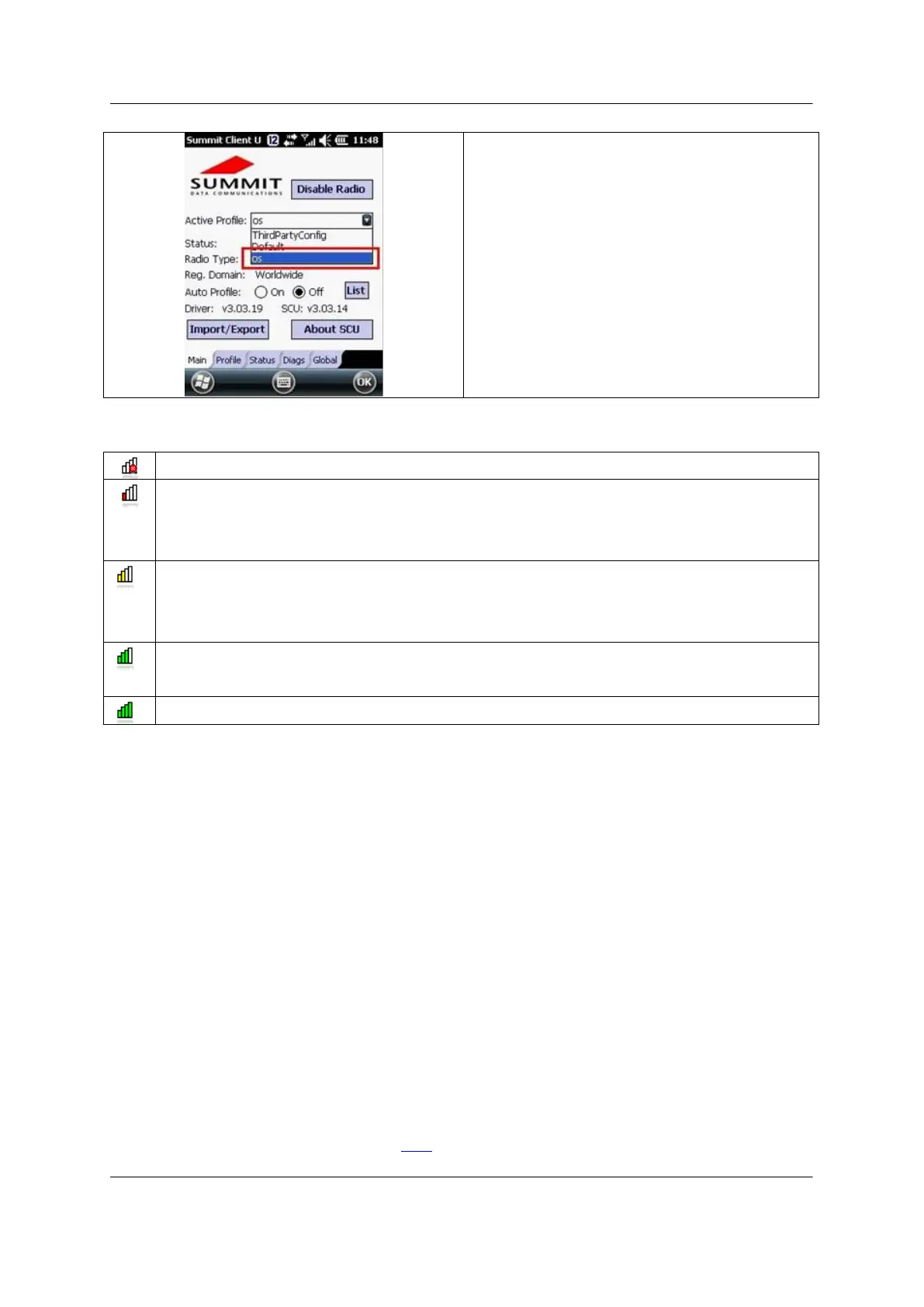
To connect the saved SSID, tap Active Profile
and your assigned SSID.
SCU Tray Icon
The radio is not associated/authenticated to an AP
The signal strength (RSSI) for the current AP (to which the radio is associated) is -90 dBm
or weaker, which means that a Summit 802.11b/g radio will operate at 802.11b data rates
only
The RSSI for the current AP is stronger than -90 dBm but not stronger than -70 dBm,
which means that a Summit radio will operate at 802.11g or 802.11a data rates that are
less than 54 Mbps
The RSSI for the current AP is stronger than -70 dBm but not stronger than -50 dBm,
which means that a Summit radio should operate consistently at 54 Mbps
The RSSI for the current AP is stronger than -50 dBm
Wi-Fi Roaming
Summit provides two complementary sets of roaming algorithms to provide for more reliable
connectivity. Those sets of algorithms are
- Standard: which manages roaming behavior under typical conditions. Users can adjust
Standard Roaming parameters to customize roaming behavior for a particular
environment.
- Aggressive: which manages roaming behavior when the station device is in areas of
particularly low coverage and is in imminent jeopardy of losing its connection to the
network infrastructure. Users may not adjust Aggressive Roaming parameters but may
disable this feature.
7-1 Standard Wi-Fi Roaming
The standard roaming algorithm is employed when Summit-enabled station devices are operating
in areas of relatively strong RF coverage. This roaming algorithm is based on the signal strength,
or Received Signal Strength Indication (RSSI, which is measured in dBm) of the current AP (the


 To Next Page