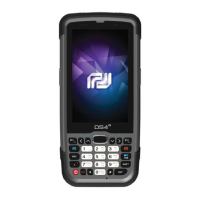
Product: DS3 SPMDS3111101
24
access point to which the station is currently associated) and any other APs that are within range
of the station. The Summit radio calculates a moving-average RSSI for the current AP and treats it
as the "current RSSI". This value is displayed on the Status tab of the Summit Client Utility (SCU).
A Standard Roam scenario would be as follows: A station that is associated to an AP sees the RSSI
go below the -75 dB Roam Trigger value, e.g. it goes to -80 dB. This prompts it to initiate a roam
scan looking for a better AP ("better" in terms of signal strength). If it finds one, it will roam to it
if the RSSI on the target AP is greater than the current AP by the Roam Delta value and it has
been associated to the current AP for at least the Roam Period value.
Changing these parameters allows users to customize the roaming behavior of the station for
environments that might be somewhere on a continuum between two extremes: if an
environment has under-coverage (i.e., relatively few APs for the size of the facility) then the user
can set the Roam Trigger to look for a new AP sooner and set the Roam Delta and Roam Period
to smaller values so that the station will roam more quickly when it finds an alternative to the
current AP. On the other hand, if an environment has over-coverage (i.e., a relatively large number
of APs for the size of the facility) the user can set the Roam Trigger to a high value so that the
station will only start looking for a new AP if the current AP signal gets very low, the new AP has
a much stronger signal (Roam Delta), and the station has been associated to the current AP for
some larger amount of time (30 seconds perhaps). How a given customer will configure these
settings will depend on their RF environment, but also on the types of devices they use (laptop vs.
data terminal for example), how those devices are used (truck-mounted going 25 MPH (40 KPH)
or carried on a belt and being walked around), and what types of data they handle (voice/video
vs. low data rate/latency insensitive bar-code scanning).
The administrator can configure three parameters for the standard roaming algorithm:
- Roaming Trigger: Roam trigger indicates the signal strength (RSSI) (in dBm) at which the
radio scans for an access point with a better signal strength. When scanning for a
different access point, the radio looks for one with a RSSI at the indicated roam delta
dBm level or stronger.
- Roaming Delta: Roam delta indicates the signal strength (RSSI) level (in dBm) that the
radio looks for in a different access point (after the roam trigger is met) before it
attempts to roam to the new access point
- Roaming Period: Roam period indicates the amount of time a radio collects RSSI scan
data (after association or a roam scan) before it considers roaming to a different access
point.
7-2 Aggressive Wi-Fi Roaming
Aggressive Roaming is employed when Summit-enabled station devices are operating in areas of
relatively weak RF coverage such as the edge of a coverage area. Aggressive roaming uses


 To Next Page