This information is provided on the System Labels located on the inside front door and the right side of the UPS. See
Chapter 2 for a complete listing of the Three Phase Inverter specications. This manual provides an overview of the Three
Phase Inverter components and their functions. The appearance and purpose of operator controls and indicators is de-
scribed with procedures for operation, start-up, shutdown and basic maintenance included.
1.2.1. UNINTERRUPTIBLE POWER SUPPLY SYSTEM (UPS) - All components within the UPS Module Cabinet
and associated batteries, which function as a system to provide continuous, conditioned AC power to a load.
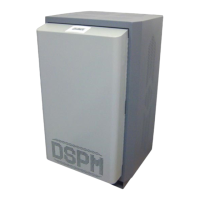
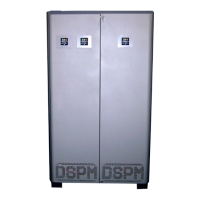
1.2.2. UPS MODULE CABINET - The metal enclosure which contains the Rectier / Charger, Inverter, Static Trans-
fer Switch, Internal Bypass line, operator controls, batteries (up to 30kVA models only) and internal control systems
required to provide specied AC power to a load.
1.2.3. UPS MODULE - The Rectier / Charger and Inverter assemblies which, under the direction of the internal
control system and operator controls, provide specied AC power to a load.
1.2.4. RECTIFIER / CHARGER - The UPS components which contain the equipment and controls necessary to
convert input AC power to regulated DC power required for battery charging and for supplying power to the Inverter.
1.2.5. INVERTER - The UPS components which contain the equipment and controls necessary to convert DC
power from the Rectier / Charger, or the battery, to AC power required by the critical load.
1.2.6. STATIC TRANSFER SWITCH - (OPTIONAL) The device that connects the critical load to the bypass line
when the Inverter cannot supply continuous power.
1.2.7. BYPASS LINE - The line, which conducts electricity directly from the input power source to the critical load
during Maintenance or whenever the UPS is not completely operational.
1.2.8. AC INPUT POWER - Is the power provided by the electrical utility company, or auxiliary generator, which is
connected to the UPS for supplying the critical load and recharging the battery.
1.2.9. BATTERY - The rechargeable battery strings that supply DC power to the inverter to maintain continuous AC
power to the load during AC input power failure conditions.
1.2. DEFINITIONS
1.3.1. Standby Mode
After power is applied, the system is placed in STANDBY mode and a self-check starts. During this period, the start
subroutine checks for the input voltage and proper operation of the inverter and bypass SCR’s. After the routine is
completed and check conrmed OK, the system stays in bypass waiting for the utility to fail. When a power outrage
occurs, the load is transferred to the inverter.
1.3.2. Online Mode
The input contactor K1 receives a closing signal, connecting input power to the DC supply transformer. The DC
rectier supplies the battery charger, Control Board and the DC/AC inverter circuit. The battery charger is then ac-
tivated allowing the batteries to be continuously charged. The on-line DC/AC inverter converts the DC voltage to a
pulse-width-modulation (PWM) waveform. This waveform is ltered and reconstructed to a desired AC output and
the load is transferred to the inverter.
1.3 THEORY OF OPERATION
Title: Micro
Doc No.: 018-1000-02
Description: Emergency Lighting Inverter User’s Manual Date: 07/26/2016
Rev: NR
1.877.DSPM.POWERPhone : 1.877.377.6769-
909.930.3335Fax:
www.dspmanufacturing.com
Website:
techsupport@dspmanufacturing.com
E-Mail:
13
Title: Three Phase 208 or 208Y/120Vac
Doc No.: 018-6000-00
Description: Emergency Lighting Inverter User’s Manual
Rev: NR
Date: 08/12/2022
Phone :
Website:
E-Mail:
Fax:
1.877.DSPM.POWER-1.877.377.6769
1.877.DSPM.POWER-1.877.377.6769
www.dspmanufacturing.com
techsupport@dspmanufacturing.com


 To Next Page