EasyManua.ls Logo

Dual 506 - Tone Arm and Bearings; Tone Arm Removal (Complete); Tone Arm;Spring Housing Removal; Tone Arm Bearing Adjustment

Dual 506
12 pages
Print Icon
To Next Page IconTo Next Page
To Previous Page IconTo Previous Page
Loading...
Rotate
the
knob
16
to
move
the
belt
pulley
112.
This
rotary
motion
is
transmitted
by
the
toothed
belt
109
to
the
belt
pulley
1
105,
see
Fig.
2.
As
a
result,
the
counter
bearing
113
and
the
taper
sleeve
of
the
motor
pulley
116
are
shifted
up
or
down.
As
an
effect
of
the
taper
sleeve,
the
motor
pulley
diameter
is
reduced
or
increased,
respectively,
thus
permitting
to
change
the
rated
speed
within
the
range
of
±
3
%.
Stroboscope
Accurate
setting
of
the
platter
speeds
33
1/3
rpm
and
45
rpm
can
be
checked
during
play
with
the
aid
of
the
stroboscope
de-
vice.
On
the
platter
4
rotating
at
exactly
the
desired
speed,
the
lines
of
the
stroboscope
appear
to
stand
still.
If
the
lines
of
the
stroboscope
move
in
the
direction
of
the
platter
rotation,
the
platter
speed
is
too
high.
If
the
lines
move
backwards
the
platter
is
rotating
more
slowly
than
nominal
speed.
The
four
rows
of
stroboscope
marks
on
the
edge
of
the
platter,
taken
botton
to
top,
are
for
the
following
speeds:
331/3
rpmat
60
Hz,
331/3
rpm
at
50
Hz,
45
rpm
at
60
Hz,
45
rpm
at
50
Hz.
Adjustment
of
the
platter
speed
is
carried
out
using
the
regulating
knob
16.
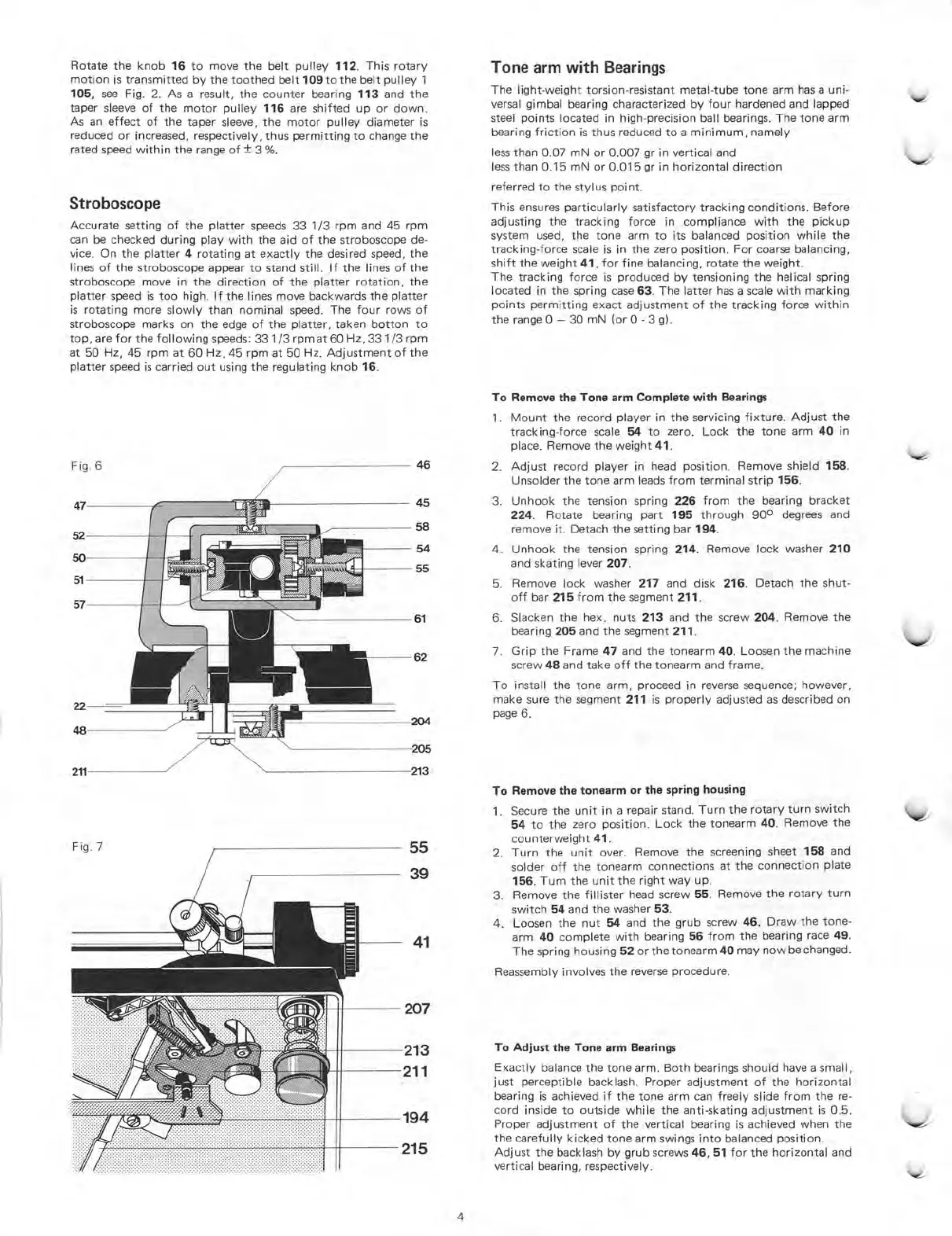
Fig.
6
46
Fig.
7
55
39
41
207
Tone
arm
with
Bearings
The
light-weight
torsion-resistant
metal-tube
tone
arm
has
a
uni-
versal
gimbal
bearing
characterized
by
four
hardened
and
lapped
steel
points
located
in
high-precision
ball
bearings.
The
tone
arm
bearing
friction
is
thus
reduced
to
a
minimum,
namely
less
than
0.07
mN
or
0.007
gr
in
vertical
and
less
than
0.15
mN
or
0.015
gr
in
horizontal
direction
referred
to
the
stylus
point.
This
ensures
particularly
satisfactory
tracking
conditions.
Before
adjusting
the
tracking
force
in
compliance
with
the
pickup
system
used,
the
tone
arm
to
its
balanced
position
while
the
tracking-force
scale
is
in
the
zero
position.
For
coarse
balancing,
shift
the
weight
41,
for
fine
balancing,
rotate
the
weight.
The
tracking
force
is
produced
by
tensioning
the
helical
spring
located
in
the
spring
case
63.
The
latter
has
a
scale
with
marking
points
permitting
exact
adjustment
of
the
tracking
force
within
the
range
0-30
mN
(or
0
-
3
g).
To
Remove
the
Tone
arm
Complete
with
Bearings
1.
Mount
the
record
player
in
the
servicing
fixture.
Adjust
the
tracking-force
scale
54
to
zero.
Lock
the
tone
arm
40
in
place.
Remove
the
weight
41.
2.
Adjust
record
player
in
head
position.
Remove
shield
158.
Unsolder
the
tone
arm
leads
from
terminal
strip
156.
3.
Unhook
the
tension
spring
226
from
the
bearing
bracket
224.
Rotate
bearing
part
195
through
90
0
degrees
and
remove
it.
Detach
the
setting
bar
194.
4.
Unhook
the
tension
spring
214.
Remove
lock
washer
210
and
skating
lever
207.
5.
Remove
lock
washer
217
and
disk
216.
Detach
the
shut-
off
bar
215
from
the
segment
211.
6.
Slacken
the
hex.
nuts
213
and
the
screw
204.
Remove
the
bearing
205
and
the
segment
211.
7.
Grip
the
Frame
47
and
the
tonearm
40.
Loosen
the
machine
screw
48
and
take
off
the
tonearm
and
frame.
To
install
the
tone
arm,
proceed
in
reverse
sequence;
however,
make
sure
the
segment
211
is
properly
adjusted
as
described
on
page
6.
To
Remove
the
tonearm
or
the
spring
housing
1.
Secure
the
unit
in
a
repair
stand.
Turn
the
rotary
turn
switch
54
to
the
zero
position.
Lock
the
tonearm
40.
Remove
the
counterweight
41.
2.
Turn
the
unit
over.
Remove
the
screening
sheet
158
and
solder
off
the
tonearm
connections
at
the
connection
plate
156.
Turn
the
unit
the
right
way
up.
3.
Remove
the
fillister
head
screw
55.
Remove
the
rotary
turn
switch
54
and
the
washer
53.
4.
Loosen
the
nut
54
and
the
grub
screw
46.
Draw
the
tone
-
arm
40
complete
with
bearing
56
from
the
bearing
race
49.
The
spring
housing
52
or
the
tonearm
40
may
now
be
changed.
Reassembly
involves
the
reverse
procedure.
213
To
Adjust
the
Tone
arm
Bearings
211
Exactly
balance
the
tone
arm.
Both
bearings
should
have
a
small,
just
perceptible
backlash.
Proper
adjustment
of
the
horizontal
bearing
is
achieved
if
the
tone
arm
can
freely
slide
from
the
re-
cord
Inside
to
outside
while
the
anti-skating
adjustment
is
0.5.
Proper
adjustment
of
the
vertical
bearing
is
achieved
when
the
the
carefully
kicked
tone
arm
swings
into
balanced
position.
Adjust
the
backlash
by
grub
screws
46,
51
for
the
horizontal
and
vertical
bearing,
respectively.
194
215
4

Related product manuals