EasyManua.ls Logo

Dual 601 - Anti-Skating Device

Dual 601
20 pages
Print Icon
To Next Page IconTo Next Page
To Previous Page IconTo Previous Page
Loading...
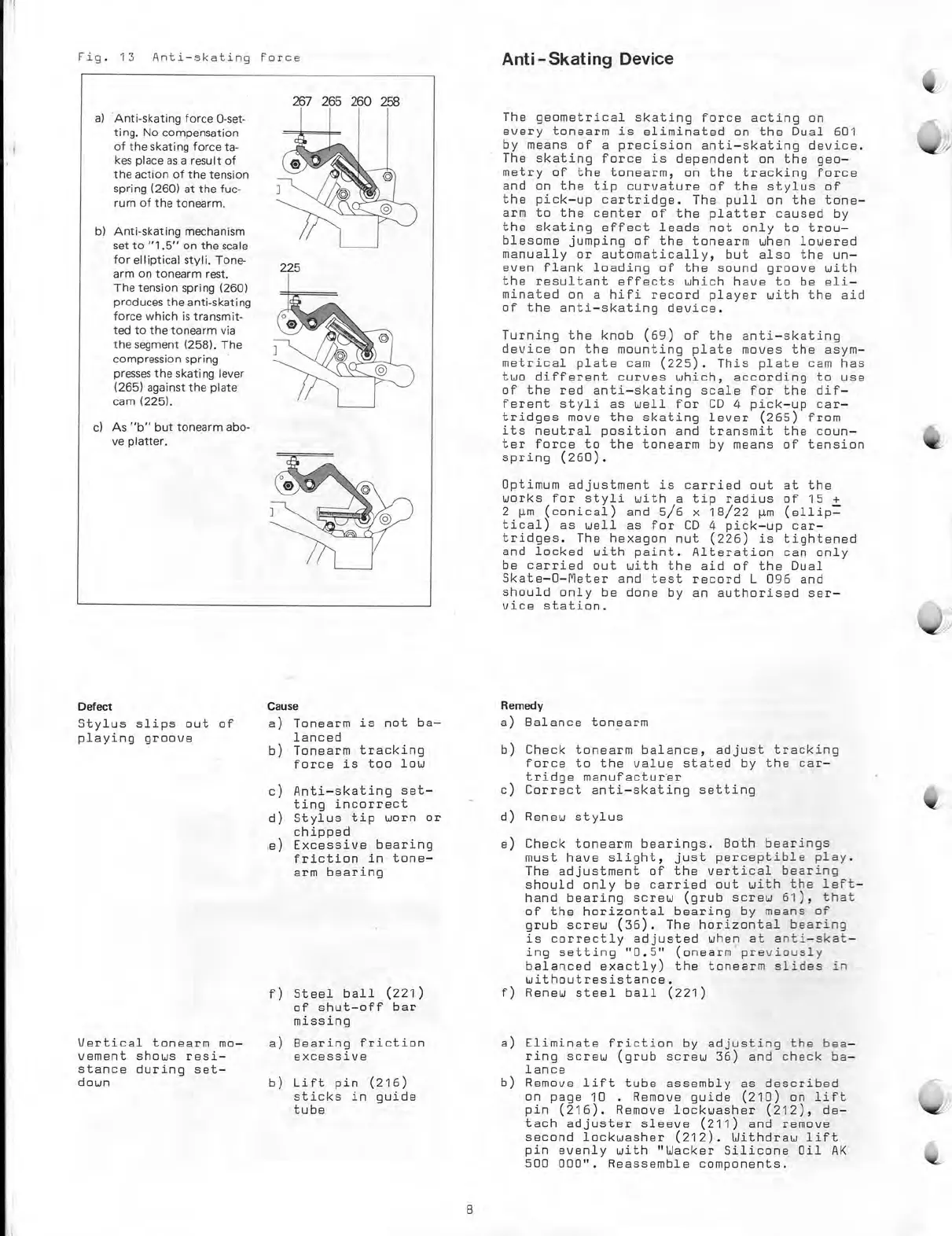
Fig.
13
Anti—skating
force
Anti-Skating
Device
a)
Anti-skating
force
0-set-
ting.
No
compensation
of
the
skating
force
ta-
kes
place
as
a
result
of
the
action
of
the
tension
spring
(260)
at
the
fuc-
rum
of
the
tonearm.
b)
Anti-skating
mechanism
set
to
"1.5"
on
the
scale
for
elliptical
styli.
Tone
-
arm
on
tonearm
rest.
The
tension
spring
(260)
produces
the
anti-skating
force
which
is
transmit-
ted
to
the
tonearm
via
the
segment
(258).
The
compression
spring
presses
the
skating
lever
(265)
against
the
plate
cam
(225).
c)
As
"b"
but
tonearm
abo-
ve
platter.
Ddect
Stylus
slips
out
of
playing
groove
Vertical
tonearm
mo—
vement
shows
resi—
stance
during
set—
down
267
265
260
258
225
Cause
a)
Tonearm
is
not
ba—
lanced
b)
Tonearm
tracking
force
is
too
lau
c)
Anti—skating
set—
ting
incorrect
d)
Stylus
tip
worn
or
chipped
a)
Excessive
bearing
friction in
tone
arm
bearing
Steel
ball
(221)
of
shut—off
bar
missing
a)
Bearing
friction
excessive
b)
Lift
pin
(216)
sticks
in
guide
tube
The
geometrical
skating
force
acting
on
every
tonearm
is
eliminated
on
the
Dual
601
by
means
of
a
precision
anti—skating
device.
The
skating
force
is
dependent
on
the
geo—
metry
of
the
tonearm,
on
the
tracking
force
and
on
the
tip
curvature
of
the
stylus of
the
pick
—up
cartridge.
The
pull
on
the
tone
arm
to
the
center
of
the
platter
caused
by
the
skating
effect
leads
not
only
to
trou—
blesome
jumping
of
the
tonearm
when
lowered
manually
or
automatically,
but
also
the
un—
even
flank
loading
of
the
sound
groove
with
the
resultant
effects
which
have
to
be
eli—
minated
on
a
hifi
record
player
with
the
aid
of
the
anti—skating
device.
Turning
the
knob
(69)
of
the
anti—skating
device
on
the
mounting
plate
moves
the
asym—
metrical plate
cam
(225).
This
plate
cam
has
two
different
curves
which,
according
to
use
of
the
red
anti—skating
scale
for
the
dif—
ferent
styli
as
well
for
CD
4
pick
—up
car—
tridges
move
the
skating
lever
(265)
from
its neutral
position
and
transmit
the
coun—
ter
force
to
the
tonearm
by
means
of
tension
spring
(260).
Optimum
adjustment
is
carried
out
at
the
works
for styli
with
a
tip
radius
of
15
+
2
µm
(conical)
and
5/6
x
18/22
µm
(ellip—
tical)
as
well
as
for
CD
4
pick
—up
car—
tridges.
The
hexagon
nut
(226)
is
tightened
and
locked
with
paint. Alteration
can
only
be
carried
out
with
the
aid
of
the
Dual
Skate
—O
—Meter
and
test
record
L
096
and
should
only
be
done
by
an
authorised
ser—
vice
station.
Remedy
a)
Balance
tonearm
b)
Check
tonearm
balance,
adjust
tracking
force
to
the
value
stated
by
the
car—
tridge
manufacturar
c)
Correct
anti—skating
setting
d)
Renew
stylus
e)
Check
tonearm
bearings.
Both
bearings
must
have
slight,
just
perceptible
play.
The
adjustment
of
the
vertical
bearing
should
only
be
carried
out
with
the
left—
hand
bearing
screw
(grub
screw
61),
that
of
the
horizontal
bearing
by
means
of
grub
screw
(36).
The
horizontal
bearing
is correctly
adjusted
when
at
anti—skat—
ing
setting "0.5"
(onearm
previously
balanced
exactly)
the
tonearm
slides
in
withoutresistance.
f)
Renew
steel ball
(221)
a)
Eliminate
friction
by
adjusting
the
bea—
ring
screw
(grub
screw
36)
and
check
ba—
lance
b)
Remove
lift
tube
assembly
as
described
on
page
10
.
Remove
guide
(210)
on
lift
pin
(216).
Remove
lockwasher
(212),
de—
tach
adjuster
sleeve
(211)
and
remove
second
lockwasher
(212).
Withdraw
lift
pin
evenly
with
"Wacker
Silicone
Oil
AK
500
000".
Reassemble
components.
8

Related product manuals