EasyManua.ls Logo

Dual 704 - Speed Regulation

Dual 704
22 pages
Print Icon
To Next Page IconTo Next Page
To Previous Page IconTo Previous Page
Loading...
Fig.
3
Rotor
a.)
b.)
d.
Sp1
Sp2
Sp3
Sp4
H1
H2
270°
202,5
°
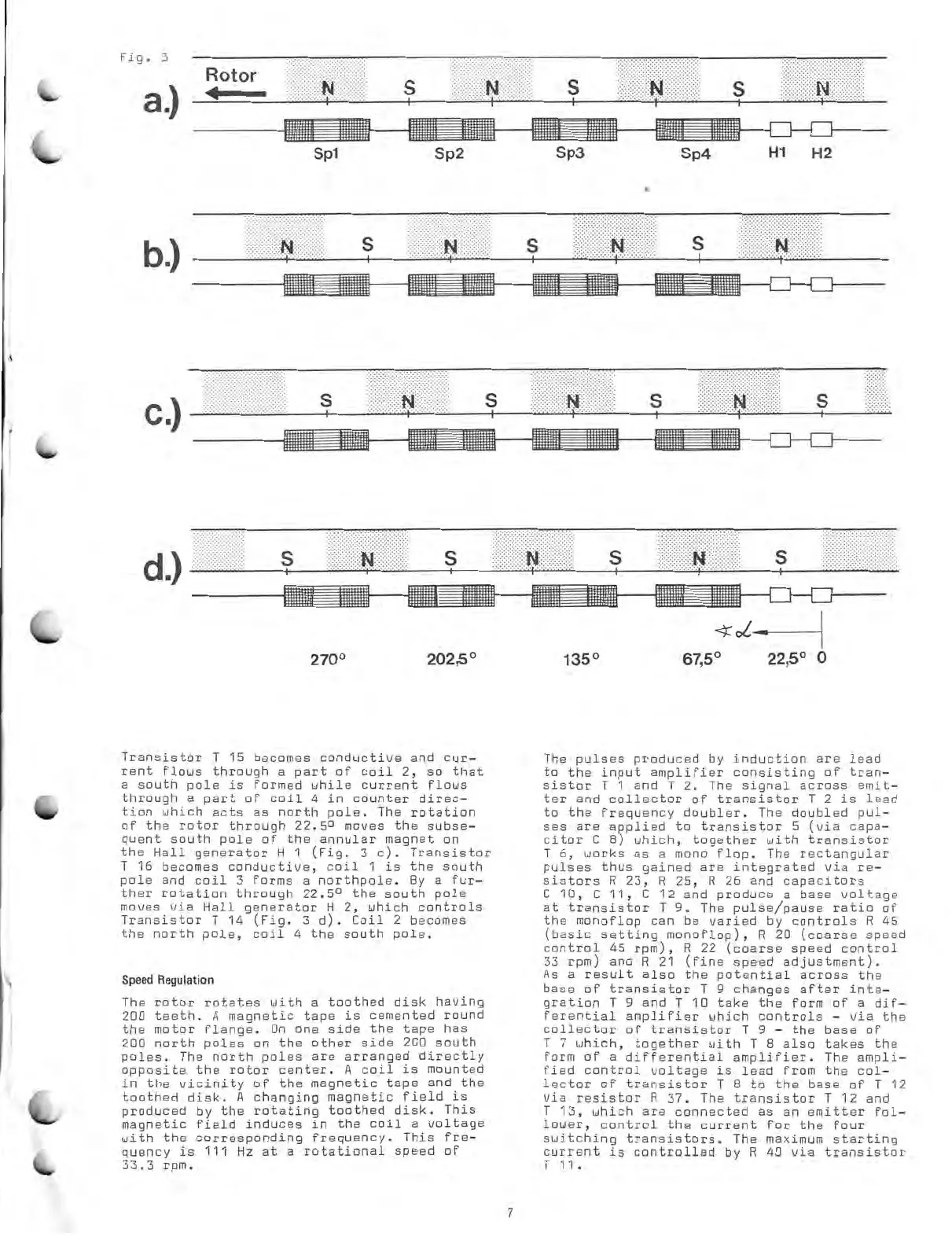
Transistor
T
15
becomes
conductive
and
cur-
rent
flows
through
a
part
of
coil
2,
so
that
a
south
pole
is
formed
while
current
flows
through
a
part
of
coil
4
in
counter
direc-
tion
which
acts
as
north
pole.
The
rotation
of
the
rotor
through
22.5
0
moves
the
subse-
quent
south
pole
of
the
annular
magnet
on
the
Hall
generator
H
1
(Fig.
3
c).
Transistor
T
16
becomes
conductive,
coil
1
is
the
south
pole
and
coil
3
forms
a
northpole.
By
a
fur-
ther
rotation
through
22.5°
the
south
pole
moves
via
Hall
generator
H
2,
which
controls
Transistor
T
14
(Fig.
3
d).
Coil
2
becomes
the
north
pole,
coil
4
the
south
pole.
Speed
Regulation
The
rotor
rotates
with
a
toothed
disk
having
200
teeth.
A
magnetic
tape
is
cemented
round
the
motor
flange.
On
one
side
the
tape
has
200
north
poles
on
the
other
side
200
south
poles.
The
north
poles
are
arranged
directly
opposite
the
rotor
center.
A
coil
is
mounted
in
the
vicinity
of
the
magnetic
tape
and
the
toothed
disk.
A
changing
magnetic
field
is
produced
by
the
rotating
toothed
disk.
This
magnetic
field
induces
in
the
coil
a
voltage
with
the
corresponding
frequency.
This
fre-
quency
is
111
Hz
at
a
rotational
speed
of
33.3
rpm.
135°
67,5
°
22,5°
0
The
pulses
produced
by
induction
are
lead
to
the
input
amplifier
consisting
of
tran-
sistor
T
1
and
T
2.
The
signal
across
emit-
ter
and
collector
of
transistor
T
2
is
lead
to
the
frequency
doubler.
The
doubled
pul-
ses
are
applied
to
transistor
5
(via
capa-
citor
C
8)
which,
together
with
transistor
T
6,
works
am
a
mono
flop.
The
rectangular
pulses
thus
gained
are
integrated
via
re-
sistors
R
23,
R
25,
R
26
and
capacitors
C
10,
C
11,
C
12
and
produce
a
base
voltage
of
transistor
T
9.
The
pulse/pause
ratio
of
the
monoflop
can
be
varied
by
controls
R
45
(basic
setting
monoflop),
R
20
(coarse
speed
control
45
rpm),
R
22
(coarse
speed
control
33
rpm)
and
R
21
(fine
speed
adjustment).
As
a
result
also
the
potential
across
the
base
of
transistor
T
9
changes
after
inte-
gration
T
9
and
T
10
take
the
form
of
a
dif-
ferential
amplifier
which
controls
-
via
the
collector
of
transistor
T
9
-
the
base
of
T
7
which,
together
with
T
8
also
takes
the
form
of
a
differential
amplifier.
The
ampli-
fied
control
voltage
is
lead
from
the
col-
lector
of
transistor
T
8
to
the
base
of
T
12
via
resistor
R
37.
The
transistor
T
12
and
T
13,
which
are
connected
am
an
emitter
fol-
lower,
control
the
current
for
the
four
switching
transistors.
The
maximum
starting
current
is
controlled
by
R
40
via
transistor
T
11.
7

Other manuals for Dual 704

Related product manuals