EasyManua.ls Logo

Dual 721 - Tonearm Adjustments; Tonearm Bearing Adjustment; Vertical Tonearm Control; Anti-Skating Device

Dual 721
25 pages
Print Icon
To Next Page IconTo Next Page
To Previous Page IconTo Previous Page
Loading...
4
5.
Unscrew
machine
screw
(232)
and
holding
spring
(231).
6.
Hold
tonearm
(50)
and
unscrew
pin
(214).
Unlock
tonearm
(50)
and
remove
it
care—
fully.
When
installing
the
tonearm
complete
with
suspension,
proceed
in
reverse
order
con—
sidering
the
following
points:
Place
pressure
spring
(39)
on
axle
of
frame
(38).
Both
axles
of
bearing
(56)
should
align
segment
(230)
accurately.
Frame
(38)
should
not
contact
cover
(73)
after
tighten—
ing
bolt
(214).
Mount
holding
spring
so
that
it
does
not
contact
the
setting
plate
when
moving
the
tonearm
(50).
Replacing
spring
hmnirm
(58)
Remove
tonearm
(50)
from
bearing
frame
(53)
as
described
above.
Loosen
lock
nut
(48)
and
threaded
pin
(49).
Unscrew
bearing
screw
(60).
Lift
bearing
frame
(53).
Remove
spring
housing
(58)
and
washer
(59).
When
install—
ing
note
that
the
helical
spring
catches
the
bearing
frame.
Slide
in
washer
(59)
and
tighten
bearing
screw
(60).
Reinstall
tone
arm
(50).
Set
bearing
play
as
described
be—
lau
using
threaded
pin
(49)
and
lock
nut
(48).
Adjusting
the
Tonearm
Bearing
First
balance
tonearm
exactly.
Both
bearings
must
have
slight,
just
perceptible
play.
The
horizontal
tonearm
bearing
is
correctly
ad—
justed
when
at
anti—skating
settings
"0.5"
and
being
touched
it
slides
in
without
re—
sistance.
The
vertical
tonearm
bearing
is
correctly
adjusted
when
it
swings
in
after
being
touches.
The
play
of
the
horizontal
tonearm
bearing
should
be
adjusted
with
threaded
pin
(37),
the
play
of
the
vertical
tonearm
bearing
with
threaded
pin
(49).
Vertical
Tonearm
Control
After
loosening
the
tension
lauer
(62)
the
tonearm
can
be
shifted
vertically
within
the
range
of
approximately
8
mm
by
turning
knob
(64).
When
turning
knob
(64)
the
pivot
cam
(223)
is
moved
thus
shifting
the
cue
con—
trol
assembly
(210)
and
the
tonearm
bearing
(38)
vertically.
This
device
is
used
to
main—
tain
the
vertical
tracking
angle
of
the
pick
up
cartridge
independent
from
its
height
(distance
between
the
mounting
level
of
the
cartridge
and
stylus
tip).
The
vertical
tracking
angle
is
properly
adjusted
with
the
stylus
tip
on
the
record
when
the
tone
arm
is
exactly
paralleled
to
it.
To
check
for
correct
adjustment
proceed
as
follows:
Disconnect
unit
plug
from
power
line.
Cor—
rectly
balance
tonearm
and
adjust
tracking
force.
Put
a
30
cm
record
on
the
platter.
Now,
lauer
the
stylus
on
the
run—out
groove
using
the
cue
control.
Check
setting,
correct
if
necessary.
Tighten
tension
lever
(62)
clockwise.
Operate
cue
control
( )
and
bring
back
tonearm
manual—
ly
on
the
rest.
Lower
cue
control
( I
).
Connect
unit
plug
to
power
line.
For
automa—
tic
adjustment
of
the
mechanical
gear
and
the
shut—off
mechanism
the
unit
should
be
started
for
the
first
time
with
the
tonearm
locked.
Adjustment
Point:
Knob
(64)
should
not
be
movable
when
ten—
sion
lever
(62)
is
tightened.
Adjustment
can
be
made
after
loosening
machine
screw
(229)
and
sliding
or
shifting
adjustment
plata
(228).
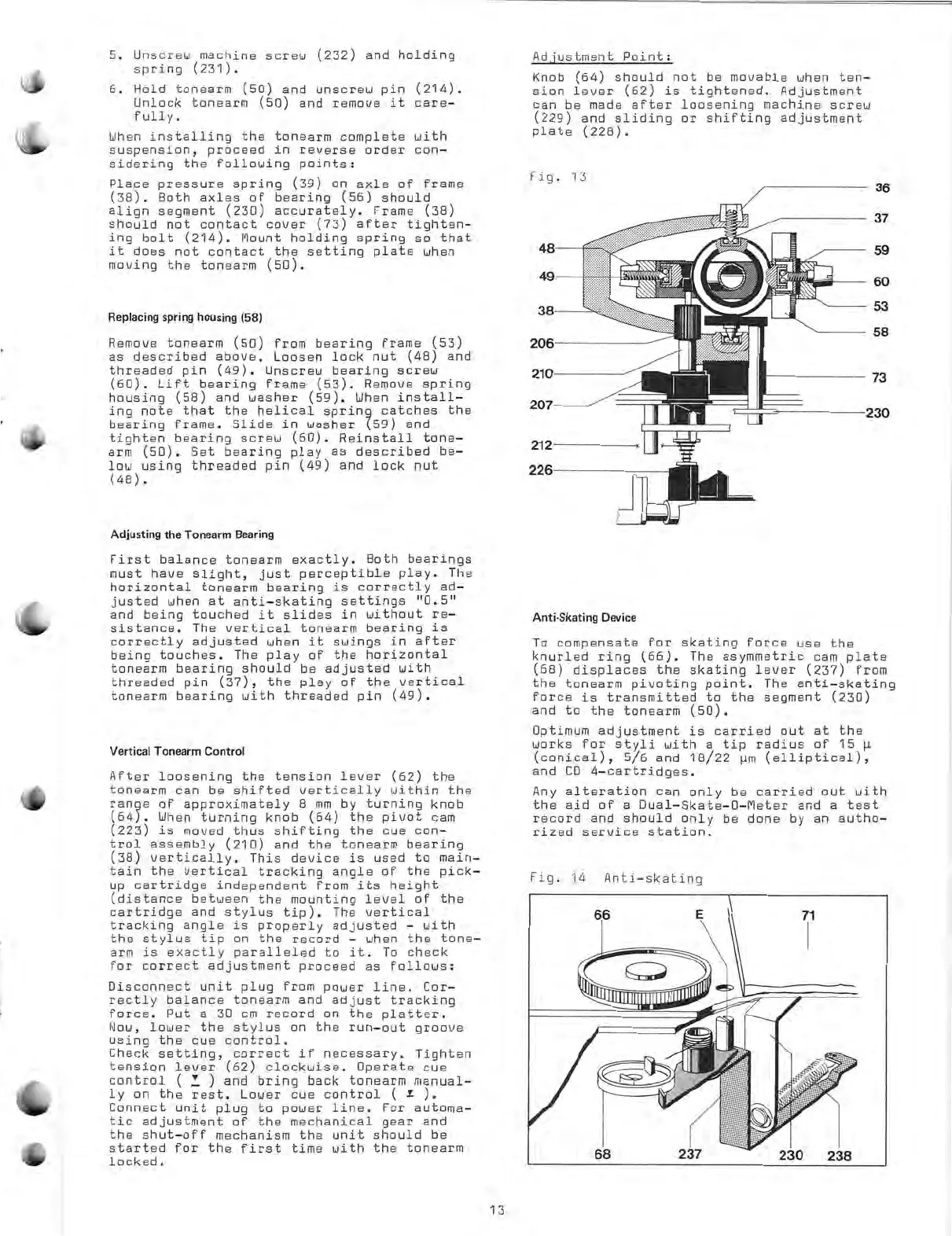
Fig.
13
48
49
38
206
210
207
212
226
Anti-Skating
Device
To
compensate
for
skating
force
use
the
knurled
ring
(66).
The
asymmetric
cam
plata
(68)
displaces
the
skating
lever
(237)
from
the
tonearm
pivoting
point.
The
anti—skating
force
is
transmitted
to
the
segment
(230)
and
to
the
tonearm
(50).
Optimum
adjustment
is
carried
out
at
the
works
for
styli
with
a
tip
radius
of
15
µ
(conical),
5/6
and
18/22
µm
(elliptical),
and
CD
4—cartridges.
Any
alteration
can
only
be
carried
out
with
the
aid
of
a
Dual
—Skate
—O
—Meter
and
a
test
record
and
should
only
be
done
by
an
autho—
rized
service
station.
Fig.
14
Anti—skating
68
237
230
238
13

Other manuals for Dual 721

Related product manuals