EasyManua.ls Logo

Dual 721 - Tonearm Control; Cue Control; Replacement of Cue Control Assembly

Dual 721
25 pages
Print Icon
To Next Page IconTo Next Page
To Previous Page IconTo Previous Page
Loading...
Recheck
as
follows:
Balance
tonearm
(50)
correctly. Set
knurled
ring
to
0.
The
tonearm
should
remain
at
any
desired
point
within
its
turning
range.
The
hole
of
the
skating
lauer
(237)
should
be
in
alignment
with
the
center
line
of
the
tone
arm.
Adjustment
is
made
by
the
eccentric
pulley
(E)
which
is
accessible
through
the
hole
in
the
installation
plate
(21)
between
the
knurled
ring
(66)
and
the
tonearm
mount—
ing
plate
(71).
See
Fig.
14.
The
set
knurled
ring
to
"0.5".
The
tonearm
should
now
smoothly
rotate
from
the
platter
center
to
its
rest.
Tonearm
Control
Automatic
movement
of
the
tonearm
is
ini—
tiated
by
the
control
cams
on
the
inside
of
the
cam
wheel
(144)
on
rotating
through
360
0
.
The
control
elements
for
raising
and
lowering
are
the
control
layer
(154),
the
main
lever
(156)
and
the
lift
pin
(47),
for
horizontal
movement
of
the
tonearm
control
lever
(154),
the
main
lever
(156),
the
coupling
plate
(233)
and
the
spring
pin
of
the
segment
(236).
The
automatic
set—down
point
is
designed
for
30
cm
and
17
cm
records
and
coupled
to
the
platter
speed
changeover.
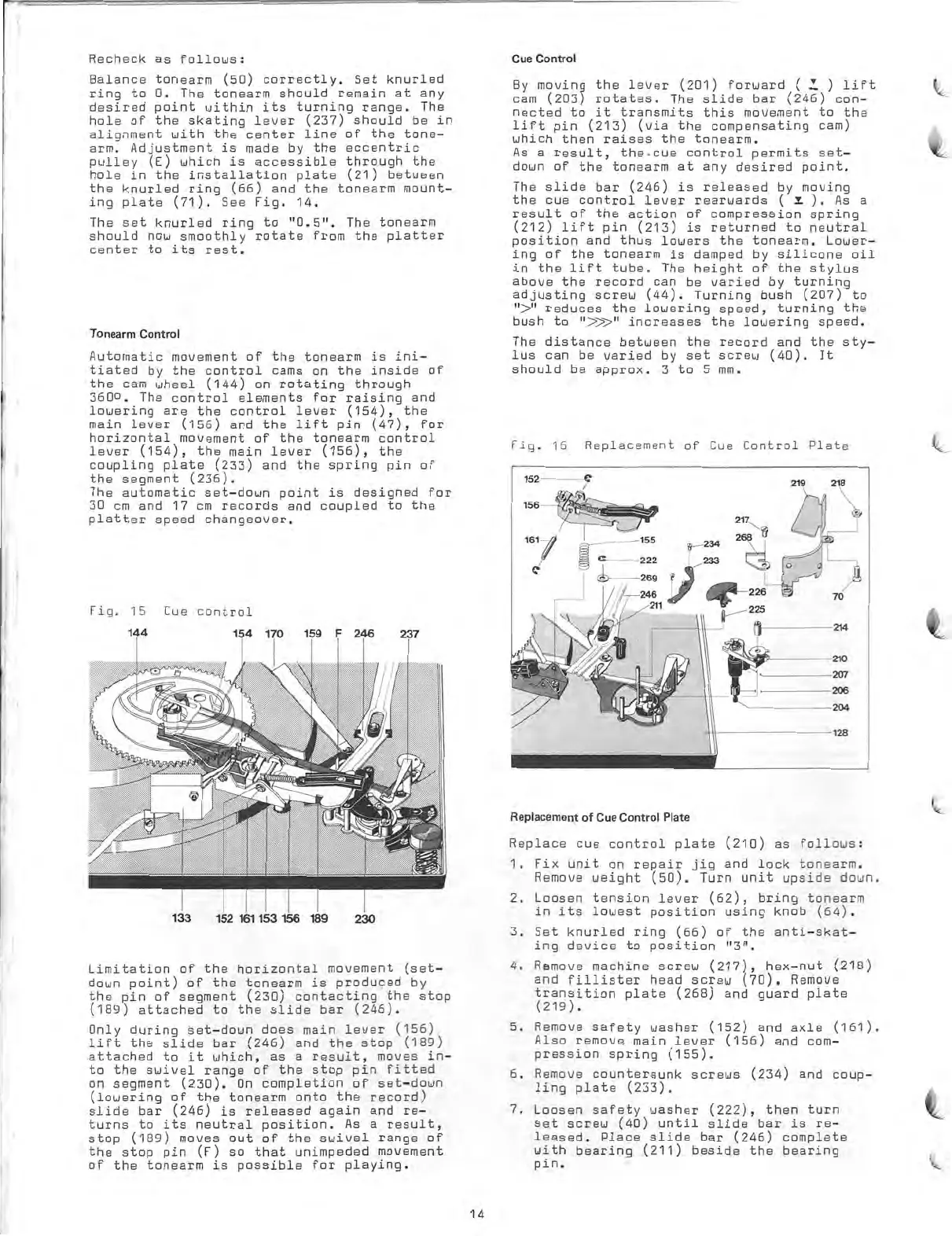
Fig.
15
Cue
control
144
1
4
170
159
F
246
237
133
152
161
153
156
189
230
Limitation
of
the
horizontal
movement
(set—
down
point)
of
the
tonearm
is
produced
by
the
pin
of
segment
(230)
contacting
the
stop
(189)
attached
to
the
slide
bar
(246).
Only
during
set—down
does
main
lever
(156)
lift
the
slide
bar
(246)
and
the
stop
(189)
attached
to
it
which,
as
a
result,
moves
in
to
the
swivel
range
of
the
stop
pin
fitted
on
segment
(230).
On
completion
of
set—down
(lowering
of
the
tonearm
onto
the
record)
slide
bar
(246)
is
released
again
and
re—
turns
to
its
neutral
position.
As
a
result,
stop
(189)
moves
out
of
the
swivel
range
of
the
stop
pin
(F)
so
that
unimpeded
movement
of
the
tonearm
is
possible
for
playing.
Cue
Control
By
moving
the
lever
(201)
forward
( )
lift
cam
(203)
rotates.
The
slide
bar
(246)
con—
nected
to
it
transmits
this
movement
to
the
lift
pin
(213)
(via
the
compensating
cam)
which
then
raises
the
tonearm.
As
a
result,
the.cue
control
permits
set—
down
of
the
tonearm
at
any
desired
point.
The
slide
bar
(246)
is
released
by
moving
the
cue
control
lever
rearwards
( I
).
As
a
result
of
the
action
of
compression
spring
(212)
lift
pin
(213)
is
returned
to
neutral
position
and
thus
lowers
the
tonearm.
Lower—
ing
of
the
tonearm
is
damped
by
silicone
oil
in
the
lift
tube.
The
height
of
the
stylus
above
the
record
can
be
varied
by
turning
adjusting
screw
(44).
Turning
bush
(207)
to
">"
reduces
the
lowering
speed,
turning
the
bush
to
">--->"
increases
the
lowering
speed.
The
distance
between
the
record
and
the
sty—
lus
can
be
varied
by
set
screw
(40).
lt
should
be
approx.
3
to
5
mm.
Fig.
16
Replacement
of
Cue
Control
Piste
Replacement
of
Cue
Control
Plate
Replace
cue
control
plate
(210)
as
follows:
1.
Fix
unit
on
repair
jig
and
lock
tonearm.
Remove
weight
(50).
Turn
unit
upside
down.
2.
Loosen
tension
lever
(62),
bring
tonearm
in
its
lowest
position
using
knob
(64).
3.
Set
knurled
ring
(66)
of
the
anti—skat—
ing
device
to
position
"3".
4.
Remove
machine
screw
(217),
hex—nut
(218)
and
fillister
head
screw
(70).
Remove
transition
plate
(268)
and
guard
plate
(219).
5.
Remove
safety
washer
(152)
and
axle
(161).
Also
remove
main
lever
(156)
and
com—
pression
spring
(155).
6.
Remove
countersunk
screws
(234)
and
coup—
ling
plate
(233).
7.
Loosen
safety
washer
(222),
then
turn
set
screw
(40)
until
slide
bar
is
re—
leased.
Place
slide
bar
(246)
complete
with
bearing
(211)
beside
the
bearing
pin.
14

Other manuals for Dual 721

Related product manuals