EasyManua.ls Logo

Dual 721 - Speed Regulation; Tacho Voltage Feedback; Speed Control Mechanism

Dual 721
25 pages
Print Icon
To Next Page IconTo Next Page
To Previous Page IconTo Previous Page
Loading...
6
6
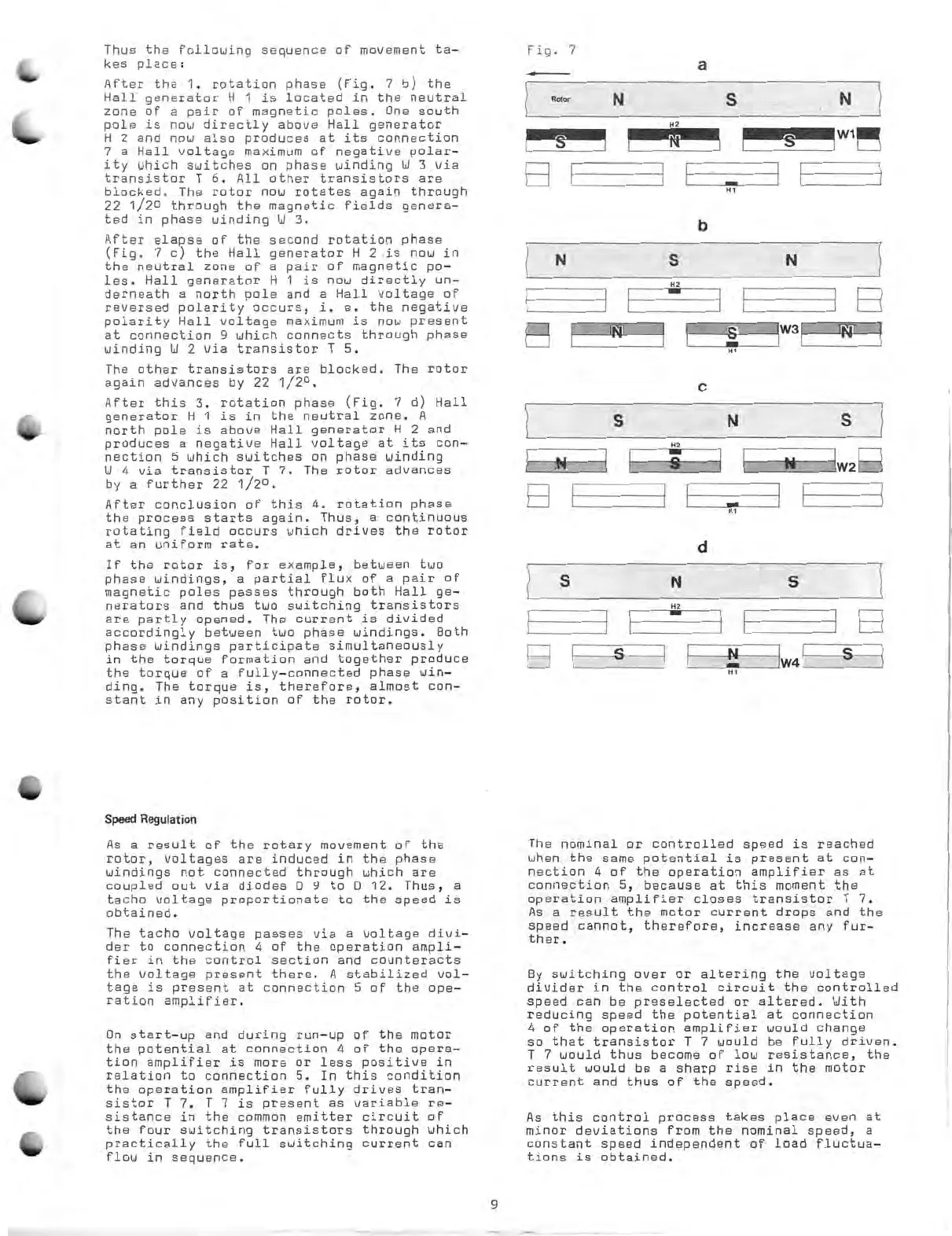
Thus
the
following
sequence
of
movement
ta-
kes
place:
After
the
1.
rotation
phase
(Fig.
7
b)
the
Hall
generator
H
1
is
located
in
the
neutral
zone
of
a
pair
of
magnetic
poles.
One
south
pole
is
now
directly
above
Hall
generator
H
2
and
now
also
produces
at
its
connection
7
a
Hall
voltage
maximum
of
negative
polar-
ity
which
switches
on
phase
winding
W
3
via
transistor
T
6.
All
other
transistors
are
blocked.
The
rotor
now
rotates
again
through
22
1/2
0
through
the
magnetic
fields
genera-
ted
in
phase
winding
W
3.
After
elapse
of
the
second
rotation
phase
(Fig.
7
c)
the
Hall
generator
H
2
is
now
in
the
neutral
zone
of
a
pair
of
magnetic
po-
les.
Hall
generator
H
1
is
now
directly
un-
derneath
a
north
pole
and
a
Hall
voltage
of
reversed
polarity
occurs,
i.
e.
the
negative
polarity
Hall
voltage
maximum
is
now
present
at
connection
9
which
connects
through
phase
winding
W
2
via
transistor
T
5.
The
other
transistors
are
blocked.
The
rotor
again
advances
by
22
1/2°.
After
this
3.
rotation
phase
(Fig.
7
d)
Hall
generator
H
1
is
in
the
neutral
zone.
A
north
pole
is
above
Hall
generator
H
2
and
produces
a
negative
Hall
voltage
at
its
con-
nection
5
which
switches
on
phase
winding
W
4
via
transistor
T
7.
The
rotor
advances
by
a
further
22
1/2°.
After
conclusion
of
this
4.
rotation
phase
the
process
starts
again.
Thus,
a
continuous
rotating
field
occurs
which
drives
the
rotor
at
an
uniform
rate.
If
the
rotor
is,
for
example,
between
two
phase
windings,
a
partial
flux
of
a
pair
of
magnetic
poles
passes
through
both
Hall
ge-
nerators
and
thus
two
switching
transistors
are
partly
opened.
The
current
is
divided
accordingly
between
two
phase
windings.
Both
phase
windings
participate
simultaneously
in
the
torque
formation
and
together
produce
the
torque
of
a
fully-connected
phase
um
-
ding.
The
torque
is,
therefore,
almost
con-
stant
in
any
position
of
the
rotor.
Speed
Regulation
As
a
result
of
the
rotary
movement
of
the
rotor,
voltages
are
induced
in
the
phase
windings
not
connected
through
which
are
coupled
out
via
diodes
D
9
to
D
12.
Thus,
a
tacho
voltage
proportionate
to
the
speed
is
obtained.
The
tacho
voltage
passes
via
a
voltage
divi-
der
to
connection
4
of
the
operation
ampli-
fier
in
the
control
section
and
counteracts
the
voltage
present
there.
A
stabilized
vol-
tage
is
present
at
connection
5
of
the
ope-
ration
amplifier.
On
start-up
and
during
run-up
of
the
motor
the
potential
at
connection
4
of
the
opera-
tion
amplifier
is
more
or
less
positive
in
relation
to
connection
5.
In
this
condition
the
operation
amplifier
fully
drives
tran-
sistor
T
7.
T
7
is
present
as
variable
re-
sistance
in
the
common
emitter
circuit
of
the
four
switching
transistors
through
which
practically
the
full
switching
current
can
flow
in
sequence.
Fig.
7
Robar
zwejam
-
H2
HI
H2
H1
W3
H2
H2
-1ZIN
HI
2
HI
W4
The
nominal
or
controlled
speed
is
reached
when
the
same
potential
is
present
at
con-
nection
4
of
the
operation
amplifier
as
at
connection
5,
because
at
this
moment
the
operation
amplifier
closes
transistor
T
7.
As
a
result
the
motor
current
drops
and
the
speed
cannot,
therefore,
increase
any
fur-
ther.
By
switching
over
or
altering
the
voltage
divider
in
the
control
circuit
the
controlled
speed
can
be
preselected
or
altered.
With
reducing
speed
the
potential
at
connection
4
of
the
operation
amplifier
would
change
so
that
transistor
T
7
would
be
fully
driven.
T
7
would
thus
become
of
low
resistance,
the
result
would
be
a
sharp
rise
in
the
motor
current
and
thus
of
the
speed.
As
this
control
process
takes
place
even
at
minor
deviations
from
the
nominal
speed,
a
constant
speed
independent
of
load
fluctua-
tions
is
obtained.
9

Other manuals for Dual 721

Related product manuals