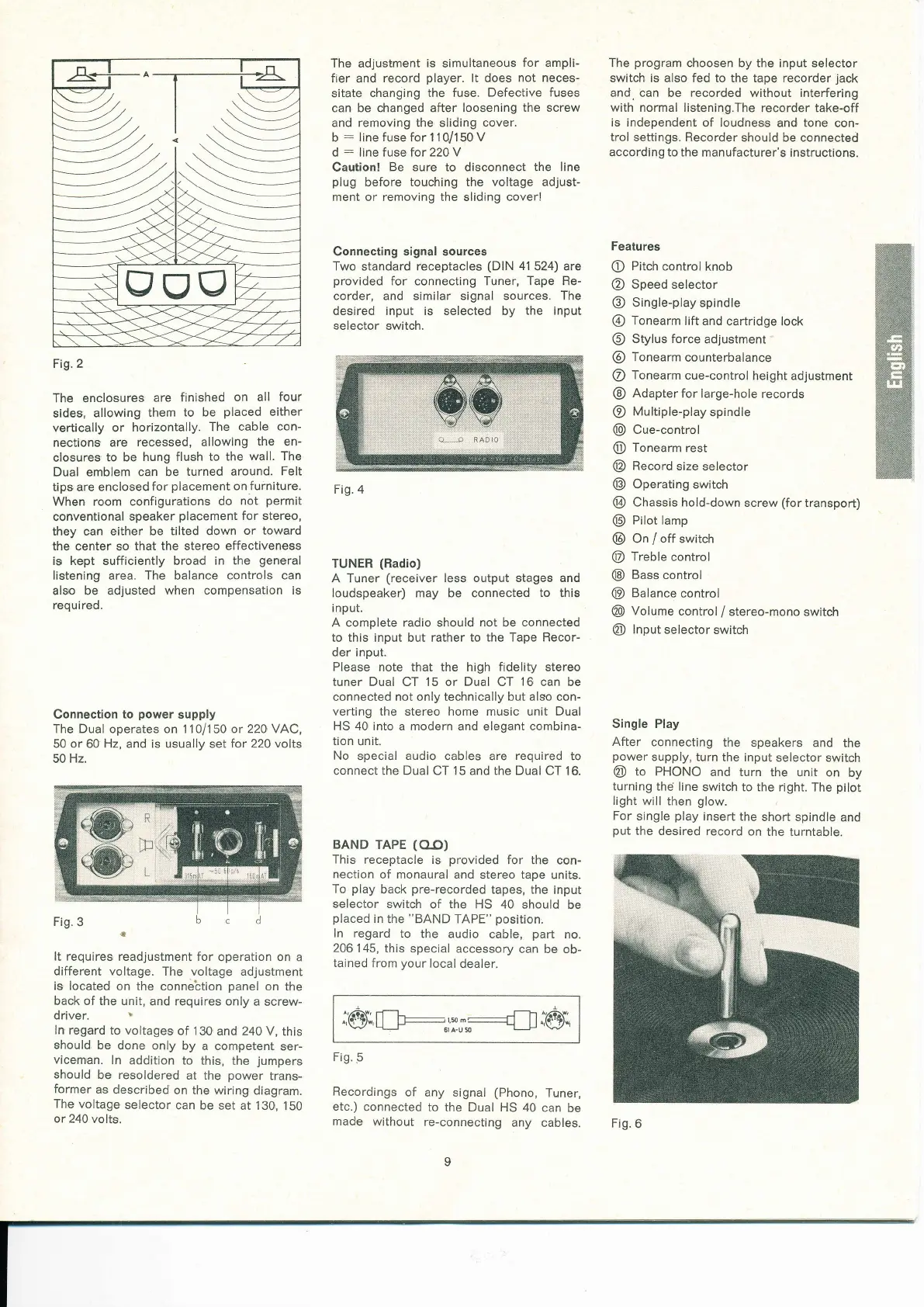
Fig.2
The enclosures
are
finished
on all four
sides,
allowing
them
to be
placed
either
vertically or
horizontally.
The
cable
con-
nections
are
recessed, allowing
the
en-
closures
to be
hung flush
to the
wall. The
Dual emblem
can be
turned around.
Felt
tips are enclosed
for
placement
on furniture.
When room configurations
do
not
permit
conventional
speaker
placement
for stereo,
they can either
be tilted down
or toward
the center so
that the stereo effectiveness
ie ke'pt sufficiently broad in
the
general
listening area.
The
balance
controls can
also be adjusted
when
compensation
is
required.
Connection
to
power
supply
The Dual operates on 1'l 0/1
50
or 220 VAC,
50 or 60 Hz, and is usually set for 220 volts
50 Hz.
Fig.3
b
c d
{
It
requires readjustment
for operation on a
different
voltage. The voltage adjustment
is located on the
connelction
panel
on
the
back of the
unit, and requires only
a screw-
driver.
t
ln
regard to voltages
of t3O
and 240 V,
this
should
be done
only by
a competent
s,er-
vicem,an.
ln addition
to this,
the
jumpers
should
be resoldered
at the
power
tran,s-
former
as described
on the wiring
diagram.
The
voltage
selector
can be
set at 130,
150
or
240 volts.
The adjustment
is
simultaneous
for
ampli-
fier and
record
player.
lt does
not neces-
sitate
chanding the fuse.
Defective fuses
can
be changed after loosening
the screw
and removing the sliding
cover.
b
:
line
fuse
for I
10/150V
d
:
line fuse
for
220 V
Caution!
Be sure
to disconnect
the line
plug
before
touching the voltage adjust-
ment or removing the
sliding
cover!
Connecting signal sources
Two standard
receptacles
(DlN
41
524) are
provided
for connecting Tu.ner, Tape Re-
corder,
and similar signal sources.
The
desired input is selected by
the input
selector
switch.
Fig. 4
TUNER
(Radio)
A Tuner
(receiver
less output s,tages and
loudspeaker) may
be
connected to this
input.
A complete radio should not be
connected
to this input but
rather to the Tape Recor-
der
input.
Please note that the high fidelity stereo
tuner Dual CT 15 or Dual CT
16
can be
connected
not
only technically but
also
con-
verting the stereo home music unit Dual
HS 40 into a modern and
elegant
combina-
tion
unit.
No
special
audio
cables are
required
to
connect the Dual CT 15 and the Dual CT 16.
BAND
TAPE
(Q.O)
This receptacle is.
provided
for the
con-
nection
of monaural and
stereo
tape
units.
To
play
back
pre-recorded
tapes, the
input
selector switch
of the HS 40 should be
placed
in
the
"BAND
TAPE"
position.
ln
regard to
the audio
cable,
part
no.
2ffi145,
this special
accessory
can be ob-
tained
from
your
local
dealer.
The
program
choosen by the input selector
switch is also fed to the ta.pe recorder
jack
and. can be recorded without interfering
with normal listening.The
recorder take-off
is independent
of
loudness
and
tone
con-
trol
settings. Recorder
should be connected
according to the
manu acturer's instructions.
Features
@
Pitch
control knob
@
Speed selector
@
Single-play
s,pindle
@
Tonearm
lift and
cartridge lock
@
Stylus force
adjustment
'
@
Tonearm
counterbalance
@
Tonearm
cue-control height
adjustment
@
Adapter
for large-hole records
@
Multiple-play
spindle
@
Cue-control
@
Tonearm
rest
@
Record
size
selector
@
Operating switch
@
Chassis
hold-down
screw
(fortransport)
@
Pilot
lamp
@
On
/
off switch
@
Treble
control
@
Bass control
@
Balance
control
@
Volume
control
/
stereo-mono switch
@
lnput selector
switch
Single Play
After
connecting
the
speakers and
the
power
supply, turn
the input
selector switch
@
to PHONO
and turn
the unit on
by
turning the
line
switch to the right. The
pilot
light
will then
glow.
For
single
play
insert the
sho,rt spindle
and
put
the desired
record on
the turntable.
lg'"
il--=r'-*--_r$
i@i
Fig.
5
Recordings
of
any signal
(Phono,
Tuner,
etc.)
connected
to the
Dual HS 40
can
be
made without
re-connecting
any cables.
UUU
Fig.6


 To Next Page
 Loading...