43
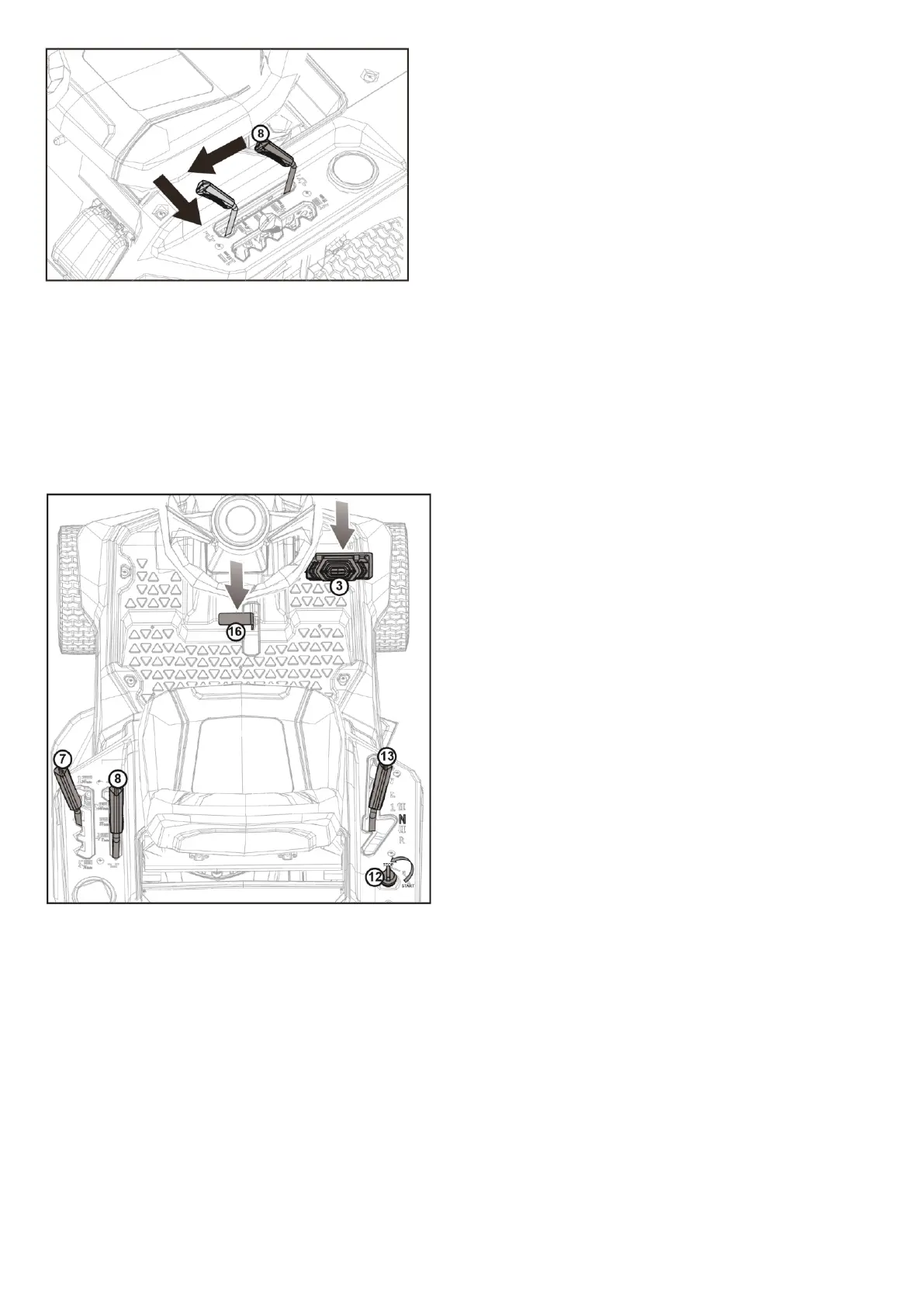
Shut off the lawnmower
• Depress the brake clutch pedal (3) completely andactivate
the locking brake (16).
• Switch off the mower by pulling the lever (8) to theright and
back
• Set the gas lever (14) to the “SLOW“ stationary throttle
• Turn the ignition key (10) to the “stop” position.
• Set the desired cutting height (7)
• Always remove the ignition key (12) when leavingthe
lawnmower.
Tips for proper mowing
Working on slopes:
Slopes are one of the major causes of accidents in which
control over the ride-on mower is lost causing it to tip over,
which can result in severe or even fatal injuries.
There is no „safe“ slope! Driving on grassy slopes re-quires
special concentration. For safety reasons, the machine must
not be used on slopes with an inclina-tion of more than 10°
(17.6 %). Risk of injury!
A slope inclination of 10° corresponds to a vertical height
increase of 17.6 cm for a 100 cm horizontal distance.
Starting off or stopping on a gradient must be avoid-ed.
Do not use the machine in places (slopes, ditches, etc.) where
the ride-on mower can tip over or slide. The danger of tipping
over or sliding increases if the ground is soft or damp.
Slopes must be driven on in a longitudinal direction. Driving
transversely increases the danger of tipping over.
Do not change speed or direction abruptly when driv-ing on slo-
pes. Work in this type of situation requires calm, cautious and
even operation of the ride-on mower.
Changes of direction on slopes must be avoided. Only turn on
slopes if this is unavoidable. If possible, drive slowly and in a
large curve in the down-slope direction.
Do not mow wet grass, particularly on slopes, as wheel grip is
reduced on wet grass. The ride-on mow-er could slide and be-
come uncontrollable for the user.
The gearbox must never be disengaged via the gear-box freew-
heel when driving on slopes.
Special care must be taken when operating attachments on slo-
pes (altered weight distribution of the machine).
If the wheels start to slip or if the vehicle becomes stuck in the
up-slope direction when driving on an incline, the mowing blade
or the attachment must be disengaged. Then leave the slope by
driving slowly downhill in a straight line.
Never try to stabilise the ride-on mower by pressing on the
ground with your foot.
The weight of the grass catcher box increases the danger of the
ride-on mower tipping over, particularly when it is full.
Never empty or lift the grass catcher box on an incline.
Stopping and parking
The ride-on mower must only be parked on a level surface.
Make sure that the ride-on mower has come to a complete
standstill before you dismount.
Beware of the cutting tool running on for several sec-onds be-
fore coming to a standstill.
Before leaving the driver’s seat, disengage the mow-ing blade
or the drive to the attachments, lower the mowing deck and all
attachments, set all control levers to the neutral position, en-
gage the parking brake, stop the engine and remove the ignition
key.
Keep the ignition key in a place where only authorised persons
can access it.
Tips for proper mowing:
• Pay attention to ensure that you do not run into or overanyt-
hing that could damage the mower. The lawn mower could be
damaged and/or the machine could inflict bodily injury.
• A hot engine, exhaust or drive unit can burn the skin if-
touched. Thus, do not touch these parts unless the mower
has been switched off for a while and you know that they have
cooled down!
• Insu cient daylight or even a su cient level of arti-ficial light is
one reason not to mow.
• Check the mower, the blade and other parts if they havestruck
a foreign object or if the machine vi-brates more than usual.
• Do not make any adjustments or repairs until the engine has
been switched off. Pull the plug boot.(22).
• Pay special attention if you are mowing directly next to a
street or are close by one (traffic). Always keep the grass
chute pointed away from the street.
• Avoid mowing in places where the wheels have trouble grip-
ping or mowing is unsafe in any other way.
• Before you back up, ensure that nobody is standing behind
you especially little children, who are more difficult to see.
• When mowing over thick, high grass, select the highest cut-
ting level and mow at a slower speed.
• Before you remove any grass or blockages of any kind,switch
off he engine and pull the plug boot.
• Never remove any safety-related parts.
• Never fill the engine with petrol when it is hot or is running.


 To Next Page
 Loading...