Inspect chimney to make certain it is constructed
according to the latest revision of the NFPA 211.
Local regulations may differ from this code and
should be checked. Where there is a conflict, the
local code will prevail.
The boiler must be installed into a chimney which
has a masonry or metallic chimney liner.
An unlined chimney wilt have leaks that wilt cause
poor chimney performance (no draft), and could
result in a positive pressure in the combustion
chamber.
Horizontal portions of the venting system should not
exceed 10 feet in length. Horizontal lengths over 10
ft. will have a negative effect on the chimney
performance.
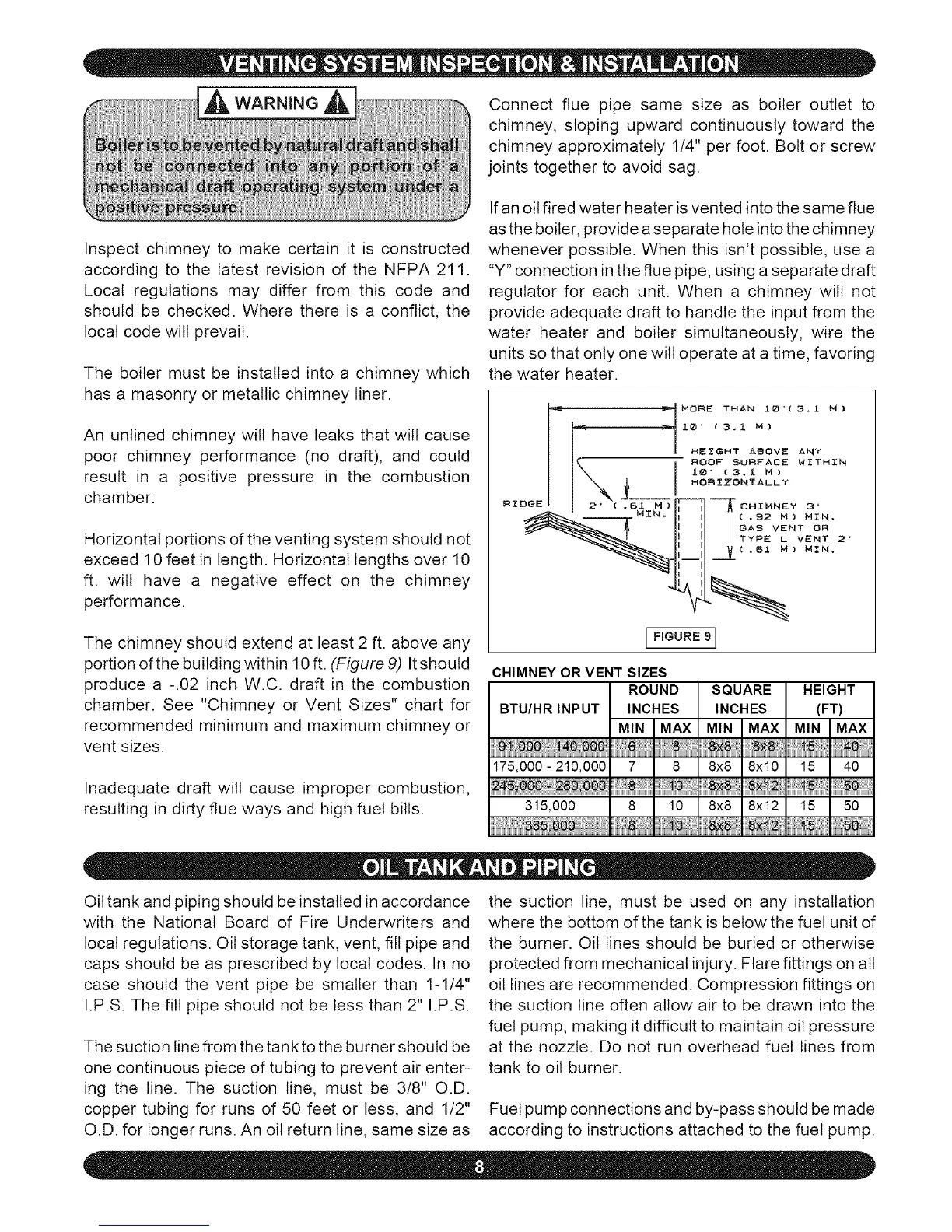
The chimney should extend at least 2 ft. above any
portion of the building within 10 ft. (Figure 9) It should
produce a -.02 inch W.C. draft in the combustion
chamber. See "Chimney or Vent Sizes" chart for
recommended minimum and maximum chimney or
vent sizes.
Inadequate draft will cause improper combustion,
resulting in dirty flue ways and high fuel bills.
Connect flue pipe same size as boiler outlet to
chimney, sloping upward continuously toward the
chimney approximately 1/4" per foot. Bolt or screw
joints together to avoid sag.
If an oil fired water heater is vented into the same flue
as the boiler, provide a separate hole into the chimney
whenever possible. When this isn't possible, use a
"Y" connection in the flue pipe, using a separate draft
regulator for each unit. When a chimney will not
provide adequate draft to handle the input from the
water heater and boiler simultaneously, wire the
units so that only one wilt operate at a time, favoring
the water heater.
I_,_ NO_E THAN J.O'(3,1 H)
q&o' (3,_ M)
/
HEZGHT ABOVE ANY
_._{ Roo_ GuR_AOEWITHIN
le" C3._ M)
HORIZONTALLY
RIDGE ( .8.f. M) "CHIMNEY 3"
c , 9;2. M ) MIN.
M N. i l
I I GAS VENT OR
TYI_E L VENT 2 '
I i ( . 6,L M MIN.
i 1-t
CHIMNEYOR VENT SIZES
ROUND
BTU/HR INPUT INCHES
MIN MAX
91,,_0"0"140_00_
175,000- 210,000 7 8
iiiiiiiiiiiiiiiiiiiiiiiiiiiiiiiiiiiiiiii r_;
315,000 8 10
SQUARE HEIGHT
INCHES (FT)
MIN I MAX MIN MAX
8x8 I 8x10 15 40
8x8 I 8x12 15 50
Oil tank and piping should be installed in accordance
with the National Board of Fire Underwriters and
local regulations. Oil storage tank, vent, fill pipe and
caps should be as prescribed by local codes. In no
case should the vent pipe be smaller than 1-1/4"
I.P.S. The fill pipe should not be less than 2" I.P.S.
The suction line from the tank to the burner should be
one continuous piece of tubing to prevent air enter-
ing the line. The suction line, must be 3/8" O.D.
copper tubing for runs of 50 feet or less, and 1/2"
O.D. for longer runs. An oil return line, same size as
the suction line, must be used on any installation
where the bottom of the tank is below the fuel unit of
the burner. Oil lines should be buried or otherwise
protected from mechanical injury. Flare fittings on all
oil lines are recommended. Compression fittings on
the suction line often allow air to be drawn into the
fuel pump, making it difficult to maintain oil pressure
at the nozzle. Do not run overhead fuel lines from
tank to oil burner.
Fuel pump connections and by-pass should be made
according to instructions attached to the fuel pump.


 To Next Page
 Loading...