The Eagle Microsystems Premier Series Monitor, models RP-1000 and RP-1200, is a versatile instrument designed for monitoring various water quality parameters, including pH, ORP (Oxidation-Reduction Potential), fluoride, and an optional residual probe. It provides real-time data display, multiple set points for control, analog outputs for remote monitoring, and a comprehensive setup and calibration system.
Function Description:
The primary function of the RP-1000/1200 is to continuously monitor the output of pH, ORP, fluoride, or ammonia probes. The RP-1200 model specifically offers a basic display of these probe outputs, including a label, value, and units. An optional residual probe can also be displayed on the main screen, enhancing its monitoring capabilities for applications requiring residual measurements.
The device features up to four set points (two for each input), which can be configured to control external devices based on the monitored parameters. An internal scaled 4-20mA signal is provided for remote monitoring of the primary probe (pH, ORP, or fluoride), with a second optional analog output available for the residual probe. This allows for integration into larger control systems, SCADA systems, or chart recorders.
The monitor includes a comprehensive menu system for setup, calibration, and alarm management. Password protection ensures secure access to advanced settings.
Important Technical Specifications:
- Monitored Parameters: pH, ORP, Fluoride, Ammonia, and optional Residual.
- Set Points: Up to four user-selectable set points (two per input).
- Analog Outputs:
- One internal scaled 4-20mA output for the primary probe (pH, ORP, or fluoride).
- An optional second 4-20mA output for the residual probe.
- Relay Outputs: The device supports multiple relays (K1, K2, K3, K4/K6) for control functions. These relays can be configured for various operating modes (e.g., LOW, LOW w/ ACK, HIGH, HIGH w/ ACK), determining when they energize or de-energize based on set point values.
- Inputs:
- PV1 input for residual probe.
- PV3 input for pH, ORP, fluoride, or ammonia probes.
- Two contact inputs (INO, IN1) for external switches, such as flow switches.
- Thermistor input for temperature compensation (optional 1000ohm RTD).
- Display: The main operating screen displays the parameter name, value, and units. A fifty-element bar graph represents the analog output.
- Power: Selectable 115V or 230V A.C. power.
- Firmware Version: >= 2.32.
- Board Revision: 0644 and above (for PS-1000S-CPU and PS-1000S-DSP).
- Serial Communication: RS232 (single 4-20mA output, 2 contact inputs, two 4-20 inputs, cell input, thermistor input). An RS485 option is available.
- Optional Hardware: PSC-3000, PS-1000-AOUT, PS-1000, PS-2000, Buzzer, Battery (Note: Battery option cannot be used for this application).
Usage Features:
- Intuitive Navigation: The device utilizes a pushbutton legend (SET, ESC, UP, DWN, ADJ, ALM, CAL, ACK, CLEAR, x:y, ZRO, SPAN, PO1, 4mA, 20mA) to guide users through setup and operation.
- Main Screen Display: Provides a clear, real-time indication of probe outputs with a bar graph representing the analog output.
- Password Protection: Access to setup menus (METER SETUP, ADVANCED PARAMETER MENU) is protected by a password (default 000 or 1?1), ensuring only authorized personnel can modify critical settings.
- Parameter Configuration: Users can configure various parameters, including:
- MODE: Selects the instrument type (e.g., METER).
- TEMPERATURE: Sets the temperature display unit (Celsius or Fahrenheit).
- BUZZER: Enables or disables the audible alarm.
- K1, K2, K3 (Relay Modes): Defines the operating mode for each relay (e.g., normally open, normally closed, with or without acknowledgment).
- PV1 ENABLE (RES ENABLE): Enables or disables the residual display.
- PV1 DP (RES DP): Selects the decimal point for residual readings.
- PV1 FS (RES FS): Sets the full-scale value for residual and the second 4-20mA analog output.
- INPUT: Selects the PV3 probe input type (ORP, FLR, pH, etc.).
- FS (Full Scale) & ZERO: Sets the 20mA and 4mA analog output values for various parameters (ORP, FLR, pH, NH3, TTL).
- PROBE DAMP: Configures probe damping (filtering) to stabilize readings, with settings ranging from OFF to 60 minutes.
- Alarm Management: Supports up to three user-selectable set points for alarms. Acknowledgment features (ACK, CLEAR) allow operators to manage alarm conditions, with options for the alarm to reappear if the condition persists. Non-acknowledgable set points also exist for direct relay control without screen prompts.
- Flow Switch Integration: The device can integrate with flow switches, enabling control based on flow conditions.
Maintenance Features:
- Calibration Menu (CAL): Provides access to various calibration procedures:
- PV3 Calibration: For pH, ORP, fluoride, or ammonia probes. This involves setting two calibration points (P1 and P2) based on known standards. Specific instructions are provided for fluoride (avoiding 0.0-0.1ppm) and ammonia (using 0.01 instead of 0.0).
- PV1 Calibration (Residual Probe): Involves a basic two-point calibration (Zero and Span) using a known residual supply.
- PO1/PO2 (Output) Calibration: Calibrates the 4-20mA analog outputs. This requires connecting a DMM (mA input) and setting the 4mA (zero point) and 20mA (span point) outputs precisely using the UP/DWN pushbuttons.
- Default Calibration Values: The RST pushbutton can restore default calibration values for PV3 (e.g., 0.2ppm @ 140mV & 2.0ppm @ 84mV).
- Troubleshooting: Wiring diagrams are provided for various configurations, including 4-20mA self-powered sources, calibrator wiring, probe and flow switch wiring, and connections for the PSC3000 module.
- Modular Design: The PS-1000S-CPU and PS-1000S-DSP boards, along with optional modules like the PSC3000, suggest a modular design that could facilitate maintenance and upgrades.
- Technical Reference Manual: The manual itself serves as a crucial maintenance tool, providing detailed instructions for setup, operation, and calibration, along with wiring diagrams.

 Need help?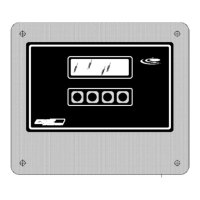

 To Next Page
 General