Need help?
Do you have a question about the ebm-paps K3G400-PA27-62 and is the answer not in the manual?
This document outlines the operating instructions for a built-in device designed for conveying air. It emphasizes safety, proper usage, and maintenance to ensure optimal performance and longevity.
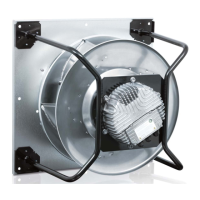
The device is primarily an air-conveying unit, designed to be integrated into larger systems. Its core function involves moving air according to specified technical data. The motor is a 3-phase unit, capable of operating within a nominal voltage range of 380-480 VAC at 50/60 Hz. It features a painted black rotor surface and a die-cast aluminum electronics housing. The impeller is made of sheet aluminum, while the support plate and bracket are galvanized sheet steel and painted black steel, respectively. The inlet nozzle is also made of galvanized sheet steel. The device has five blades and rotates clockwise when viewed toward the rotor. It is rated for IP55 protection and an insulation class of "F." The moisture and environmental protection class is H1.
The device incorporates an integrated PI controller, configurable inputs/outputs (I/O), and MODBUS V6.0 compatibility, including RS-485 MODBUS-RTU. It supports soft start functionality and provides a voltage output of 3.3-24 VDC with a maximum power of 800 mW for external devices. The control interface is designed with SELV potential, safely disconnected from the mains. Motor protection features include thermal overload protection for electronics/motor, and line undervoltage/phase failure detection. It also includes reverse polarity and locked-rotor protection. The device is equipped with RFID - ISO 15693 compatibility.
The device is designed for use in power systems with grounded neutral (TN/TT), phase conductor grounding, or IT power systems, and in networks with quality characteristics as per EN 50160. It is intended for stationary systems and can convey air at ambient pressures between 800 mbar and 1050 mbar.
The device is designed for safe and reliable operation when installed and used correctly. It is crucial to read the operating instructions thoroughly before any work on the device. The device must be sold or passed on with its operating instructions, which can be duplicated for informing about potential dangers and their prevention.
Safety: The instructions highlight various hazard levels:
Only suitably qualified, trained, and authorized technical staff should transport, unpack, install, operate, maintain, and use the device. Specialists are required for installation, test runs, and electrical work. The device must always be operated with a fixed protective device and guard grille, which must withstand the kinetic energy of a fan blade at maximum speed and prevent finger access. The operator is responsible for ensuring adequate securing of the built-in component.
Electrical Connection: The device is a built-in component without a disconnecting switch. It must only be connected to circuits that can be switched off with an all-pole disconnection switch. Live terminals and connections can remain energized even when the device is switched off, necessitating a five-minute wait after disconnecting voltage before opening. Electrical equipment should be checked regularly, and loose connections or defective cables replaced immediately. Due to integrated EMC filters, reactive currents may be measured in the supply line even when the motor is at a standstill. If a residual current device (RCD) is required, only AC/DC-sensitive (type B or B+) RCDs are permissible, with a recommended trip threshold of 300 mA and delayed tripping.
Mechanical Connection: Care must be taken when removing the device from packaging, grasping the frame, and avoiding impacts. Due to its weight (over 25 kg), suitable hoisting equipment should be used for unpacking. The fan must not be subjected to force or excessive vibration from the installation. If connected to air ducts, vibration isolation (e.g., using compensators) is recommended. Stress-free attachment to the substructure is essential. The fan should not be handled by the inlet nozzle during transport or installation to prevent impeller damage. Any transport damage must be checked, and damaged devices should not be installed. The device must be securely positioned until all fastening screws are tightened.
Storage: The device should be stored in a dry, weather-protected, vibration-free, clean environment in its original packaging. It should be protected from environmental effects and dirt until final installation. Storage for no longer than one year is recommended to ensure trouble-free operation and maximum service life. Even devices intended for outdoor use should be stored as described before commissioning.
Improper Use: Prohibited and hazardous uses include operating the device in an unbalanced state (e.g., due to dirt or ice), resonant operation with severe vibration, use in life-sustaining or life-support medical equipment, conveying solids or abrasive/corrosive particles, painting the device, or operating it in an explosive atmosphere. Modifications without ebm-papst approval are forbidden.
Regular maintenance is crucial for the device's long service life and proper operation.
Safety Inspection: The device's electrical equipment should be checked at regular intervals. Loose connections and defective cables must be replaced immediately. A high-voltage test, if legally required, should be performed with DC voltage due to the integrated EMC filter. The voltage used should correspond to the peak value of the AC voltage required by the standard.
Vibration Testing: Mechanical vibration should be checked every six months based on ISO 14694. The maximum permissible vibration severity is 3.5 mm/s, measured at the motor fastening diameter on the motor support plate in the direction of the motor axis of rotation and perpendicular to this. Low-vibration operation must be ensured across the entire speed control range. Excessive vibration can lead to premature failure and should be addressed by running through resonant ranges quickly or finding other remedies.
Cleaning: Fans should be checked regularly for proper operation and soiling. The cleaning frequency should be adapted to the degree of soiling. Cleaning must only be performed when the fan is not in motion, by switching it off via the control input, not by disconnecting the power supply. Dry cleaning with compressed air is the preferred method. If water is needed, conventional water hoses or foam cleaning can be used. Aggressive cleaning agents, high-pressure cleaners, acids, alkalis, solvents, or pointed/sharp-edged objects must not be used. After using cleaning agents, rinse with clean water. If severe corrosion is visible on load-bearing or rotating parts, the device must be switched off and replaced; repairs to these parts are not permitted. After cleaning with water, operate the fan at maximum speed for two hours to evaporate any ingressed water. If cleaning does not eliminate vibrations, rebalancing may be necessary.
Bearing Maintenance: The fan is equipped with maintenance-free ball bearings, lubricated for a service life of 40,000 hours. If bearing replacement is needed after this period, ebm-papst should be contacted. Maintenance intervals should be adapted to the level of dust exposure.
Malfunctions and Remedies: In case of malfunctions, repairs should not be attempted by the user; the device should be sent to ebm-papst for repair or replacement. The integrated protective functions automatically switch off the motor for faults such as rotor position detection error, blocked rotor, line undervoltage, or phase failure. An automatic restart follows once the fault is cleared. The LED on the electronics housing indicates motor status with various colors and flash codes (2 Hz frequency, 3-second pause). Green indicates no warning/fault, orange indicates a warning (no user intervention needed), and red indicates an error.
Storage for Extended Periods: If the device is not operated for a lengthy period in a dry environment, it should be started up and operated at full speed for one hour every four months. In a damp environment (e.g., outdoors), it should be operated for at least three hours once a month to move the bearings and evaporate condensate.
Disposal: ebm-papst prioritizes environmental protection. The product components are mostly steel, copper, aluminum, and plastic. Metallic materials are recyclable. Components should be separated into categories for recycling: steel and iron, aluminum, non-ferrous metal (e.g., motor windings), plastics (especially with brominated flame retardants), insulating materials, cables and wires, and electronic scrap (e.g., circuit boards). Ferrite magnets can be disposed of like normal iron and steel. Electronic components should be disposed of using proper procedures for electronic scrap. For further questions on disposal, ebm-papst should be contacted.
 General
| Model | K3G400-PA27-62 |
|---|---|
| Phase | 3~ |
| Nominal Voltage | 400 V |
| Frequency | 50/60 Hz |
| Speed | 1400 min-1 |
| Min. Ambient Temperature | -25 °C |
| Max. Ambient Temperature | 60 °C |
| Noise Level | 74 dB(A) |
| Weight | 8.2 kg |
| Size | 400 mm |
| Impeller Diameter | 400 mm |
| Protection Class | IP54 |
| Type | Axial |
| Motor | EC |
| Voltage | 380-480 V |
| Power Input | 1.2 kW |
| Power Consumption | 1.2 kW |
| Power | 0.56 kW |
| Current | 1.0 A |
| Dimensions | 400 mm |

 To Next Page