The E32-433T20S1 is a wireless serial port module designed for various IoT applications, smart homes, and utility metering. It operates on the SEMTECH SX1278 RF chip, utilizing LoRa spread spectrum technology to achieve long-range communication and robust anti-interference capabilities.
Function Description
The module supports multiple transmission modes, allowing for flexible operation depending on the application requirements. It can function in Normal Mode (Mode 0), Wake-up Mode (Mode 1), Power-saving Mode (Mode 2), and Sleep Mode (Mode 3).
- Normal Mode (Mode 0): In this mode, both the UART and wireless channels are open, enabling transparent data transmission. The module can receive user data via the serial port and transmit wireless data packets of up to 58 bytes. If the data input is less than 58 bytes, the module waits for a 3-byte time to determine data termination before transmitting. When the module receives the first data packet, the AUX pin outputs a low level, and after all data is transmitted to the RF chip, AUX goes high. Data transmitted in Mode 0 can only be received by modules also operating in Mode 0 or Mode 1.
- Wake-up Mode (Mode 1): Similar to Normal Mode, both UART and wireless channels are open. The key difference is that the module automatically adds a preamble code before each data packet transmission. This preamble code is designed to wake up receiving modules operating in Power-saving Mode (Mode 2). The length of the preamble code is configurable through user parameters. Data transmitted in Mode 1 can be received by modules in Mode 0, Mode 1, and Mode 2.
- Power-saving Mode (Mode 2): In this mode, the UART is closed, meaning the module cannot receive serial port data from an external MCU. Consequently, wireless transmission is not available. The module continuously monitors for preamble codes. Once a preamble code is detected (from a transmitter in Mode 1), it enters a receiving state to complete the reception of the entire valid data package. After reception, the AUX pin outputs a low level, and 5ms later, the serial port opens to transmit the received wireless data via the TXD pin. The module then returns to a "power-saving - monitoring" (polling) state. Different wake-up times can be set, affecting the receiving response delay (up to 2 seconds) and average power consumption (as low as 30µA). Users need to balance communication delay and power consumption.
- Sleep Mode (Mode 3): This mode is primarily used for parameter setting. The module's working parameters can be configured via the serial port (9600 baud, 8N1 format) using specific instruction formats. When switching from Sleep Mode to other operating modes, or during a reset process, the module will reset its parameters. During this reset, the AUX pin remains low and then goes high after the reset is complete.
Mode Switching: The operating mode is controlled by the M1 and M0 GPIO pins. After modifying M1 or M0, the module will switch to the new mode within 1ms if it is idle. If there is ongoing serial data transmission or reception, the mode switch will occur after the current operation is completed. It is recommended to check the AUX pin status and wait 2ms after AUX outputs a high level before initiating a mode switch to ensure proper operation. The module's design allows for flexible mode switching, reducing MCU workload and power consumption by enabling the MCU to enter dormancy while the module completes its tasks.
Fixed Transmission: The module supports fixed transmission by specifying the target address and channel in the data frame. For example, to send data "AA BB CC" to address 0x0003 on channel 0x04, the data frame would be "00 03 04 AA BB CC".
Broadcasting Transmission: Broadcasting is achieved by setting the module's address to 0xFFFF and specifying a channel. When the module transmits in transparent mode with these settings, all modules on the same channel will receive the data.
Monitor Address: Similar to broadcasting, setting the module's address to 0xFFFF allows it to receive data from all modules on a specified channel, enabling a monitoring function.
AUX Pin Functionality: The AUX pin indicates the module's working status, including buffer status and self-check progress. It outputs a low level during self-check initialization and when the internal buffer is not empty (data is waiting to be written to the RFIC). It outputs a high level when the buffer is empty and the module is ready for new data or has completed its operations. This pin can be used to wake up an external MCU.
Important Technical Specifications
- Operating Voltage: 2.3V to 5.5V DC (5.0V recommended for best performance).
- Communication Level: 3.3V TTL.
- Operating Temperature: -40°C to 85°C.
- Operating Frequency: 410MHz to 441MHz (default 433MHz), supporting the global license-free ISM band.
- Maximum Transmission Power: 100mW (20dBm), software multi-level adjustable.
- Receiving Sensitivity: -144dBm to -147dBm.
- Air Data Rate: 0.3kbps to 19.2kbps (default 2.4kbps).
- UART Baud Rate: 1200bps to 115200bps (default 9600bps).
- Buffer Size: 512 bytes.
- Communication Distance: Up to 3km (tested in clear, open areas with 5dBi antenna, 2.5m height, 2.4kbps air data rate).
- Current Consumption: Transmitting: 110mA; Receiving: 14mA; Turn-off: 4µA.
- Modulation: LoRa™.
- Package: SMT (17mm x 25.5mm) with stamp hole.
- Antenna Impedance: 50 ohm.
- FEC Switch: Forward Error Correction can be turned on (default) or off. Turning off FEC increases data rate but decreases anti-interference ability and transmission distance. Both communication parties must have the same FEC setting.
Usage Features
- LoRa Technology: Utilizes LoRa spread spectrum technology for extended communication range, concentrated power density, and enhanced confidentiality.
- Data Encryption and Compression: Features data encryption and compression, making data interception meaningless and reducing transmission time, thereby improving reliability and efficiency.
- Industrial Grade Design: Built with industrial-grade crystal oscillators for stability and consistency, suitable for long-term operation in harsh environments (-40°C to 85°C).
- Flexible Power Supply: Supports 3.3V to 5.5V power supply, with 5.0V ensuring optimal performance.
- Secondary Development: IPEX and stamp hole options facilitate secondary development and integration into various systems.
- Parameter Setting: Module parameters can be configured in Sleep Mode (Mode 3) using specific commands, allowing customization of address, channel, air data rate, UART baud rate, parity, and transmission power.
- Default Parameters: Default settings include 433MHz frequency, 0x0000 address, 0x17 channel, 2.4kbps air data rate, 9600 baud rate, 8N1 parity, and 100mW transmission power.
Maintenance Features
- Power Supply Recommendations: Use a DC stabilized power supply with minimal ripple. Ensure correct polarity to prevent permanent damage. Verify that the power supply voltage is within the recommended range (2.3V-5.5V) and stable, without frequent fluctuations. Reserve at least 30% margin for the power supply circuit to ensure long-term stable operation.
- Electromagnetic Interference (EMI) Avoidance: Keep the module as far as possible from power supplies, transformers, high-frequency wiring, and other sources of electromagnetic interference. Avoid routing high-frequency digital, analog, and power traces directly under the module. If routing under the module is unavoidable, ensure the module is soldered to the Top Layer and the contact part is well-grounded on the Top Layer.
- Antenna Considerations: The antenna plays a crucial role in communication performance. Ensure the antenna is exposed, preferably vertically upward. If mounted inside a metal case, use a good antenna extension cable to route the antenna outside, as metal enclosures significantly weaken transmission distance. Poor antenna quality or mismatch can lead to short communication range and high bit error rates.
- ESD Protection: High-frequency devices are susceptible to electrostatic discharge. Implement antistatic measures during installation and handling to prevent damage.
- Humidity and Temperature: Ensure the module operates within specified humidity ranges and avoid extremely high or low temperatures.
- Troubleshooting Communication Range:
- Obstacles: Communication distance is affected by obstacles.
- Environmental Factors: Temperature, humidity, and co-channel interference can impact data loss rate.
- Ground Proximity: Performance may be poor near the ground due to absorption and reflection of radio waves.
- Water Bodies: Sea water significantly absorbs radio waves, leading to poor performance near the sea.
- Metal Objects: Proximity to metal objects or placement in a metal case can affect the signal.
- Incorrect Settings: Ensure power register settings are correct and the air data rate is not excessively high (higher air data rate shortens distance).
- Low Voltage: Low power supply voltage (below 2.5V at room temperature) can reduce transmitting power.
- Troubleshooting High Bit Error Rate (BER):
- Interference: Check for co-channel signal interference. Move away from interference sources or modify frequency and channel.
- Power Supply: A poor power supply can cause messy code. Ensure the power supply is reliable.
- Cables: Poor quality or excessively long extension lines and feeders can lead to a high bit error rate.
- Reflow Soldering Guidance: Follow the recommended reflow soldering temperature profile for Sn-Pb or Pb-Free assembly to ensure proper module integration and prevent damage. The profile specifies preheat temperatures, preheat time, ramp-up rates, liquidous temperature, time above liquidous, peak temperature, and ramp-down rates.

 Need help?
 General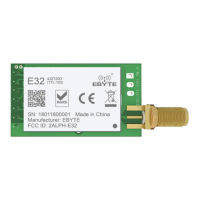



 To Next Page