Need help?
Do you have a question about the Echo SRM-3021TES and is the answer not in the manual?
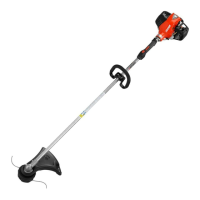
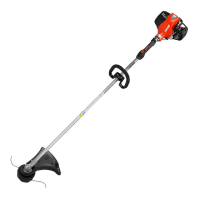
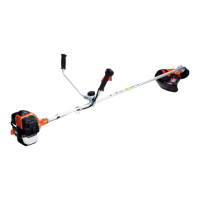
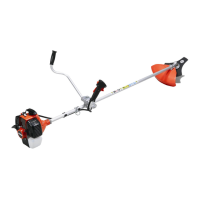
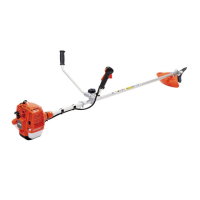
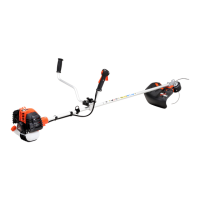
The ECHO SRM-3021TES is a lightweight, high-performance petrol-engined grass-trimmer/brushcutter designed for weed control, grass trimming, and brush cutting in areas difficult to manage by other means. It is available in two main versions: a loop-handle (L) version and a U-handle (U) version, with slight differences in dimensions and weight.
The SRM-3021TES is equipped with a 30.5 cm³ air-cooled two-stroke single-cylinder engine, featuring a diaphragm-type carburettor and a flywheel magneto - CDI ignition system. It uses an automatic centrifugal clutch for power transmission. The unit is designed for efficient cutting with either a nylon line cutting head or a metal blade, depending on the task. The angle transmission allows for a change in the angle of the rotating axis, while a shield protects the operator from accidental contact with the cutting head and thrown objects. A cut-off knife on the shield automatically adjusts the nylon line length to maintain a proper swath.
The SRM-3021TES requires proper training and protective equipment for safe operation. Users should be thoroughly familiar with the controls, including the ignition switch, throttle trigger, and throttle trigger lockout. The unit is started by pulling the starter handle, with specific procedures for cold and warm engines, involving the choke lever and purge bulb. The engine can be stopped using the ignition switch or, in an emergency, by moving the choke lever to the "Cold Start" position.
The product is designed to be used with a shoulder harness, which should be adjusted so the cutting attachment hangs a few centimetres above ground level and is level in all directions. Balancing the unit is crucial for comfortable and safe operation.
When trimming, it is important to clear the work area of small stones, cans, strings, or wires that could ricochet or become entangled. The danger zone around the product is a 15-meter radius, and no children, people, or animals should be allowed to enter this zone. The cutting attachment should not be held above knee level to prevent debris from flying towards the operator's face.
For nylon line cutting, the head is tapped against the ground to advance the line. For metal blade operation, the blade type must match the material being cut (e.g., 3-cutter blade for weeds/grass, 8-tooth for grass/garden debris/thick weeds, 22-tooth for dense thickets/saplings up to 64mm, 80-tooth for brush/woody growth up to 13mm). Special attention must be paid to kickback when using metal blades, avoiding hard objects and trimming from left to right.
Regular maintenance is essential for safe and efficient operation. Key maintenance tasks and their recommended frequencies include:
The air filter should be cleaned by brushing off dirt or using compressed air. The fuel filter should be replaced if excessively dirty or improperly fitted. Carburettor adjustments, particularly idle speed, should be performed carefully, ensuring the cutting attachment does not rotate at idle. Cooling fins and silencer deposits must be regularly cleaned to prevent overheating and power loss. The spark plug gap should be checked and adjusted to 0.6-0.7 mm, and the plug replaced if worn or damaged. The angle transmission requires periodic greasing.
When replacing the shield or installing a metal blade, a locking tool must be used to secure the output shaft. Blades should be inspected for sharpness and cracks before installation, and dull or damaged blades must be replaced. Nylon line is loaded by cutting it to the recommended length (2.4 mm diameter, 3.5 m length) and winding it onto the spool until about 13 cm remains exposed on each side. Wear indicators on the nylon line cutting head signal when the cover or entire head needs replacement.
For long-term storage (30 days or more), the fuel tank and purge bulb should be completely drained, the engine run until it stops, and the unit cleaned. The spark plug should be removed, a small amount of 2-stroke engine oil added to the cylinder, and the piston positioned at the top of its travel before reinstalling the plug (without connecting the cap). The unit should be stored in a dry, dust-free location away from children and ignition sources.

 To Next Page
 General