EC-11 User’s Manual 23
DALSA Corp. 03-32-00418-05
points for a lens should be available from the lens data sheet or from the lens
manufacturer. Primed quantities denote characteristics of the image side of the lens. That
is, h is the object height and h
′
is the image height.
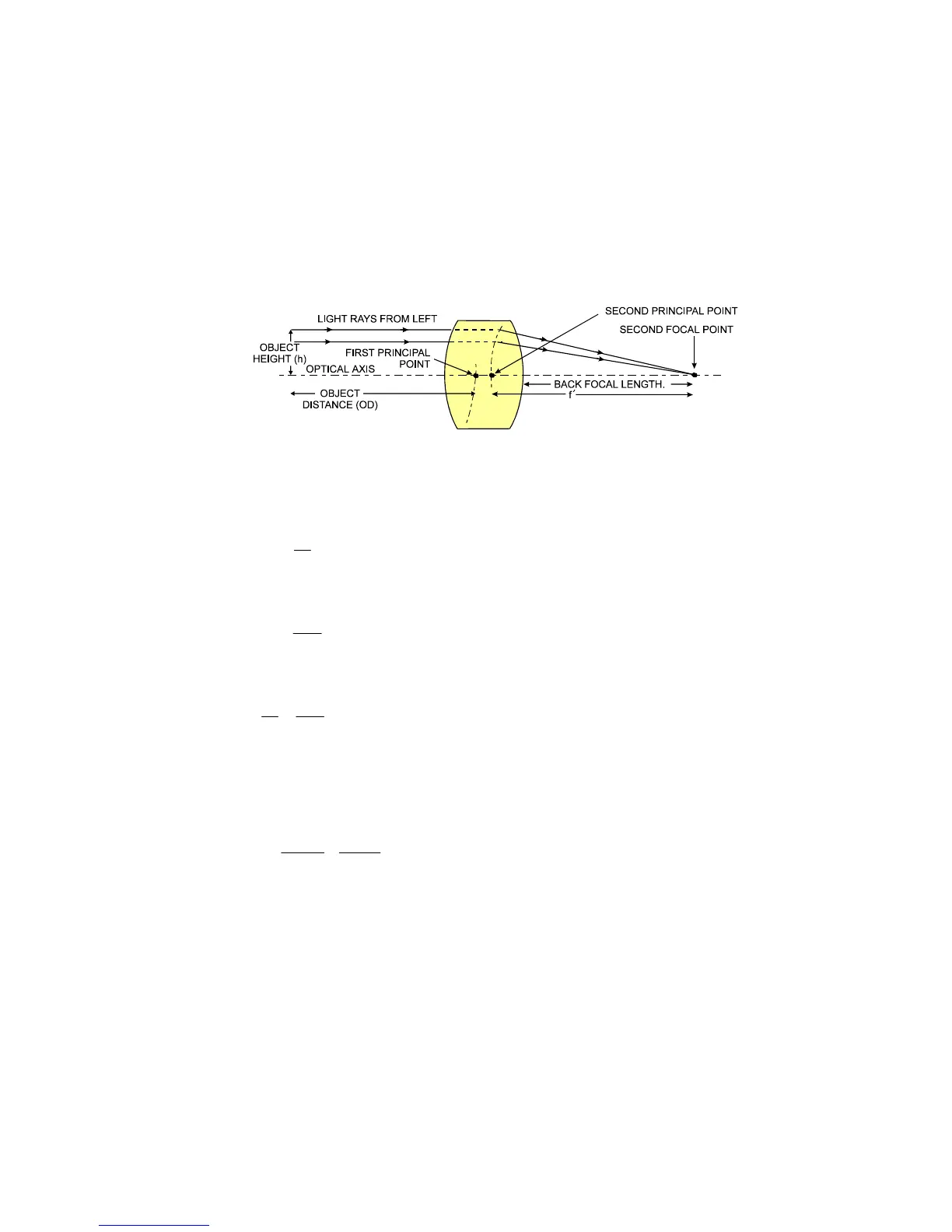
The focal point is the point at which the image of an infinitely distant object is brought to
focus. The effective focal length (f
′
) is the distance from the second principal point to the
second focal point. The back focal length (BFL) is the distance from the image side of the
lens surface to the second focal point. The object distance (OD) is the distance from the first
principal point to the object.
Figure 5. Primary Points in a Lens System
Magnification and Resolution
The magnification of a lens is the ratio of the image size to the object size:
m
h
h
=
′
where m is the magnification, h’ is the image height (pixel size)
and h is the object height (desired object resolution size).
By similar triangles, the magnification is alternatively given by:
m
OD
=
′
These equations can be combined to give their most useful form:
′
=
′
h
h
OD
This is the governing equation for many object and image plane
parameters.
Example: An acquisition system has a 512 x 512 element, 10µm pixel pitch area scan
camera, a lens with an effective focal length of 45mm, and requires that 100µm in the
object space correspond to each pixel in the image sensor. Using the preceding equation,
the object distance must be 450mm (0.450m).
10
100
45
450 0 450
µ
µ
m
mm
OD
OD mm m==(. )



 To Next Page