
 Need help?
Do you have a question about the EcoFlow Glacier and is the answer not in the manual?
Details dangers and precautions related to electrical shock.
Lists precautions to prevent fire risks.
Warns against storing flammable materials.
Instructions to avoid food contamination and mold.
Details how to adjust temperatures for both zones independently.
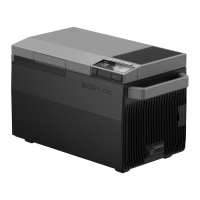
The EcoFlow Glacier Portable Fridge is a versatile cooling device designed for various applications, including household, outdoor, vehicle, boat, and similar environments such as staff kitchens, offices, farmhouses, hotels, motels, bed and breakfast establishments, catering, and camping. Its primary function is to provide refrigeration and freezing capabilities for food and medicine, with the added convenience of an integrated ice maker.
The EcoFlow Glacier operates as a portable fridge and freezer, offering both single and dual-zone temperature control. This allows users to simultaneously refrigerate and freeze items at different temperatures, or to convert the entire unit into a single temperature zone by removing the internal divider. The device is powered by multiple sources, including AC mains, 12V/24V car charging, and solar charging (with an optional EFBX100-EB battery pack).
A key feature of the EcoFlow Glacier is its integrated ice maker. Users can produce bullet-head-shaped ice cubes, with options for large or small sizes. The ice-making process is initiated by filling the ice maker compartment with potable water and pressing the dedicated ice-making button. The device provides visual feedback on the LCD, indicating the ice-making time and status. An ice detaching button allows for manual ice detachment or cancellation of the ice-making operation.
The device is equipped with an LCD screen that displays important information such as battery level, charging status (car, adapter, solar), ECO mode activation, Wi-Fi and Bluetooth connections, temperature settings for both left and right zones, and ice-making status (water shortage, ice container missing, ice cube size, and remaining time). Error codes are also displayed on the LCD to assist with troubleshooting.
For enhanced control and monitoring, the EcoFlow Glacier can be connected to the EcoFlow App via Wi-Fi (2.4GHz only) or Bluetooth. The app allows users to remotely control temperature settings, monitor device status, and customize various functions.
The EcoFlow Glacier is designed for ease of use and portability. It features a detachable handle and optional detachable wheels, making it convenient to transport. The installation process involves selecting a dry, well-ventilated location with adequate clearance (at least 2 inches or 50 mm on all sides) to ensure proper heat dissipation. The device should be placed on a steady surface to prevent vibration and noise, and it includes an anti-fall protection mechanism that activates if the tilt angle exceeds 30 degrees.
Connecting to a power supply is straightforward. For AC mains, a dedicated power outlet should be used, and the power adapter and cable are provided. When connected to AC mains, the device prioritizes refrigeration power and charges the optional EFBX100-EB battery pack at an optimal rate. For car charging, the device connects to a 12V/24V car charging port, also charging the optional battery pack. Solar charging is supported with an optional solar charging cable and requires the EFBX100-EB battery pack to be connected for proper operation.
The device incorporates a 3-stage battery protection function, which can be managed via the EcoFlow App. This feature prevents excessive discharge when connected to a vehicle starter battery. If the supply voltage drops below a set level, the device automatically switches off or, if an EFBX100-EB battery pack is connected, switches to battery power without shutting down. Users are advised to turn off battery protection when connecting to a portable power station.
Temperature settings are intuitive. After powering on, users can short press the temperature zone switching button to select a zone, then use the + or - buttons to adjust the temperature. Long pressing these buttons allows for quick temperature adjustments (±5°C). The settings are confirmed after 2 seconds of inactivity. The EcoFlow App also provides remote temperature control.
For food storage, specific recommendations are provided for both fridge and freezer modes. In fridge mode, it's suitable for fresh food with a short storage period, and users are advised to cool hot food before placing it inside, avoid frequent door openings, and use sealed containers to preserve freshness and prevent odors. In freezer mode, it's ideal for long-term storage of frozen foods like meat, sausage, poultry, and fish. Users are cautioned against placing bottles in the freezer to prevent rupture and injury, refreezing thawed food, and directly touching the freezer interior or metal containers with wet hands to avoid frostbite.
Regular care and maintenance are crucial for the longevity and optimal performance of the EcoFlow Glacier. Before any cleaning or maintenance, the device must be disconnected from all power sources to ensure safety.
Internal parts, such as the ice maker and ice container, should be cleaned every time ice is made. The user manual provides instructions for removing and cleaning these components. When reassembling, users should avoid using excessive force to prevent damage.
Cleaning the refrigerator involves wiping both the inside and outside with a soft cloth dampened with a neutral detergent. Harsh cleaning agents, abrasive materials, hot water, or rough brushes should be avoided as they can damage or corrode the device. The device should never be cleaned under running water or immersed in water.
Good ventilation is essential, so users must ensure that the air inlets and outlets are free of dust and dirt. After cleaning, it's important to check the power cable for damage or wetness and ensure the power plug is not overheated before reconnecting to a power supply. Any moisture on electrical components should be dried with a soft cloth or sponge to prevent electric shock or short circuits.
Defrosting is recommended when frost accumulates inside the refrigerator or on the evaporator, as this can reduce refrigeration capacity. The defrosting process involves removing all items, chilling them in another refrigerator if possible, turning off the device, leaving the door open, and wiping away any water stains with a clean rag. Users are explicitly warned against using hard or sharp tools or mechanical devices not recommended by the manufacturer to speed up defrosting.
The device also includes drainage features for both single/dual zones and the ice maker, facilitating the removal of water during cleaning or defrosting.
 General
| Capacity | 38L |
|---|---|
| Rated Power | 120W |
| Refrigerant | R134a |
| Power Source | AC, DC, Battery |
| Battery Capacity | 298Wh |
| Input Voltage | 12/24V DC, 100-240V AC |

 To Next Page