This document describes the EcoWater Systems ERO-175 Undersink Reverse Osmosis Drinking Water System, a unit designed to provide high-quality drinking water by reducing dissolved solids and organic matter. The system is certified by NSF International against NSF/ANSI Standards 42 & 58 for specific performance claims, including pentavalent arsenic reduction on chlorinated water supplies.
Function Description:
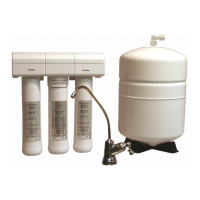
The ERO-175 is a reverse osmosis (RO) water treatment unit that processes cold water to remove impurities. Water first enters a sediment prefilter, which reduces chlorine, sand, silt, dirt, and other sediments. This pre-filtration is crucial as chlorine can destroy the RO membrane. After pre-filtration, water proceeds to the RO membrane cartridge, where it is forced through a special membrane that separates minerals and impurities. High-quality product water then goes to a storage tank or directly to the postfilter and RO faucet. Reject water, containing dissolved solids and organic matter, is routed through a flow control and to the drain. From the storage tank, product water passes through a postfilter, an activated carbon type filter, which further reduces any remaining tastes, odors, and sediments before it is dispensed through the RO faucet. The faucet includes an air-gap to comply with plumbing codes. The system features an automatic shutoff that stops water flow when the storage tank is full and the faucet is closed, conserving water. A check valve in the RO manifold prevents backward flow from the storage tank, protecting the RO membrane. A flow control regulates water flow through the RO membrane to maintain optimal product water quality.
Important Technical Specifications:
- Feed Water Pressure Limits: 40-100 psi
- Feed Water Temperature Limits: 40-100°F (minimum/maximum)
- Maximum Total Dissolved Solids (TDS): 2000 ppm
- Maximum Water Hardness @ 6.9 pH: 10 grains per gallon (gpg)
- Maximum Iron, Manganese, Hydrogen Sulfide: 0
- Chlorine in Water Supply: Allowable (max. 2.0 ppm for RO Prefilter reduction)
- Feed Water pH Limits: 4-10
- Product (Quality) Water, 24 hours (closed system): 18.4 gallons
- Percent Rejection of TDS (minimum, new membrane): 86.5%
- Automatic Shutoff Control: Yes
- Efficiency Rating: 12.2% (percentage of influent water available as RO treated water under typical daily use)
- Recovery Rating: 22.9% (percentage of influent water available as RO treated water when operated without a storage tank or when the storage tank is bypassed)
- Storage Tank Air Charge: 5-7 psi
- Nitrate/Nitrite Reduction: Certified for influent concentrations of no more than 27 mg/L nitrate and 3 mg/L nitrite (measured as N) at 280 kPa (40 psig) or greater.
Usage Features:
- Installation Flexibility: The system fits under a kitchen or bathroom sink but can be installed in other convenient locations, provided there is a cold water supply pipe and drain point within a few feet (6' tubing lengths included). Longer tubing lengths are available for more distant installations.
- Faucet Installation: The RO faucet can be installed in an existing sink spray attachment hole, a drilled hole in the sink top, or on the countertop next to the sink.
- Drain Connection Options: Reject water can be routed directly to a floor drain, laundry tub, sump, or standpipe, or connected to the sink p-trap drain pipe using a drain clamp or special drain adapter (part no. 7192230). Local plumbing codes must be followed.
- Tubing Connections: The system uses push-in fittings for quick and secure tubing connections. Tubing should be cut square and free of nicks or scratches to prevent leaks.
- Sanitization: Sanitization is recommended immediately after installation and after servicing inner parts. It involves adding a small amount of household bleach to the yellow tank tubing.
- Purging: After installation and sanitization, the system must be purged by letting water flow from the RO faucet for a 24-hour period to remove bleach and carbon fines.
- Pressure Testing: After initial setup, the system should be pressure tested for approximately two hours to check for leaks.
Maintenance Features:
- Prefilter and Postfilter Cartridge Replacement: These cartridges must be replaced at least every 6 months of product water use, or more often if the prefilter begins to plug with sediments or if chlorine taste/odor is detected in the product water. Regular replacement is critical to protect the RO membrane from chlorine damage and sediment plugging.
- RO Membrane Cartridge Replacement: The RO membrane cartridge is a critical component for system efficiency. It should be replaced when the product water rate or quality drops (e.g., water tastes different or bad), indicating that solids and organics are passing through the membrane. Membrane life is affected by pH and hardness of the supply water, ranging from over a year with neutral pH to as short as 6 months with high pH (8.5-10). When replacing the RO cartridge, it is recommended to also replace the prefilter and postfilter cartridges.
- Flow Control Inspection: Periodically check the flow control to ensure the small hole through it is clean and unrestricted, as it is vital for maintaining proper water flow through the membrane.
- Automatic Shutoff/Paddlewheel Service: If the shutoff assembly or paddlewheel requires service, parts must be reassembled exactly as shown in the manual.
- Troubleshooting Guide: The manual includes a comprehensive troubleshooting guide for common issues such as slow product water production, high TDS in product water, chlorine taste/odor, other tastes/odors, continual water flow to drain, and leaks.
- Accessibility for Service: Tubing lengths should be kept long enough to allow for removal of the RO assembly from hanger washers for easier servicing. The assembly can be wall-mounted or laid on the cabinet floor.

 Need help?
 General

 To Next Page