Chapter 3 Propulsion SystemChapter 3 Propulsion System
Chapter 3 Propulsion SystemChapter 3 Propulsion System
Chapter 3 Propulsion System
2020
2020
2 0 EdgeWater 175CC /
155CC
3.3 Pr3.3 Pr
3.3 Pr3.3 Pr
3.3 Pr
opellersopellers
opellersopellers
opellers
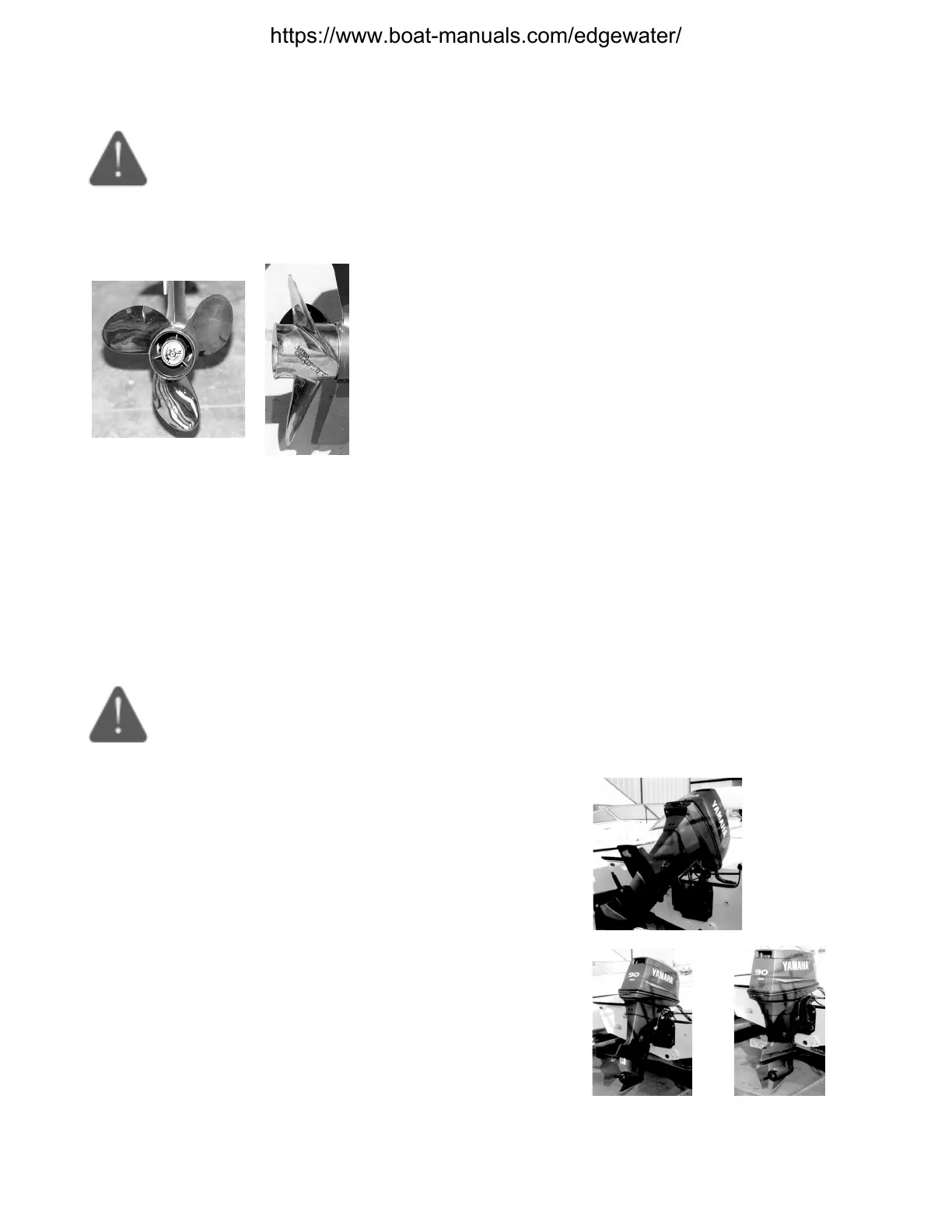
A turning propeller moves the boat through the water, forward or backward. They should
always be clean and free from nicks or dings, which can adversely affect performance. Your
dealer can assist you in the proper selection of a propeller for your boat. This selection is based on the
horsepower of the engine and its relationship to the size and
weight of the boat.
Propeller sizes are determined by two numbers, which appear
on different propellers at various locations. They are listed in
sequence, for example 13 x 17. The first number is the diameter
of the propeller and the second is the pitch. Pitch is the
theoretical distance the propeller moves through the water with
each complete revolution. The larger the number the greater
the theoretical movement. It also follows that the larger the
number the greater horsepower is required to turn it. With a
load which is normal, or usual for your boating activities, the
engine should be able to reach its maximum operating RPM range at wide open throttle (WOT). With a
light load on smooth water, the engine should reach its manufacturers rated maximum operating RPM
at wide open throttle (WOT) and maximum trim. If it does not, you may have a propeller which has too
much pitch. If it goes beyond the maximum recommended RPM range, you may have too little pitch.
Neither condition is good for the engine. You will get shorter engine life and poorer performance than
your boat and motor were designed to provide.
If your boat came from the factory with a propeller selected by EdgeWater, it should already be
optimized for the performance of your boat. Before changing the pitch or diameter of your propeller
always check with your dealer to determine how the changes will affect your boat and engine
performance.
3.4 Engine Power T3.4 Engine Power T
3.4 Engine Power T3.4 Engine Power T
3.4 Engine Power T
ilt and Tilt and T
ilt and Tilt and T
ilt and T
rimrim
rimrim
rim
The power tilt and trim system on your outboard provides the ability
to optimize the running angle of your EdgeWater 175CC / 155CC
to allow for load and sea conditions. Moving the outboard lower
unit toward the transom is generally referred to as trimming in,
while moving the outboard lower unit away from the transom is
referred to trimming out. It is generally best to have the engine
trimmed in for acceleration from displacement to planning mode.
This brings the bow down and requires less fuel and effort on the
engines part to plane off the hull.
The first 20
o
of movement aft of the transom is referred to as
trim and is the area generally used to operate the boat while on
plane. The area beyond the first 20
o
is referred to as tilt and is
usually reserved for operating in shallow water or pulling up on a
beach.
While running under normal conditions, the bow should be in a 3
o
to 5
o
up angle to maximize the hulls ride and performance. When
Engine
Tilt
Max
Trim
Tilt
Under
https://www.boat-manuals.com/edgewater/



 To Next Page