Need help?
Do you have a question about the EFT Z Series and is the answer not in the manual?
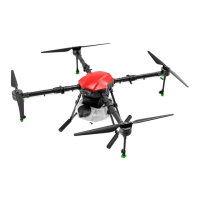
Describes the Z series agricultural UAV system features, load models, design, and waterproof capabilities.
Provides a labeled diagram identifying the main components of the agricultural drone.
Details the visual and functional checks required for all drone components before flight.
Covers the installation procedure for the smart battery and essential handling precautions.
Presents a visual overview of the remote control, labeling its various buttons, sticks, and screen.
Explains the function of each control stick, lever, and button on the remote control for aircraft operation.
Details the meaning of different LED light patterns and colors on the remote control.
Illustrates the remote control's home screen layout and explains the information displayed on the top bar.
Explains how to navigate the touchscreen interface using gestures like sliding up and down.
Provides instructions on how to charge the remote control using a PD fast charger and Type-C cable.
Details the recommended antenna positioning and the maximum safe operating distance between the remote and aircraft.
Explains how to control the aircraft using the sticks in the recommended 'American Hand' mode.
Provides step-by-step instructions on how to establish a wireless connection between the remote control and the aircraft.
Details how to customize channel settings for various functions, such as gear levers and buttons.
Configures the flight controller and baud rate for optimal data transmission.
Displays the main interface of the Agri Assistant app, showing connection status and navigation icons.
Guides users through the initial account registration process.
Covers drone plan addition and account activation after initial verification.
Provides instructions for calibrating the remote control's sticks to ensure accurate input.
Details the process for calibrating the accelerometer and compass for accurate flight data.
Provides steps to calibrate the flowmeter by measuring water flow through the pumps and nozzles.
Guides users on calibrating the weight system, requiring at least 10kg of objects for accuracy.
Configures spray parameters like liquid protection, liquid type, level type, and work mode.
Sets flight parameters including course mode and back head direction for optimal performance.
Configures additional modes like RTK trust, K-Box type, and other advanced settings.
Guides the selection of map types, such as Google Maps, for pre-flight debugging and operation.
Details the procedures for unlocking the motors and performing a safe landing of the aircraft.
Explains how to test the functionality of each motor by controlling the right stick.
Guides users on testing the water pump and nozzle functionality by pressing specific buttons.
Explains how to switch between Attitude, Manual, and Auto operation modes.
Guides the setup and execution of automated flight paths by defining two waypoints (A and B).
Details the process for creating and executing fully automated flight plans using the Ground Plan feature.
Provides steps for debugging the spreading system, including setting sowing mode and testing spreader speed.
Guides users on performing spreading operations by selecting plots, setting parameters, and initiating takeoff.
Details the steps for cleaning the drone and spraying system after each operation to ensure longevity.
Outlines routine checks for the drone frame, propulsion system, motors, and ESCs.
Details calibration needs and checks for impeller pump, tank, and filter.
Covers maintenance for the battery and power socket, including charging, handling, and cleaning precautions.
Provides guidelines for safely transporting the aircraft, including folding propellers and securing the drone.
Explains the different RTH modes (smart, low battery, failsafe) and the concept of the Home Point.
Guides users on how to download and share log files from the device for analysis or troubleshooting.
Explains how to access and interpret alarm messages and prompts from the device.
Presents detailed technical specifications for the Z30 and Z50 drone models, covering weight, dimensions, and system components.

 To Next Page

 General