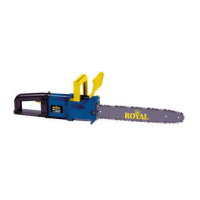
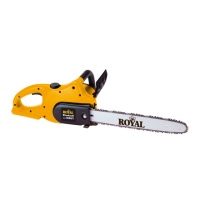
This document describes the Einhell® ROYAL KSE 2040 WK Electric Chainsaw, a tool designed for sawing wood.
Function Description
The electric chainsaw is intended exclusively for sawing wood and wooden objects. Any other use is considered improper and potentially dangerous, with the manufacturer not liable for damages resulting from such misuse or incorrect operation.
The chainsaw is operated by a single person. It features a safety switch (3) and an On/Off switch (4) with a power-on disable (4a). To start, the power-on disable (4a) is pressed with the thumb, followed by the On/Off switch (4), then the power-on disable is released. The chainsaw immediately runs at maximum speed upon activation. To switch off, the On/Off switch (4) is released. The chainsaw should only be put down once the chain has stopped rotating.
A key safety feature is the chain brake (16). In the event of kick-back, the front finger guard (1) is pushed forward by the back of the hand, which actuates the chain brake, stopping the chainsaw motor within 0.10 seconds. To release the chain brake and make the saw operational again, the machine must first be switched off. Then, the front finger guard (1) is pushed back into its vertical position until it locks in place.
The chainsaw has an automatic chain lubrication system (10). It is crucial to ensure proper lubrication to prevent excessive wear of the saw chain and chain bar. The oil flow can be adjusted using the oil regulating screw (13), allowing for less oil with damp, soft wood (clockwise turn) and more oil with dry, hard wood (anti-clockwise turn).
Important Technical Specifications
- Power Supply: 230 V ~ 50 Hz
- Power Rating: 2000 W
- Max. Cutting Length: 40 cm
- Cutting Speed at Rated RPM: 22 m/s
- Oil Tank Capacity: 85 ml
- Weight (without sword + chain): 4.5 kg
- Protection Class: II/
- Guaranteed Sound Power Level under Load: 106 dB(A)
- Sound Pressure Level under Load: 84 dB(A)
- Acceleration (calculated according to EN 50144):
- Rear grip under load: 2.77 m/s²
- Front grip under load: 2.71 m/s²
Usage Features
Safety First: Always wear protective headgear, goggles, ear muffs, protective gloves, and heavy-duty work clothes. Avoid working on ladders, in trees, or unstable positions. Do not saw above shoulder height or with one hand. Ensure a firm footing when operating the chainsaw.
Extension Cables: Use only approved extension cables with prescribed insulation and connections for outdoor use (approved rubber-sheathed cables) that fit the machine plug.
Sawing Wood (Fig. 4 and 5):
- Secure wood firmly, especially short pieces, before sawing.
- Saw only wood or wooden objects. Avoid contact with stones, nails, wire fences, or the ground, as these can damage the chain and be catapulted.
- Use a strong support like a sawing trestle (Fig. 4) for converted timber and thin branches. Do not stack timber or have it held by another person or foot.
- Secure logs in position.
- On sloping ground, always work facing upwards.
- Pull the saw out of the wood only when the saw chain is running.
- If performing multiple cuts, switch off the chainsaw between cuts.
- Be cautious with splintered wood, as pieces can be catapulted.
- Do not use the chainsaw to remove or sweep away small pieces of wood or similar objects.
- Branch lopping should only be done by trained personnel due to injury risk.
- Pay special attention to branches under tension; do not cut freely suspended branches from underneath.
- Never stand on the trunk when lopping off branches.
- The chainsaw is not for forest work (felling and lopping in forests) due to cable connection limiting mobility and safety.
- When felling, always stand to the side of the tree. Watch out for falling branches when retreating.
- On slopes, the operator should stand to the upper or left/right side of the trunk or lying tree.
Preventing Kick-back:
- Never start cutting with the tip of the chain bar (Fig. 6). Always observe the tip.
- Be careful when continuing cuts already started.
- Always start cuts with the chainsaw running.
- Ensure the saw chain is properly sharpened.
- Do not cut through more than one branch at a time.
- When cross-cutting, pay attention to nearby trunks. Use a sawing trestle if possible.
- Plunge cuts and horizontal cuts should only be performed by professionals due to high kick-back risk (Fig. 6).
- For horizontal cuts, position the saw at the smallest possible angle, exercising extreme caution as the claw stop cannot be applied.
- If the chain gets stuck when sawing with the upper side, it may be thrust towards the operator. Saw with the bottom side whenever possible, as the chainsaw will then be pulled away from the body towards the wood (Fig. 7 and 8).
Felling Trees:
- Only fell trees with a diameter smaller than the length of the chain bar.
- Never try to extract a jammed saw with the motor running; use a wooden wedge.
- Danger Zone (Fig. 11): Falling trees can bring down others. The danger zone is twice the length of the tree being felled.
- Escape Area (Fig. 13): Plan and clear an escape area (A) behind the expected felling direction (B).
- Felling Direction (Fig. 12): Estimate direction based on crown's center of gravity and wind. Make an undercut in the felling direction, then a horizontal back cut on the opposite side.
- Undercut: Provides direction and guidance. Correct if necessary by recutting across the entire width.
- Shout "Timber!"
- Back Cut: Higher than the undercut's sole. Insert wedges in time.
- Break Strip: Leave it as a hinge; cutting it through leads to uncontrolled fall.
- Wedge the tree, don't saw through it.
- Retreat when the tree falls. Observe the crown's swing. Do not work under hung-up branches.
- Do not fell in fog, rain, snow, twilight, or strong winds.
- Do not fell on steep, icy, frozen, or dewy ground unless footing is secure.
Maintenance Features
After Each Use: Clean the saw chain and chain bar. Attach the chain guard.
Before Starting Up:
- Check chain lubrication and oil level (Fig. 9). If oil is approx. 5 mm from the "Min" mark, top up.
- Switch on the chainsaw and hold it over light-colored ground (approx. 20 cm clearance). If an increasing oil trace appears, lubrication is working. If not, clean the oil outlet, upper chain tensioning borehole, and oil duct.
Chain Bar (13): The chain bar experiences high wear at the nose and bottom. To prevent one-sided wear, turn the chain bar over every time you sharpen the chain.
Chain Wheel (14, Fig. 2/Item C): Subjected to high wear. Replace if deep wear marks are visible on teeth, as a worn chain wheel curtails saw chain life.
Sharpening the Saw Chain (18): Can be done by specialist dealers or yourself using sharpening equipment. Follow corresponding instructions. Keep tools sharp and clean.
Storage: Store the chainsaw safely. Clean unused tools and store them on a flat, dry surface, inaccessible to children.
Ordering Replacement Parts (21): When ordering, provide the machine type, article number, identification number, and the required part number.

 Need help?
 General

 To Next Page