43
R-134a PROPERTIES
The properties of R-134a are very similar to those of
R12. The principal data for the two refrigerants are
shown in the chart below.
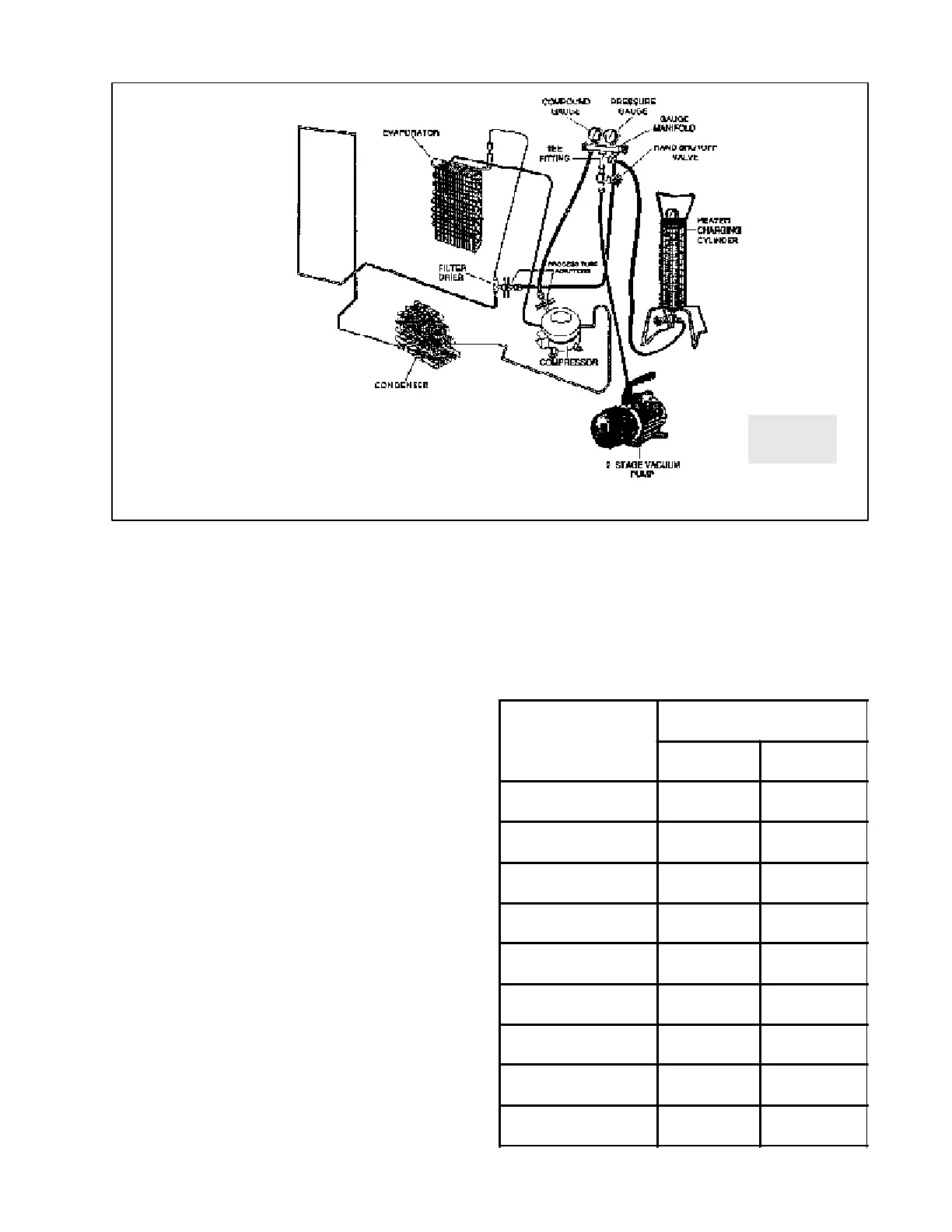
Evacuating and Recharging Connections
REFRIGERANT LEAKS
A system with R-134a and Ester oil will become
saturated with moisture much faster than a system with
R-12 and mineral oil. The compressor in an R-134a
system will have to be replaced if the product has had a
low side leak.
R-134a refrigerant molecules are smaller than R-12
molecules. This means that R-134a will pass more minor
leaks and the rate of flow will be greater than for R-12.
Therefore, it is now more important than ever to follow
good brazing practices. Use a good grade of silver
solder. 45% silver solder is recommended.
LEAK DETECTION
R-134a system leaks can be pinpointed by means of an
electronic leak detector or by bubble solution.
Electronic leak detectors for R-134a service are currently
available from several manufacturers. The least
expensive models are non-selective detectors that will
detect any type of emission or vapor present, regardless
of its chemical composition. Some non-selective
detectors designed for use with R-12 may have a much
lower sensitivity when used with R-134a. However,
newly designed detectors with good R-134a sensitivity
are now available. Be sure to consult with the
manufacturer before selecting or using a non-selective
detector with R-134a.
Halogen-specific detectors use a specialized sensor
that allows detection of compounds containing chlorine,
fluorine, bromine, and iodine without being activiated by
other species. The major advantage of this type of
REFRIGERANTS
R-12 R-134a
NAME
Dichlorodifluoro-
methane
1,1,1,2--Tetra-
fluoromethane
Formula
CCI
2
F
2
CH
2
F-CF
3
Molecular Weight (g/mol)
120.93 102.3
Ozone Depletion Potential
(ODP)
1 0
Global Warming Potential
(GWP)
3.1 0.3
Boiling Point °F
-21.6 -15.7
Vapor Pressure (77°F)
80 psig 82 psig
Flammability None None
Solubility of Water in
Refrigerant (wt% @ 77°F)
0.009 0.11
detector is a reduction in the number of “nuisance
alarms”. Halogen-specific detectors are generally more
expensive than non-selective detectors but feature
higher sensitivity.
Figure
E4




 To Next Page