-8-
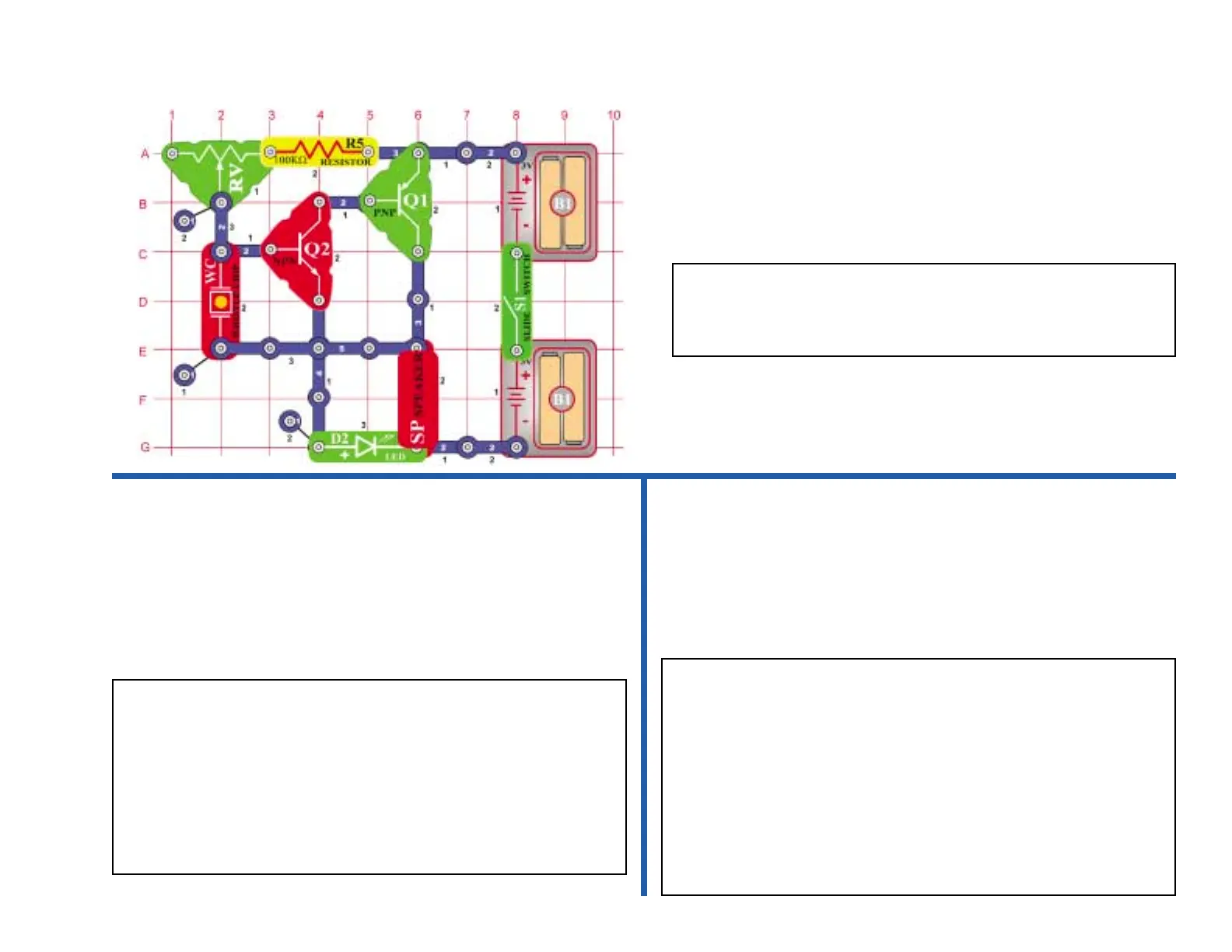
Project #110
OBJECTIVE: To show how resistor values change the
Turn on the slide switch (S1), the speaker (SP) will sound and the LED
(D2) will light. Adjust the resistor (RV) to make different tones. In an
oscillator circuit, changing the values of resistors or capacitors can
vary the output tone or pitch.
Adjustable Tone Generator
OBJECTIVE: To show how resistor values change the
Project #112
Electronic Cicada
OBJECTIVE: To show how capacitors in parallel
Use the circuit from Project 110 shown above, replace the
photosensitive resistor (RP) back to the 100kΩ (R5) resistor. Place the
0.02µF (C1) on top of the whistle chip (WC). Place the slide switch (S1)
on and adjust the resistor (RV). The circuit produces the sound of the
cicada insect. By placing the 0.02µF on top of the whistle chip, the
circuit oscillates at a lower frequency. Notice that the LED flashes also
at the same frequency.
It is possible to pick resistors and capacitors that will make the pitch
higher than humans can hear. Many animals, however, can hear these
tones. For example, a parakeet can hear tones up to 50,000 cycles per
second, but a human can only hear to 20,000.
Use the circuit from Project 110 shown above. Replace the 100kΩ (R5)
with the photosensitive resistor (RP). Turn on the slide switch (S1). The
speaker (SP) will sound and the LED (D2) will light. Move your hand up
and down over the photosensitive resistor (RP) and the frequency
changes. Decreasing the light on the photosensitive resistor increases
the resistance and causes the circuit to oscillate at a lower frequency.
Notice that the LED flashes also at the same frequency as the sound.
By using your finger, see if you can vary the sounds enough to make this
circuit sound like an organ playing.
Project #111
Photosensitive Electronic Organ


 To Next Page