5.2
Installation and operation
Before the new EG series compressor is operated for the
first time, it needs to be installed at your site according to
ELGi's installation guidelines.
5.1.1 Unpacking
Unpack the compressor from the packing case by
removing the nails. Unscrew the bolts, holding the
compressor to the base of the crate.
Once the packing material is removed, check the contents
against the packing list. The compressor is shipped with
the following
Key for doors
Operation and maintenance manual
Checklist of parts of the machine
Electrical drawing
5.1.2 Disposal of packing material
The wood/cardboard used to make the shipping crates of
the EG series compressors are biodegradable.
The polyethylene covers wrapped around the compressor
and the polystyrene packing provided around the electrical
panels are not recyclable. They must be disposed off in
accordance with prevailing local environmental laws.
5.1.3 Handling
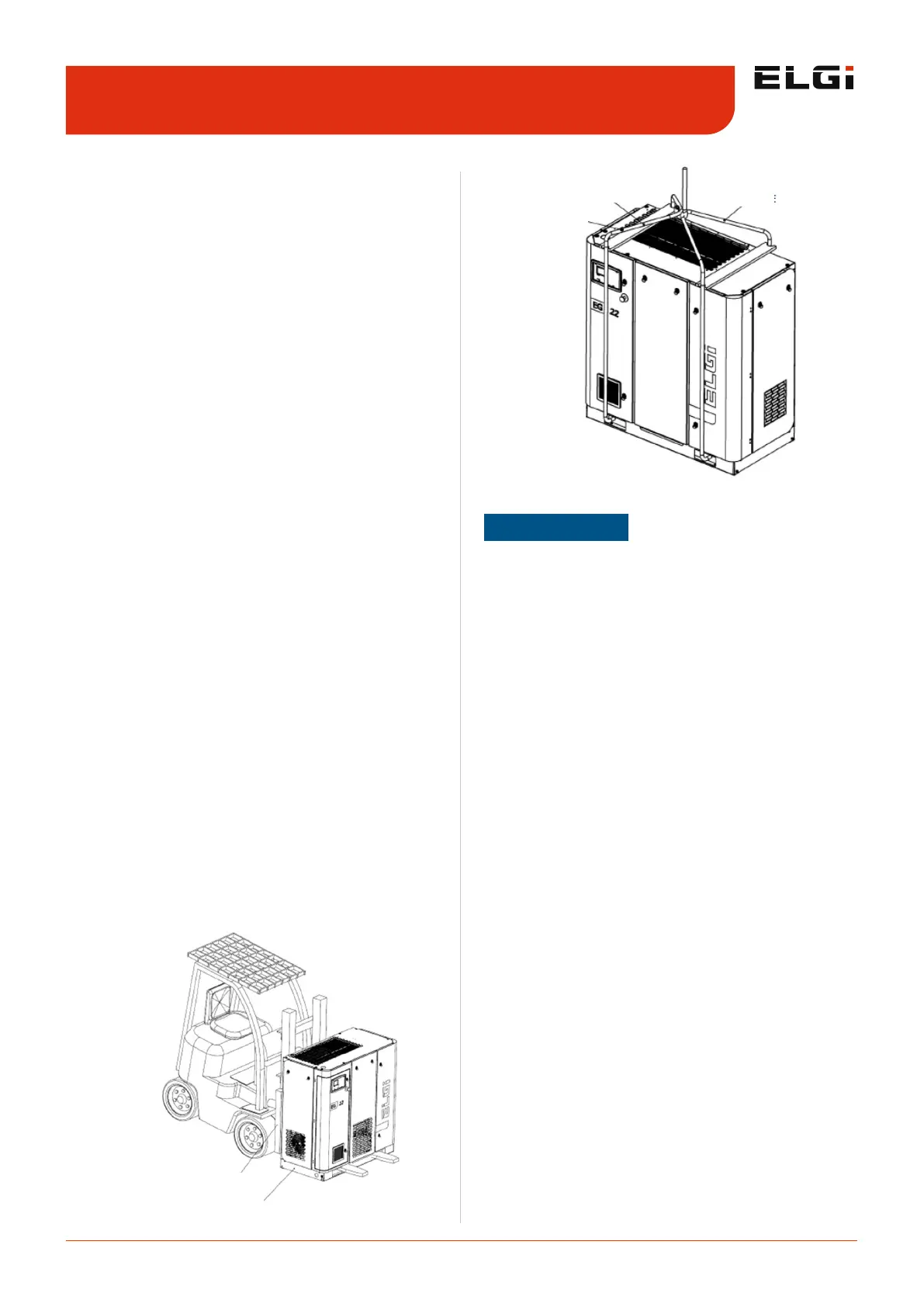
1. Lift compressors using either a forklift/pallet truck
(Fig.2) or a crane (Fig.3).
2. When using a forklift, ensure padding is used in
between the compressor and forklift (as shown in Fig.2)
to prevent damage to the compressor’s canopy.
3. When using a crane, please ensure stiff spreader bars
are used (as shown in Fig.3) to prevent rope slings from
damaging the compressor’s canopy.
4. Do not drop the compressor.
5. Do not attempt to move the compressor by pushing or
dragging it as this may cause jerky movements causing
damage to the compressor.
5.1.4 Site requirements
Install the air compressor in a clean, dry, cool and dust
free room as extreme temperatures (hot or cold),
moisture, air borne contaminants can significantly affect
compressor performance, durability and compressed air
quality.
Be aware the entrance to the compressor room should
be high enough and wide enough to carry the
compressor in and out.
Leave a minimum of 1m (3.28ft) space around the
compressor for safe and proper inspection, cleaning,
and maintenance activities.
Leave minimum of 2m (6.56ft) space above the
compressor for hot air to flow away from the
compressor.
Ensure the compressor is protected against direct
sunlight and rain.
Avoid exposing the compressor to excessive moisture
(from rain, dryer vent, etc.) as moisture can affect
airend lubrication, promote rust formation on the
compressor and lead to electrical problems of the
motor.
Neither install the machine in a location where flame is
used nor place any inflammable objects near the
compressor.
Installation and commissioning 5.1
NOTE
Removal of transit brackets:
Once you have placed the compressor in its final position,
remove the red painted transit brackets and store for
future use.
Locations:
Bracket in between the base and airend support
Bracket in between the base and motor
Bracket in between the shroud and control panel box
Figure 2. Lifting using forklift
PLACE A PAD HERE
COVER TO ACCESS PALLET
TRUCK
Figure 3. Lifting using crane
STIFF SPREADER BAR
ROPE
ROPE


 To Next Page
 Loading...