5.3
Installation and operation
Ensure the room temperature is within 50ºC (122ºF) as
high ambient temperatures can reduced oil life due to
higher discharge oil temperature (DOT). It also results
in high approach temperatures affecting cooling and
condensation efficiency in the after-cooler and in air
treatment equipment like air dryers.
Ensure the hot medium of other utility equipments like
genset/dryer/ boilers, etc., hot medium not sucked by
compressor inlet or that in any way room temperature
does not rise to prevent high discharge oil temperature.
Ensure the ambient temperature does not drop below
0ºC (32ºF). Provide air supply openings and adjustable
louvers to ensure that the minimum temperature does
not drop down below 0ºC (32ºF).
Ensure unevenness of the surface is within 6mm
(0.25").
If the floor is splashed frequently with water while
cleaning, then place your compressor on a raised
concrete plinth 100 to 150 mm (4 to 6 inches) high.
Ensure the compressor base makes 100% contact
directly with the floor.
Know that an industrial floor with level surface capable
of supporting the weight if the compressor is sufficient
for installing your compressor. No special foundation or
anchoring is necessary for rotary screw compressors.
Do not store toxic, volatile, or corrosive agents near the
compressor.
Isolate the compressor from corrosive agents like
ammonia, chlorine, salt spray, and other chemicals as
these may erode the internal components and also
contaminate the oil and filters.
Do not allow hot air from additional equipment to blow
towards the compressor.
If you operate in high dust applications like rice mills,
cement, flour mills, etc., it would be necessary to clean
and replace the filters more often.
Good practice is to have overhead lifting in the
compressor room to facilitate any major overhaul. If an
overhead hoist is not available, you should be able to
use a mobile crane or forklift truck in your compressor
room at a minimum.
5.1.4.1 Ventilation
A part of electric energy to your compressor motor is
converted into heat and this heat must be removed
from the compressor room by suitable ventilation.
The ventilation requirements of the compressor are
listed in Table 1.
The ventilation requirements could be achieved by the
following methods.
Natural ventilation is sufficient if the temperature rise in
the compressor room (measured by a thermometer
near the air inlet pre-filter) is within 5ºC (9ºF) when
compared with outside temperature
Forced ventilation with an exhaust fan is necessary if
the temperature rise inside the room (measured by a
thermometer near the air inlet pre-filter mesh) is rises
above 5ºC (9ºF) .
Ventilation with ducts: Ensure hot air exhaust from the
compressor is diverted through the ducts when installed
in an enclosed area. (contact ELGi for ducting
requirements)
Provide openings on walls/partitions close to the air
suction side of the compressor.
Provide exhaust openings close to the ceiling for hot air
exit.
If more than four compressors are installed in a room,
good practice is to provide ducting arrangements. This
will avoid hot air recirculation.
Be aware hot air recirculation in the enclosed area will
affect the compressor performance.
Ensure the air velocity in the supply and exhaust ducts
does not exceed 4 m/s (13 ft/s).
Know air velocity is ascertained during commissioning
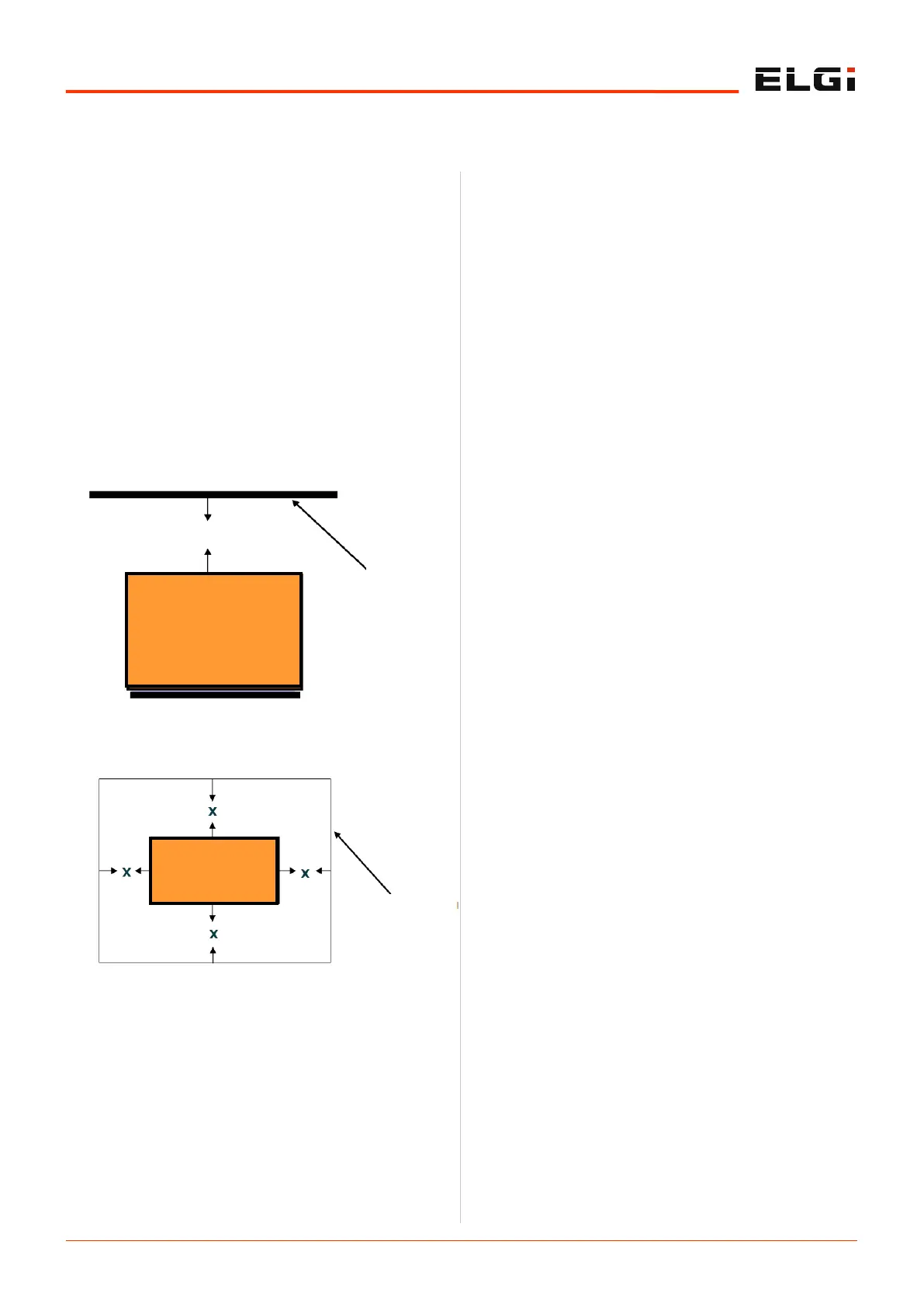
Figure 4. Vertical clearance around the
compressor
MINIMUM 2 m (6.6 ft) CLEARANCE
CEILING
ELGi SCREW AIR
COMPRESSOR
Figure 5. Horizontal clearance around the
compressor
ELGi SCREW AIR
COMPRESSOR
MINIMUM CLEARANCE, X=1 m (3.5 ft)
WALLS OR
OTHER
EQUIPMENTS


 To Next Page
 Loading...