Technical description
EGRD 600 – 2900 19 – EN
7 Technical description
7.1 Control panel
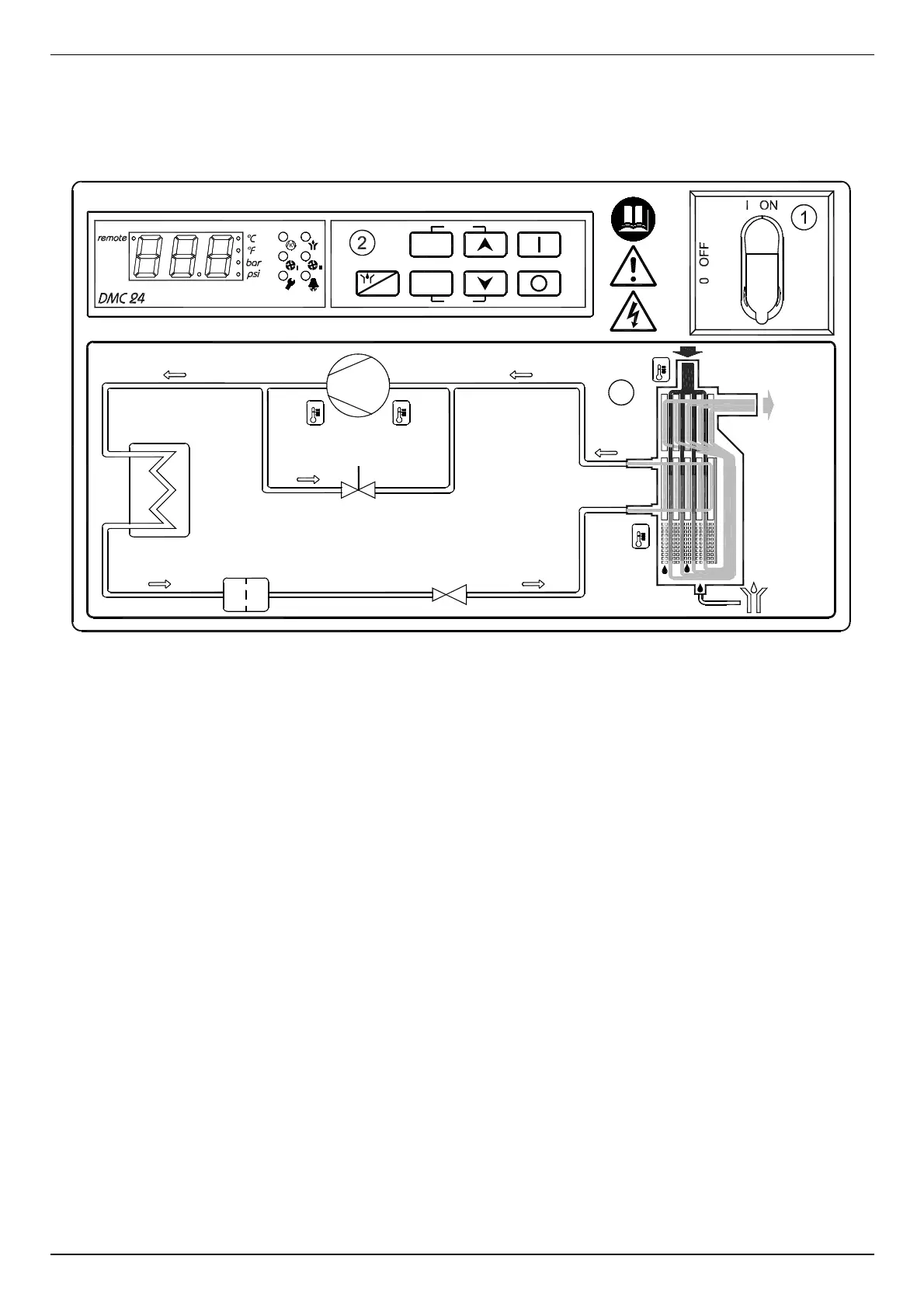
The control panel illustrated below is the only dryer-operator interface.
K
3
P
Q
S
0
0
4
7
T4 T3
T1
T2
set
log
info
ESC
reset
1
Main switch
2
Electronic instrument DMC24
3
Air and refrigerant flow diagram
7.2 Operation
Operating principle - The dryer models described in this manual operate all on the same principle. The hot
moisture laden air enters an air to air heat exchanger. The air then goes through the evaporator, also known
as the air to refrigerant heat exchanger. The temperature of the air is reduced to approximately 2°C, causing
water vapor to condense to liquid. The liquid is continuously coalesced and collected in the separator for
removal by the condensate drain. The cool moisture free air then passes back through the air to air heat
exchanger to be reheated to within 8 degrees of the incoming air temperature as it exits the dryer.
Refrigerant circuit - Refrigerant gas is cycled through the compressor and exits at high pressure to a
condenser where heat is removed causing the refrigerant to condense to a high-pressure liquid state. The
liquid is forced through a capillary tube where the resulting pressure drop allows the refrigerant to boil off at
a predetermined temperature. Low-pressure liquid refrigerant enters the heat exchanger where heat from
the incoming air is transferred causing the refrigerant to boil; the resulting phase change produces a low
pressure, low temperature gas. The low-pressure gas is returned to the compressor, where it is re-
compressed and begins the cycle again. During those periods when the compressed air load is reduced the
excess refrigerant is by-passed automatically back to the compressor via the hot gas by-pass valve circuit.



 To Next Page