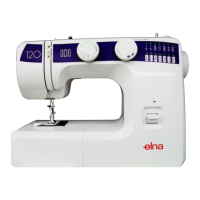
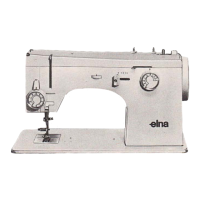
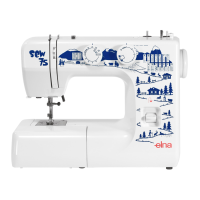
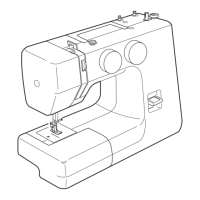
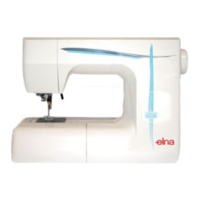
The Elna 1600 is a household sewing machine designed for a wide range of sewing tasks, from basic mending to decorative stitching and specialized applications. This instruction manual provides comprehensive guidance on its operation, handling, and maintenance, ensuring users can maximize its versatility and longevity.
Function Description
The Elna 1600 is a versatile sewing machine capable of performing numerous stitching functions. It supports both straight stitches and zigzag stitches, with adjustable width and length settings to accommodate various fabric types and project requirements. The machine features a 2-in-1 free-arm sewing surface, which allows it to function as a flatbed machine for regular sewing and easily convert into a free-arm machine by removing the extension table. This free-arm capability is particularly useful for mending and repairing tubular items, darning socks, blind hemming cuffs, sewing buttons and buttonholes on sleeves, embroidery, topstitching on cuffs and sleeves, and working on doll or child-sized clothes, as well as other hard-to-reach areas.
The machine includes a bobbin winding mechanism and a clear process for inserting and removing the bobbin. Threading the upper thread is also detailed, ensuring correct setup for optimal stitching. Stitch selection is managed via a dial on the front panel, displaying a variety of automatic stitches. The stitch width lever and stitch length dial provide precise control over stitch dimensions, allowing for customization of zigzag stitches, satin stitches, and buttonholes.
Specialized functions include:
- Blind Hem Stitching: Creates a durable, almost invisible hem using a combination of straight and zigzag stitches.
- Elastic Stitch Sewing: Designed for overcasting and joining two pieces of fabric, especially elastic or stretch fabrics.
- Decorative Stitch Patterns: Offers a selection of patterns for embellishment.
- Overcasting-Overlocking: Finishes seam edges to prevent fraying.
- Three-Stitch Zigzag: Used for overcasting knitted fabrics and mending tears.
- Sewing Buttonholes: A four-step process for creating buttonholes, with adjustments for length and width.
- Sewing on Buttons: Allows for secure attachment of two-hole buttons.
- Sewing Zippers: Facilitates the sewing of zippers on both the right and left sides.
- Free-Hand Embroidery: Requires removing the presser foot and attaching a darning plate, allowing for creative embroidery.
- Darning: Used for repairing worn areas by reinforcing them with thread.
Important Technical Specifications
- Bulb Type: 15 Watts (for the sewing light).
- Needle Types: US size 15x1, European 705. The manual provides a detailed chart for selecting the appropriate needle size (10/70, 12/80, 14/90, 18/110, 20/120) based on fabric type and work to be done, ranging from delicate fabrics like georgette and chiffon to heavy woven suiting and canvas. Special needles are available for leather, denim, and stretch fabrics.
- EEC Prescriptions: The machine corresponds to EEC prescriptions 76/889, indicating compliance with European safety and electrical standards.
- Connector Cord: Equipped with a special connector cord that, if damaged, must be replaced by an identical cord obtainable at an Elna service center.
Usage Features
- Ease of Setup: Clear instructions are provided for electrical connection, including plugging in the foot control and turning on the mains switch.
- 2-in-1 Free-Arm Design: The removable extension table enhances versatility, making it easy to sew cylindrical items and hard-to-reach areas. The extension table also serves as an accessory storage compartment.
- Presser Foot System: The machine uses snap-on presser feet, which can be easily changed by raising the presser foot lever and pushing the release lever. For certain non-snap-on feet, the presser foot holder can be changed by loosening a thumb screw.
- Needle Insertion: Detailed steps ensure correct needle insertion, with the flat part of the needle facing the back of the machine.
- Bobbin Winding and Insertion: A straightforward process for winding thread onto the bobbin and inserting it into the bobbin holder, ensuring the thread runs counter-clockwise.
- Thread Tension Adjustment: The manual explains how to adjust upper thread tension for various stitch types and fabrics, with visual examples of correct, too tight, and too loose tension.
- Stitch Control: Independent controls for stitch width and length allow for precise customization of stitches. The stitch width lever limits zigzag width, and the stitch length dial controls the density of stitches.
- Reverse Stitching: A reverse stitch lever allows for backstitching to reinforce seams at the beginning and end.
- Darning Plate: Can be attached to cover the feed dog for darning or free-hand embroidery, allowing the fabric to be moved manually.
- Starting and Removing Work: Guidance on placing fabric, holding threads, using the foot control for speed, and removing finished work, including cutting threads with the built-in thread cutter.
- Turning Corners: Instructions for pivoting fabric with the needle in the fabric to achieve sharp corners.
- Fabric Handling: Advice on guiding fabric gently and not pulling it, especially when sewing thin fabrics, where placing a sheet of paper beneath the fabric is recommended to prevent puckering.
Maintenance Features
- Safety First: Emphasizes disconnecting the machine from the electrical outlet before any maintenance or bulb changes.
- Cleaning: Regular cleaning of the hook race, feed dog, and bobbin holder is crucial to prevent lint and thread accumulation, which can interfere with smooth operation. A brush is recommended for cleaning.
- Bobbin Holder Maintenance: Instructions for removing and cleaning the bobbin holder.
- Hook Race and Feed Dog Cleaning: Detailed steps for removing the needle, presser foot, bobbin cover plate, bobbin, and needle plate to access and clean the hook race, feed dog, and bobbin holder.
- Oiling: The manual indicates specific oiling points (marked by arrows) on the machine, advising users to apply one drop of oil and wipe away any excess to prevent staining fabric.
- Troubleshooting Guide: A comprehensive table of common problems, their causes, and corresponding corrections, covering issues like the machine not running, improper fabric feeding, needle breaks, upper thread breaks, lower thread breaks, skipped stitches, fabric puckering, loose stitches, and difficulty running. This guide helps users diagnose and resolve minor issues independently.

 Need help?
 General

 To Next Page